The best thing that could have happened for the FIFA World Cup was for the matches to begin and the fans to arrive.
Much of the financial and political drama in the lead-up has dissolved, replaced by joyful antics of rowing Norwegian legions, highlighter-orange Dutch hordes, kilted, chanting Scots and yellow-shirted Ecuadorean and Colombian takeovers of various U.S. cities.
The action on the field is of great interest, of course, but the joy of the World Cup is generated by the fans.
There was the USSF office in Chicago, but anytime one of the federation’s 27 national teams convened, it was at a different location across the vast United States. The sporting and business sides of the nonprofit USSF were never permanently together in one place.
That changed when the $250 million, 200-acre facility opened in May, becoming the sport’s first true home in America. Between 300 and 350 employees, including Norton — the facility’s GM, who joined from a similar role at IMG Academy — now work out of the complex in Fayetteville, Ga.
It represents a hub for everything the USSF does, like training referees and coaches, convening and training the various national teams or raising money for the sport’s growth.
There is some symbolism with the timing of its opening; soccer is ascendant in the U.S., belief in the Men’s National Team is building during the World Cup and the Women’s World Cup is just five years off. In the same way home ownership can indicate adulthood, the National Training Center represents a similar maturation of U.S. Soccer.
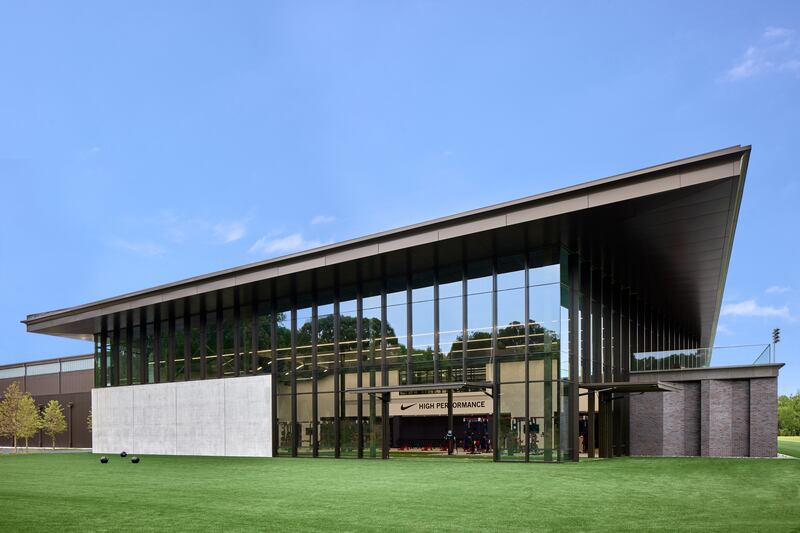
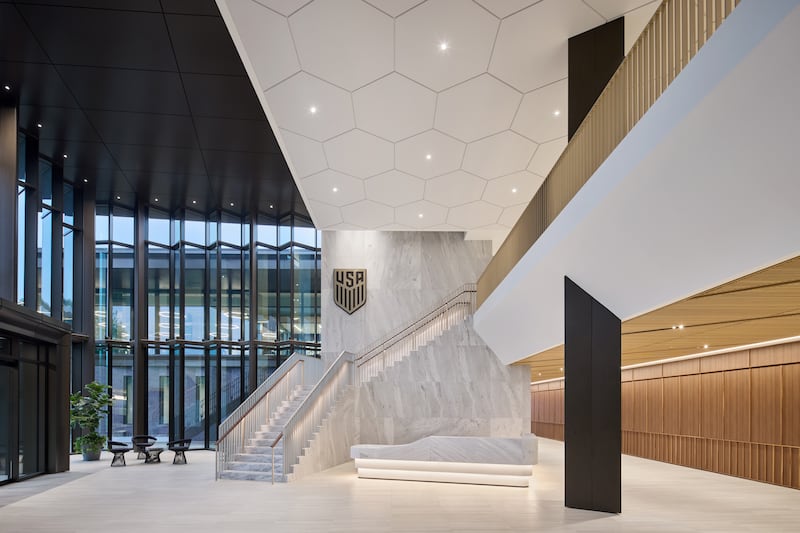
The architecture was modern but somewhat understated, helping the facility blend into its bucolic surroundings. U.S. Soccer worked with the same landscape architects as Augusta National, HGOR. Gensler designed the building, which leans in on wood tones, dark steel and lots of natural light. Everpresent windows offer views of the surrounding training pitches.
“You can see soccer everywhere,” said Norton.
The main building holds several smartly finished hosting spaces where USSF can welcome philanthropic backers and corporate partners (previously, the main option would have been a restaurant in whatever city the meeting was happening in). Impact Development Management managed the project, which was built by Brasfield & Gorrie.
The attention to accessibility was noteworthy. U.S. Soccer has the most national teams (27) in part because of its five teams for players with various disabilities. And the attention to their experience using the campus was evident. A power chair-charging room next to the gymnasium — home to U.S. futsal and power chair soccer teams — features 30 electrical outlets, each with four plugs, a concentration of electrical outlets that’s often difficult for the team to find on the road. The cerebral palsy men’s national team played one of the National Training Center’s first official matches on the full-size indoor field, notable because that match would have otherwise been canceled due to rainy weather. National team camps aren’t very long, and the teams aren’t together that often. Every day they’re together, especially for the amateur players, is valuable.
Sports medicine facilities focus on recovery, not rehab, for the simple reason that injured players are rarely, if ever, called up to national teams (they rehab with their club teams, if they have one). Post-training and match recovery is the priority.
The playing surfaces are immaculate. I visited the National Training Center on a gray, drizzly morning, but several of the 16-member grounds crew were still buzzing around on mowers, including one named Hunter, who made a cameo on a recent “After Hours with James Corden” episode. The expanse of 17 outdoor playing fields sit on either side of the building, with the two competition fields to its right. There are even two beach soccer pitches; apparently, you maintain sand playing surfaces with a good raking, making sure it’s clear of leaves or other debris. (A Lego seems like it could be disastrous?)
Goals, goals, goals ... there are 144 of them at the National Training Center.
U.S. Soccer wants fans to tour the complex. While the National Training Center is only 30 minutes south of Atlanta, it feels like the backwoods. I took the Jeff Foxworthy Highway (lol!) to get there in time for my private tour, which was followed shortly by a paid, public tour. U.S. Soccer hopes it can develop a National Training Center tour business and generate revenue from a campus that’s otherwise not intended to do so. Could they get visitors out to the facility with a tour that included watching the first 10 or 15 minutes of a men’s or women’s national team training session? Soccer fans would traverse the Jeff Foxworthy Highway to see that, for sure.
0 of 9
Arthur M. Blank U.S. Soccer National Training Center The Arthur M. Blank U.S. Soccer National Training Center officially opened on Thursday, May 7. (U.S. Soccer/Garrett Rowland/U.S. Soccer/Garrett Rowland)
Arthur M. Blank U.S. Soccer National Training Center The Arthur M. Blank U.S. Soccer National Training Center officially opened on Thursday, May 7. (U.S. Soccer/Garrett Rowland/U.S. Soccer/Garrett Rowland)
Arthur M. Blank U.S. Soccer National Training Center The Arthur M. Blank U.S. Soccer National Training Center officially opened on Thursday, May 7. (U.S. Soccer/Garrett Rowland/U.S. Soccer/Garrett Rowland)
Arthur M. Blank U.S. Soccer National Training Center The Arthur M. Blank U.S. Soccer National Training Center officially opened on Thursday, May 7. (U.S. Soccer/Garrett Rowland/U.S. Soccer/Garrett Rowland)
Arthur M. Blank U.S. Soccer National Training Center The Arthur M. Blank U.S. Soccer National Training Center officially opened on Thursday, May 7. (U.S. Soccer/Garrett Rowland/U.S. Soccer/Garrett Rowland)
Arthur M. Blank U.S. Soccer National Training Center The Arthur M. Blank U.S. Soccer National Training Center officially opened on Thursday, May 7. (Wendell Weithers/U.S. Soccer/Garrett Rowland)
Arthur M. Blank U.S. Soccer National Training Center The Arthur M. Blank U.S. Soccer National Training Center officially opened on Thursday, May 7. (U.S. Soccer/Garrett Rowland/U.S. Soccer/Garrett Rowland)
Arthur M. Blank U.S. Soccer National Training Center The Arthur M. Blank U.S. Soccer National Training Center officially opened on Thursday, May 7. (Wendell Weithers/U.S. Soccer/Garrett Rowland)
Arthur M. Blank U.S. Soccer National Training Center The Arthur M. Blank U.S. Soccer National Training Center officially opened on Thursday, May 7. (Wendell Weithers/U.S. Soccer/Garrett Rowland)
A proposed mixed-use project would help better connect Kentucky's Kroger Field football stadium and the campus, which are now separated by parking lots. Google Earth Pro
Kentucky recently hired J Batt from Michigan State to replace retiring Mitch Barnhart as its AD. Part of what Batt inherits is a burgeoning mixed-use development project (or two).
An internal steering committee led by UK President Eli Capilouto has been working on mixed-use development concepts since December 2025. Kentucky has zeroed in on two main locations, one next to Kroger Field — UK’s football stadium, south of the main campus — and another, Memorial Coliseum, where the women’s basketball team plays and both basketball programs practice north of the main campus.
“This is a revenue generator, and that’s a big reason why we’re doing this,” Kevin Locke, associate VP/planning, design and construction, told me. “Our stadium, Kroger Field, is somewhat isolated from the central portion of campus in a sea of parking. I see this as a way of connecting traditions and that part of campus with the central part of campus.”
A steering committee is creating base guidelines and expectations for the project in advance of possibly issuing a request for proposals (or information, or qualifications) to developers in late 2026 or early 2027. Locke said the goal was to give developers a more concrete idea of what UK wants from the project, instead of a vague, choose-your-own adventure homework assignment. The latter has proven to be off-putting to developers wading into the college sports-adjacent world, in part because these projects are already complicated enough.
Key components
The prevailing idea in Lexington is a multi-use facility near Kroger Field incorporating a men’s basketball practice facility with a sports medicine/recovery/rehab-focused component. Kentucky’s men’s and women’s hoops teams practice at the Joe Craft Center next to Memorial Coliseum on the north side of campus.
Additional facets of the development would include a hotel and conference center, a food hall, market rate housing, student housing, green space and parking structures.
Housing for the public and university population would be a central component of any plan, Locke said. UK’s roughly 9,000 on-campus housing units are full, and the university could easily use another 1,500 housing units. A significant housing component would activate the development regardless of the sports schedule, “and that’s critical to its success,” Locke said.
Sasaki is working with the university on a mixed-use master plan, continuing a relationship that’s existed for about 13 years. Populous is part of the project team, as is CDM Smith, which is conducting traffic and people-movement studies. The Champions Blue LLC would likely get involved once the developer was in place, enabling the project to move quicker than if it remained fully in the public university realm.
Using mixed-use development to strengthen the ties between Kroger Field and the UK campus is something that other universities are pondering. And in some cases, like at North Carolina, these projects are being viewed as possible anchors for new satellite campuses. Locke cited SEC rivals Texas A&M and Florida as models for a football stadium being the heart of campus.
“This is a great way for us, the university, to create new traditions and have that connection with athletics,” Locke said, while “making that an integral part of campus life, more so than it is today.”
Dude Perfect CEO Andrew Yaffe doesn’t believe kids aren’t as excited about sports as past generations. Sports Business Journal
I had an interesting conversation with Dude Perfect CEO Andrew Yaffe — in spite of his Duke basketball fandom — at SBJ’s Brand Innovation Summit earlier this month. I wanted to share some of my takeaways from his thoughts about the sports fandom of Gen Z and Gen Alpha. Both groups are of particular concern to many in the sports industry.
Family friendly
Dude Perfect’s family-friendly slant is ideal at a time when parents (including me!) are almost universally concerned about what their children might stumble upon while perusing the web. Dude Perfect has foregone sponsorship dollars from alcohol and sports betting companies and is pitching its app as a safer online space, which, again, as parent, is a compelling argument even if I understand how it benefits Dude Perfect to play within their walled environment.
Many sports properties would say they’re not in a position to shirk sponsorship deals with alcohol or betting brands, but it hasn’t hurt Dude Perfect.
I’d interpret family-friendly in another way. Family is often the most fruitful breeding ground for lifelong sports fandom, and the first seeds are often sewed at a live event. Apologies for sounding preachy, but the sports industry can’t let live sports become the domain of just affluent adults.
Social media
Yaffe, who was formerly an NBA EVP overseeing social media, digital and original content, was blunt in his assessment of sports properties’ social media: They’re doing a bad job. To be fair, the individuals working on social media teams are handcuffed by a risk-averse industry. But the lack of creativity, whatever the reason, is unavoidable to Yaffe’s eyes.
Yaffe: “If you put a YouTube native creator in charge of those assets and said, ‘Hey, come back with 10 ideas that could generate millions of views on YouTube,’ they would look nothing like what teams and leagues and properties are currently putting on YouTube. Too much of what happens on social and digital is really just a re-created version of existing content elsewhere, and it doesn’t work.”
Younger fans’ consumption
Yaffe does not subscribe to the “kids have no attention span these days” theory that is widely held by non-kids.
Yaffe: “The good news, and I truly believe this, is that there’s no shortage of sports fandom. Kids are not any less interested or excited about competition and sports. The way they consume it is totally different. The way kids are consuming sports looks a lot more like Dude Perfect and Jesser and Mr. Beast than it does sitting down and watching a two-and-a-half-hour game, and just pumping out more of that is not going to change that. It’s really on leagues and properties and teams and sports to figure out what are the connections we can make, what are the stories we can tell, what are the formats that work to fish where the fish are. ... It’s not about shorter; it’s about finding the right format that audiences are actually consuming.”
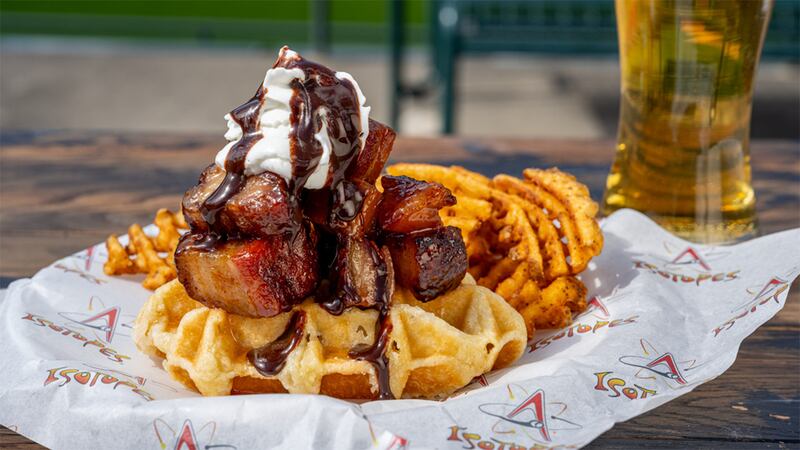
OVG Hospitality handles food and beverage service for Diamond Baseball Holdings’ dozens of Minor League Baseball teams, including the Albuquerque Isotopes. OVG is serving “The Hogfather” at Rio Grande Credit Union Field this season, an open-faced Belgian waffle covered in sweet and spicy pork burnt ends and finished with chocolate whipped cream (it costs $14). Crispy sweet potato waffle fries are served on the side. I’m not 100% sure what this would taste like, but even if it didn’t work, I’d just flick off the whipped cream and devour the burnt ends.
Kansas City's FIFA Fan Fest makes an impression, both with SBJ's Bret McCormick and the thousands of fans who have filed through the celebration. SBJ
Kansas City might be the least known of the 16 World Cup cities to international visitors, but the smallest market for a FIFA Fan Festival is a prime example of the success that can come when planners lean in to an event.
Sodexo Live shares with me what it’s learned about food and beverage service and premium customers at one of the busiest venues in the U.S.: Miami’s Hard Rock Stadium.
The Titans picked Extreme Networks to provide Nissan Stadium’s Wi-Fi 7 network when the venue opens in 2027. The existing Titans’ stadium also uses Extreme Wi-Fi, one of the vendor’s 14 NFL stadium clients.
The Commanders, who are building a new $3.65 billion stadium in D.C., issued a request for information to identify AI capabilities, integrations and collaborations that could impact a wide range of stadium functions and commercial activations for both the stadium and the mixed-use district that will surround it.
The Crew are launching a season ticket membership program called The C96 ahead of the MLS club’s July season ticket renewal window. Perks include $5 hot dogs, popcorn, and bottled soft drinks, and $3 coffee and hot chocolate at Scotts Miracle-Gro Field.
In this week’s magazine, SBJ’s David Broughton profiles Cubs VP/Events Morgan Bucciferro, who spearheads the staging of concerts, ice hockey, golf, football, volleyball and the growing roster of other non-baseball events at one of the world’s most iconic ballparks: Wrigley Field.