

In 26 years working on West Virginia’s athletic facilities, April Messerly has watched the priorities of college sports swing dramatically.
After decades of athlete-focused investment — the proverbial waterfall in the football locker room of the 2010s — NIL and revenue sharing have swung the pendulum toward fan-facing projects.
“Everyone is still trying to get their arms around how we make this sustainable moving forward,” said Messerly, WVU’s executive senior associate athletic director for capital projects and facilities. “What do we need to do to look at revenue generation pieces in this new age of college athletics?”
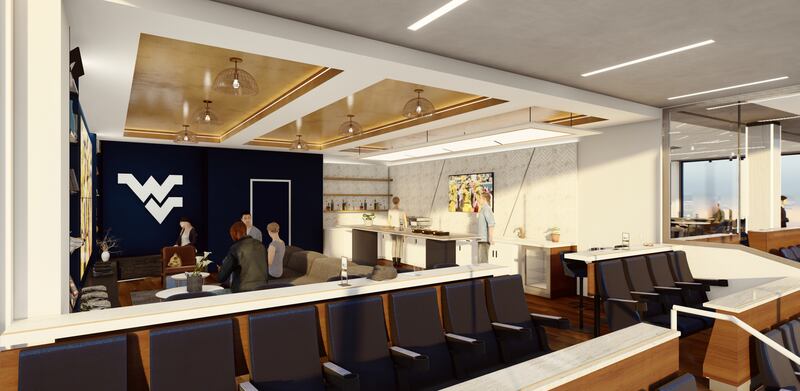
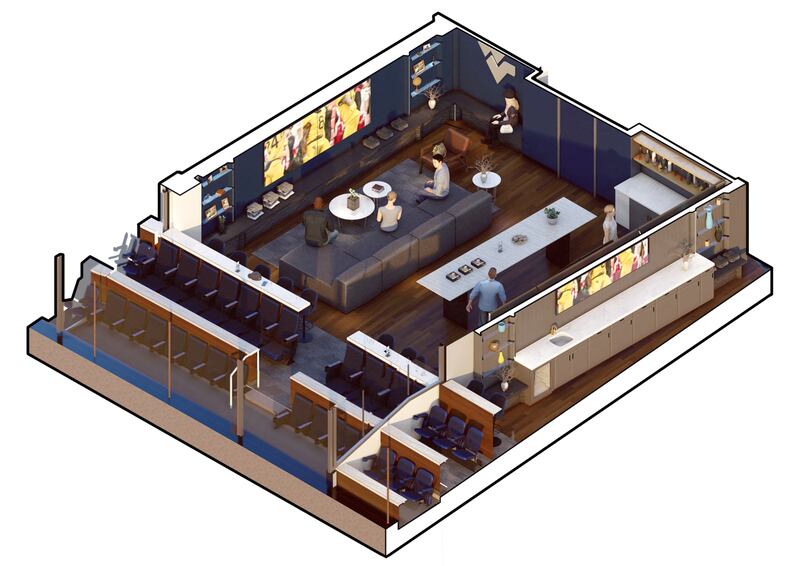
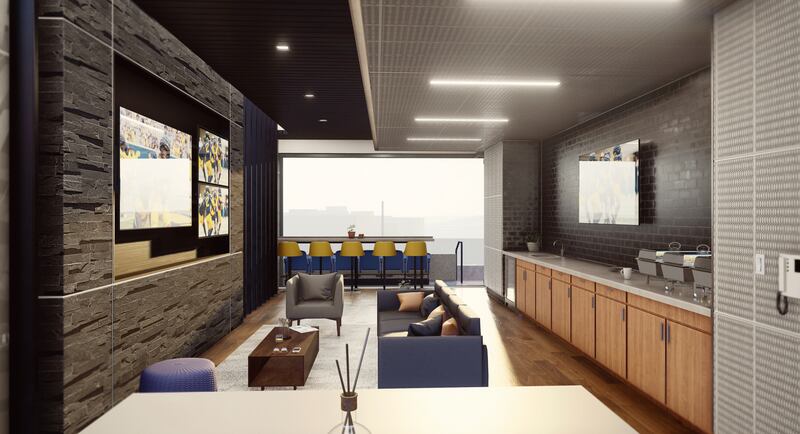
West Virginia has shifted its priorities toward revenue generation and fans’ experience in a big way, with simultaneous renovations of its most prominent athletics venues. The first is a $150 million reconstruction of 60,000-seat Milan Puskar Stadium’s West Tower, including a significant addition of premium seating options. The other is a humbler, $1.5 million project to create loge boxes and ledge seating in the 14,000-seat Hope Coliseum.
There was untapped demand for more premium seating, which generates the kind of revenue athletic departments need more of due to the $20.5 million annual revenue-sharing commitment required by the House settlement.
WVU reported $128 million in athletics revenue in 2025 against nearly $131 million in expenses.
Its West Tower rebuild is projected to produce $5 million in new annual revenue. The basketball project should generate roughly $250,000 more each year.
“For a majority of the Power Four schools, it’s not easy to just find 20 million bucks,” said Oliver Luck, a member of WVU’s board of governors and the school’s AD from 2010-14. “That was the first shock to the system, and that literally happened from one day to the next.”
For decades, student athlete-focused facility investment was the coin of the realm, one of the main ways schools attracted recruits. Other than ballooning stadium seating capacities, fans’ live viewing experience was relatively untouched.
The coin of the realm now, of course, is NIL and revenue share. Actual coin, in other words.
It’s forcing universities to rethink their aging venues, where bleacher seating remains common and concourses are often cramped with too few amenities.
“Every school is on the hunt for long-term, consistent revenue streams that can be developed now,” Luck said. “Maybe they take three or four years to materialize, but it’s all wrapped up in this notion that college athletics, at the top level, is going to require more dollars.”
0 of 9




Laser focus
Wren Baker was hired as WVU’s AD in 2022 in a different era, the post-NIL, soon to be post-House period. He dusted off the university’s facilities master plan but added a new focus.
“One of his first priorities charged from the board was, ‘We need to increase revenues,’” said Rob Alsop, WVU senior deputy AD. “Definitely something that’s a laser focus for Wren.”
That led to the coliseum’s naming rights being sold to Hope Gas on a 10-year deal last fall, the first time sponsorship was sold in the venue’s 56-year history.
And it heavily influenced Baker’s presentation to the university’s board of governors meeting last November, during which he underscored the need to create more premium seating in its aging sports venues.
A CSL market study showed significant unmet demand for premium seating and outlined potential returns.
“We’re really intentional now about how things pencil out,” Messerly said. “You have to do that when you’re specifically trying to generate revenue.”
The response to the West Tower rebuild justified the university’s suspicions. Both projects, which are being overseen by Legends Global’s owners’ rep group, will be funded by private donations, though West Tower fundraising is ongoing.
“Once we announced, we’ve had several folks come to us and say ‘We’re in,’” said Alsop. “You make the presentation at the board of governors, you unleash a couple of RFPs and people who’ve said, ‘I’d really be interested in that’ say, ‘Let’s sit down and talk.’ I won’t say surprised, but really excited that what they saw in the market demand study turned out to be real.”

Egg in the snake
The Milan (pronounced my-lan) Puskar Stadium project is the more straightforward of the two, adding new club, founders and suite levels to the West Tower.
Over the years, premium seating was added to the 46-year-old stadium’s north, south and east sides, but the West Tower remained an eyesore, as described by Baker and Marc Clear, principal and architect with the SLAM Collaborative, which is designing the renovation for WVU.
CSL’s football market study showed demand across the entire premium seating spectrum, Clear said. “And now they’re getting into sales, it’s just going gangbusters,” he said.
Milan Puskar Stadium has 2,316 premium seats, all of which are sold out. But that inventory ranks just 12th among the Big 12’s 15 stadiums — roughly half the premium capacity of league leaders such as Oklahoma State, Kansas State, Colorado and Texas Tech. For WVU administrators, that gap represents a clear revenue opportunity.
The most recent premium seating addition to the stadium, the Hartley Club Suites in the south end zone, was added in 2008. Baker’s board of governors presentation noted there are 83 accounts on the waitlist for those seats.
“A lot of it is demographics,” said the 65-year-old Luck. “And the baby boomers have all this money and they’re huge fans of college athletics, and as you get older, you want a little more comfort. It’s the proverbial egg working its way through the snake’s digestive system.”
Construction is expected to begin after the 2026 football season, with the new tower opening in 2028. By then, the West Tower structure will include suites, loge boxes, ledge seating and a 1,000-person club.
Like many college athletics venues, Milan Puskar Stadium is the biggest live events venue in a state that doesn’t have a major league sports team. It’s the front porch of the state. And yet, other than John Denver’s brief singing of “Take Me Home, Country Roads” when the stadium opened in 1980, it hasn’t been able to host concerts for reasons best summed up as “it wasn’t designed for anything other than playing football.”
Arena conundrum
Hosting non-university events has become a clear and quick way to generate more revenue from athletics venues, leading universities to sign booking deals with content providers and tour promoters or host international soccer matches.
Like the football stadium, Hope Coliseum is hamstrung by its creation in an era when college arenas’ objectives were to host basketball games and winter graduations.
Opened in 1970, it has neither suites nor a loading dock, the access tunnel to its event floor is curved and its clam shell-shaped concrete roof is acoustically poor. The venue has hosted 150 shows, including a Boston concert Luck attended in 1979, but none since 2019.
The bones of the venue are in good shape, following a major upkeep investment before COVID. But its revenue potential is limited.
“As the entertainment industry has exploded, and concerts have gotten bigger, when is the last time you went to a concert that didn’t have a screen behind it?” Messerly said. “We’re trying to balance what we need to do facility-wise to make it — both our stadium and Hope Coliseum — as easy as possible to host those kinds of events as well.”
Hope Coliseum also houses several Olympic sports and athletics offices, leaving little available space.
The venue has The Peak Club for fans with seats on the court and the Clark Mountaineer Club, a more entry-level premium space. The $1.5 million project is adding loge boxes — similar to suites, but uncovered so as not to block the views of fans above — containing roughly 85 seats in total. Sixteen ledge seats — premium seats with a drink rail — will be added, too. Work has already begun; the new premium will be available for the 2026-27 season.
WVU faced a classic college arena conundrum: Adding significant premium seating would require major surgery on the building and likely lose upper bowl seats. In West Virginia, those sell well.
“They know there is a market for premium, it’s huge,” said Clear, but “it becomes a can of worms, and you end up with a $100 million project to address everything.”
Despite the challenges WVU’s projects illustrate, they also show a potential headwind: donor fatigue with NIL. Initial concerns that NIL would vacuum all facility donations have not materialized and the opposite seems to be happening in many cases. For donors, buildings feel like a much more solid investment than the fickleness of NIL funding, especially when the needs are so glaring.
“You just realize how much pent-up need there is in these venues,” said Clear. “For the most part, it’s been a doubling down. Donors realize they need to do that; people aren’t shying away from athletics, they know they need to invest.”