
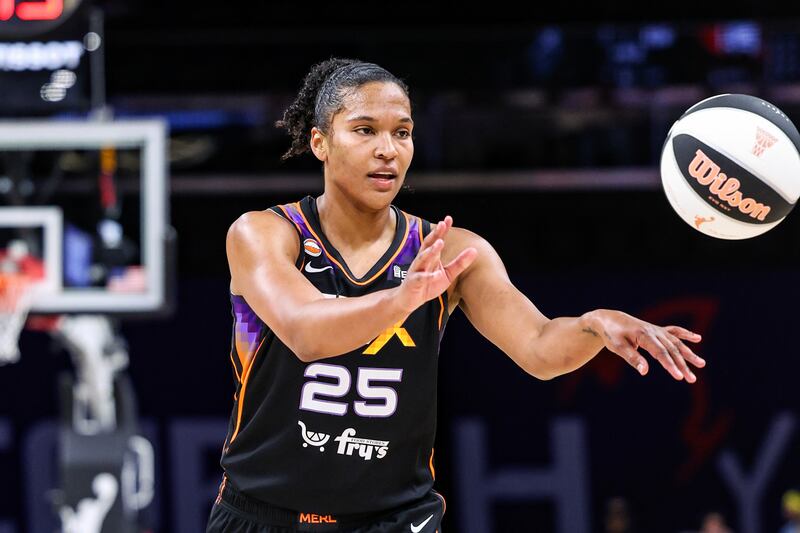
Mercury F Alyssa Thomas is “calling on the WNBA and commissioner Cathy Engelbert to take action after she was on the receiving end of death threats and online abuse following her suspension," according to Cydney Henderson of USA TODAY. The WNBA handed Thomas a one-game suspension for “recklessly” making contact with Fever G Caitlin Clark’s throat during the Mercury’s 111-109 win on June 24. Thomas said that the league “failed to reach out to her about the suspension or in the aftermath of the on-court incident.” She added, “We still have yet to hear anything from Cathy (Engelbert). It’s no surprise. You can see what’s being said on social media ... but as usual, she remains silent and that’s unfortunate when our lives are being threatened. ... The league has to do better.” Following Thomas’ comments, Engelbert in a statement said the league “vehemently condemns any and all forms of hate.” Thomas said that the league “has a duty to protect and support all players.” Thomas: “We’re so concerned about the safety on the court, but time and time again, we’re having people threatening our lives. At some point the league needs to (take) a stand on it.” A source noted that Engelbert “exchanged text messages with Thomas and offered to have a phone call with her last week.” Engelbert also “directed league security to contact Phoenix security amid ongoing threats” (USA TODAY, 6/30).
CREATING NARRATIVES: In London, Andrew Lawrence writes after “years of bad-faith discourse about Clark on social media and conservative television,” many of Clark’s fans find it “hard to see her as anything other than a damsel in distress.” By their reckoning, the league “didn’t go far enough in punishing Thomas.” Some have decided to “dole out their own dismal form of justice.” Thomas said that she has “received racist abuse and death threats since the incident.” Lawrence notes one of the “burning frustrations of the Clark era is the degree to which the narratives surrounding her have reinforced the WNBA’s impulse to shield players from criticism, even as the league insists on being covered as seriously as the NBA.” All the while, the “most obvious Clark story -- that her struggles are the ordinary growing pains of a young superstar -- is missed.” That “vacuum has allowed conspiracy-minded fans to run amok.” The suggestion that Clark is “being targeted because she is an anomaly in a league that skews Black and queer is not just a slight to the many white stars who have graced the league.” It “amplifies a deeply entrenched hierarchy with rigid, almost fundamentalist roots in American life at a moment when the nation’s politics are once again sharpening against Black women and the LGBTQ+ community” (London GUARDIAN, 7/1).