
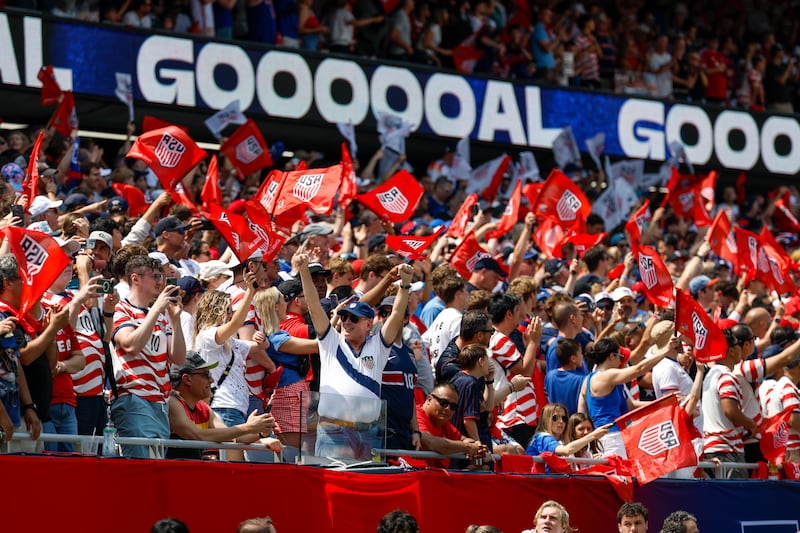
This latest USMNT World Cup “failure seems like a carbon copy of so many others,” but “in reality, this performance was worse,” according to Ann Killion of the S.F. CHRONICLE. The U.S. men’s team “will never have this kind of opportunity again, or at least not for a very long time.” It was a home World Cup, with “enormous and supportive crowds, a rare event for the Americans.” The U.S. hosts “had every advantage served up.” Even with all three co-hosts eliminated, the World Cup will go on, with “many of the world’s elite teams and players still at work.” It “will be a success.” But the U.S. “is not a true soccer country.” The “enthusiasm for the world’s greatest sporting event will probably not translate into a significant bump for MLS.” Killion: “Will hosting this competition send millions more kids flocking to the game? They’re already there, that is, if they can afford to be.” Part of our “fundamental problem as a soccer country is the way we develop our players, through a broken system that prioritizes a family’s ability to pay” (S.F. CHRONICLE, 7/8). TRIBLIVE’s Mark Madden wrote the USMNT losing Monday night “was disappointing and embarrassing. … But it wasn’t surprising. This is what the USMNT is. It won’t ever get appreciably better.” Madden: “America’s best athletes will never play soccer. There are flaws in the developmental process, not least pay-for-play” (TRIBLIVE, 7/8).
WILL AMERICAN FANDOM LIVE ON? In Seattle, Matt Calkins wrote the question is “whether Americans will remain spellbound by soccer once the World Cup is over.” And though soccer fanatics “surely hope they will,” it is “more likely this fever breaks once the tournament ends.” The first reason is the “most obvious: Our sporting dance cards are full.” Americans have a “nonstop diet of sports that regularly sell out venues year-round.” Second, soccer’s stars are spread across different leagues -- and “ours is barely in the top 10.” Calkins: “There is no single umbrella for the world’s best players over the course of a domestic season. I’m not sure Americans want to follow all of that.” Lastly, soccer “lacks the cultural roots in America that its biggest competitors enjoy.” Calkins: “None of this is meant to downplay the beautiful game or the spectacle that this World Cup has been. … It’s everything a soccer fan could have wished for -- but it’s wishful thinking to believe this will carry over to everyday American fandom” (SEATTLE TIMES, 7/8).
AFFORDABILITY AND ACCESSIBILITY: In Baltimore, Vivian Yao writes a “disappointing performance” by the USMNT in the World Cup has “reignited the debate about the county’s pay-to-play system.” Through the Open Goal Project and District of Columbia Football Club, better known as DCFC, Open Goal Project Exec Dir and former professional player Amir Lowery is “working to create a model that removes financial barriers and offers an alternative to the country’s entrenched system.” In 2019, Lowery and Open Goal Project Dir of Development and Partnerships Simon Landau launched DCFC. Unlike traditional travel soccer clubs, it is “entirely free for participating families and the team competes in leagues with pay-to-play clubs from the area” (BALTIMORE BANNER, 7/9).
UNDERWHELMING PERFORMANCE: SI’s Grey Whitebloom noted USMNT F Christian Pulisic “appeared to be playing while impaired for the vast majority of an ultimately underwhelming World Cup.” The face of the tournament for the co-host “showed his true potential for no more than 45 minutes.” The Pulisic that “dominated the first half of the USMNT’s opener against Paraguay was the closest he has ever come to living up to the ridiculous expectations placed upon him.” Still only 27, Pulisic will “likely remain a key part of the U.S. roster for the 2030 World Cup” (SI, 7/8). PRO FOOTBALL TALK’s Mike Florio wrote above all else, U.S. soccer “needs a superstar. A true, global, 15-to-20-year talent who is a goal-scoring machine” (PRO FOOTBALL TALK, 7/8).
LEAVING A SOUR TASTE: In West Palm Beach, Eric Wallace writes the “unprecedented political controversy that engulfed the Americans in the 36 hours before kickoff will become the lasting memory of the U.S. team at its home World Cup.” FIFA’s decision to overturn USMNT F Folarin Balogun’s suspension and make him eligible for the Belgium match “immediately became one of the tournament’s biggest controversies.” The subsequent revelations that President Trump and U.S. Soccer officials had involved themselves in the process “only intensified the backlash against perceived corruption.” Wallace: “Whether the decision was technically permissible is almost beside the point. The reputational damage was already done” (PALM BEACH POST, 7/9). In L.A., Gustavo Arellano wrote, “Maybe Team USA should have just gone into the game with a giant chip on their shoulder after losing Balogun via an unfair red card; maybe that would have given them an edge.” Instead, the U.S. squad “played listlessly” (L.A. TIMES, 7/8).
WHERE TO NEXT? In London, Peter Rutzler writes the World Cup is over, and so USMNT coach Mauricio Pochettino -- “the gun for hire -- is a free agent,” given he was contracted to the end of the tournament. It is also clear that the Argentinian and his staff will “give serious thought to continuing.” But by 2030, Pochettino would be 58, and the coach has “made no secret of his desire” to return to the Premier League at some stage. Those that know him “speak of how he has missed the day-to-day dynamic of club football.” There is “not, though, an immediate vacancy to jump into.” Rutzler: “If Pochettino stays he will need to navigate a qualifying campaign that jumps across the Caribbean and North America. The call of club football will be hard to ignore” (London TIMES, 7/9).
CONTINUE THE CULTURE: THE ATHLETIC’s Joshua Kloke wrote the World Cup “will be missed in Canada. Because co-hosting it has the potential to prove transformative.” The 13 games Canada hosted over the past month “suggested we may not yet understand just how far this country could climb on the men’s side.” Canada “showed out as co-hosts for this World Cup.” There were “raucous atmospheres and full stadiums for every game, despite the exorbitant ticket costs.” Kloke wrote the tournament “dominated the Canadian public’s interest from start to, for them, finish. … And the interest in soccer stretched beyond Vancouver and Toronto.” Moving forward, Canada “has an opportunity to cultivate a long-lasting soccer culture.” Kloke noted public and private investment in local club sides is the “easiest way to ensure that the legacy of this World Cup in Vancouver and Toronto will not fade away” (THE ATHLETIC, 7/8).