A rendering of the Jets’ 2026 NFL Draft viewing party in New York City’s Seaport. NY Jets
Both the New York Giants and Jets are bringing next week’s NFL Draft fan parties to an unusual place by their New Jersey-centric standards: Manhattan, the center of New York City. Instead of the typical party at MetLife Stadium in East Rutherford, N.J., Jets Draft Night presented by Verizon will be at the South Street Seaport, and the Giants will be at Hudson Yards for a Draft Night Block Party presented by Moody’s.
Both teams are excited to see what the prime real estate can do, but it was something of a forced move. They had to temporarily abandon MetLife because FIFA is now in the stadium preparing the pitch for the World Cup. This appears to be the first tangible effect on any NFL team operations for the global soccer tournament, which requires 13 NFL teams give up control of their venues for about two months.
“This year, with the stadium and FIFA preparing to host the World Cup, we embraced the opportunity to experiment and see how other venues could handle the scale needed to put on a great event for our fans,” said Giants SVP/Marketing and Brand Strategy Nilay Shah. “Hudson Yards presented that opportunity, and we are excited to bring the Giants Draft party to NYC.”
Jets Chief Brand and Communications Officer Eric Gelfand said their location (near ESPN’s studios) in lower Manhattan allows the team to create an “authentic, high-energy experience.”
“We are excited to bring our draft party back to New York City and celebrate one of the most important moments on the NFL calendar with our fans in the heart of the city,” Gelfand said.
World Cup means an unusual offseason for 13 teams
FIFA won’t fully control MetLife or the 10 other NFL venues until 30 days from the start of the tournament, or the middle of May. But when they do, it will mean big changes for parts of NFL workforce and operations teams until nearly training camp in late July. None of this is a surprise, and a generation ago, might have been scarcely noticed during a sleepy offseason.
But in 2026, there’s barely an offseason for the business side, and NFL teams have become revenue-oriented 12 months a year. Take Arrowhead Stadium in Kansas City, where the Chiefs have always been enthusiastic supporters of the World Cup but acknowledge there is a cost to losing the stadium for the summer.
“Last year we had a record year with concerts. We won’t have any this year,” said Chiefs President Mark Donovan. “So, you’re giving that up.”
The 13 teams affected are: the Cowboys, Jets, Giants, Falcons, Chiefs, Texans, 49ers, Chargers, Rams, Eagles, Seahawks, Patriots and Dolphins.
Most employees of these teams work at offsite team HQ/practice facilities. But insofar as team employees do primarily work in the stadium, there will be changes. In Kansas City, Chiefs ticketing sales and operations workers will relocate, while stadium/events staff essentially get folded into FIFA operations. In Atlanta, the AMBSE employees at the stadium will continue to report to work there, but they are subject to FIFA credentialing instead of their usual access procedures and have been instructed to work from home on match days. The Texans negotiated terms that mostly allows business as usual. In Santa Clara, 49ers stadium operations employees will remain at Levi’s Stadium, but other employees may relocate to the team’s other offices, work from home or receive a FIFA credential and keep coming in.
Back at MetLife, the Giants will start coach John Harbaugh’s first training camp with the team spending two weeks at the Greenbrier in West Virginia, thanks to the stadium hosting the World Cup final on July 19 and ongoing renovations at the team’s HQ, Quest Diagnostics Training Center in East Rutherford, N.J.
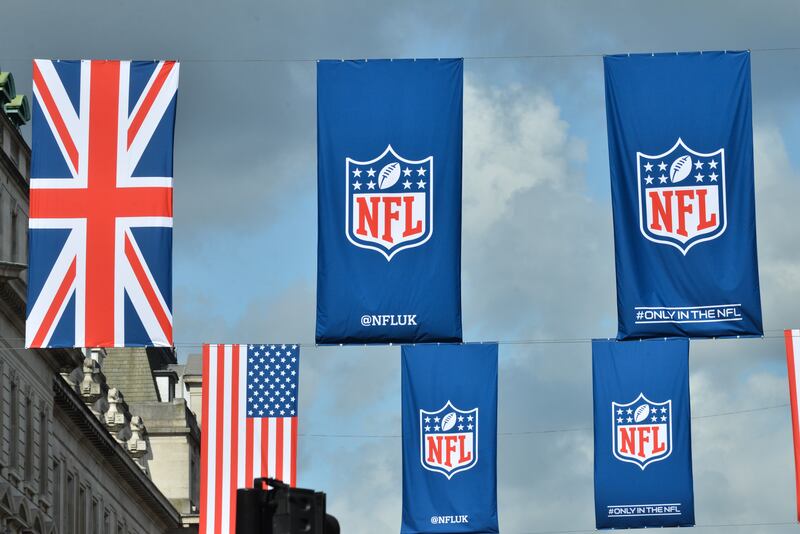
The NFL has been playing games in London since 2007 and has ramped up its international efforts to include games in other countries, as well as a marketing push around the globe. Getty Images
For the NFL, the rest of the world is such a greenfield that most of the time we don’t view its international growth efforts through a competitive lens. But nobody has invented the 25-hour day, so any attention the NFL picks up in places like the U.K., Spain or Germany is coming from something else.
That’s why I was so intrigued to hear senior NFL and Premier League executives acknowledge this dynamic onstage at the CAA World Congress of Sports on Wednesday, even if they downplayed it. Both NFL CRO Renie Anderson and Will Brass, the chief commercial officer of the Premier League, said there’s room to co-exist, but Anderson did make a point about the NFL’s ambitions with a smile.
“So, we want people thinking about the NFL 365 days a year, which we do,” Anderson said. “But if there’s a day or two where they can think about soccer, that’s OK.”
The Premier League and the NFL are among the best-suited properties in the world to resist competition, so this is pretty theoretical. (If you know anyone who used to be a big EPL fan but has drifted away in favor of the NFL, let me know.) But, Brass acknowledged, there are only so many winners in the attention economy. “In the end, and maybe taking it on a step to state the obvious, you live in a world where winner takes most,” Brass said.
In the end, he said, it’s not so much about having a certain amount of attention on your sport — it’s about having enough attention, and there is a growing gap between premium properties like the Premier League and the NFL who succeed in that regard, and smaller sports that struggle to capture the public’s eye. “The key thing, though, is to sit [on] the right side of the line where you have the opportunity to have oxygen around your quality product to bring fans in,” Brass said.
To date, the NFL’s international tacticians have viewed major sports brands in their target markets (like Tottenham Hotspur and Real Madrid) as assets, not competitors. Those teams can be sophisticated partners, and they’re proof the market loves sports and spending money on sports.
But if the NFL really does become “the third sport” in a country, then the competition is on. Maybe the elite European soccer clubs don’t worry, but someone else over there might.
The good: Attendance in two of the new markets: Columbus (14,810 in one game), Louisville (12,558 avg. through two games). The not as good: The third new market, Orlando (9,857 avg. through two games).
The bad: Attendance in the two cities that changed venues within the same market: The Dallas Renegades moved from Choctaw Stadium in Arlington to Toyota Stadium in Frisco (6,601 avg. through three games, well down from last year’s average in Arlington), and the Houston Gamblers moved from TDECU Stadium to Shell Energy Stadium (7,744 in one game, up some from last year.) Both new stadiums seat about 20,000 people, less than half than the venues they replaced.
The promising: Scoring. The four UFL games in Week 3 averaged more than 55 combined points a game, a veritable explosion of offense after the first two weeks averaged just 41.5 combined points. Most experts believe the UFL’s football clears a basic threshold of quality, but there has been some grumbling about quarterback play and too many games being decided by scores in the teens or lower. For context, the NFL believes 45 points per game is the sweet spot; the NFL averaged 46 in 2025, and the UFL averaged 41 last year.
The good: TV viewership when games are in prime windows with limited competition. Look at the ABC doubleheader on April 12: 968,000 viewers for Columbus v. Dallas, followed by just over 1 million for Birmingham v. St. Louis.
The bad: Viewership is still highly contingent on the quality of its window and competition. Going head-to-head against the Final Four on April 4, Louisville-Orlando drew just 308,000 viewers on ESPN. The next day, Birmingham-Houston became the first ESPN game moved to NFL Network since the acquisition, and it drew just 196,000 viewers on NFLN. The following Tuesday, St. Louis-Dallas on FS1 drew 156,000.
It’s too early to draw many conclusions from league-wide attendance and viewership averages due to some outliers, such as the Final Four weekend and the Birmingham Stallions not playing a home game yet.
Even as ticket prices keep growing, teams are reevaluating the role of upper decks, seats that are the most expensive to build but tend to bring in the least amount of revenue. SBJ’s Bret McCormick highlights one example of this trend in this week’s magazine: The Browns’ Huntington Bank Field will open in 2029 with a 14-row upper deck — a fraction of the 26 rows in the current stadium.
This week’s SBJ Media newsletter from Austin Karp looks at the NFL’s Broadcasting and Media Workshop — many may remember it with the “Boot Camp” moniker — as 24 participants prepare for potential careers in a media landscape where assets are more valuable than ever before for football.
YouTubers Dhar Mann and Jesse “Jesser” Riedel shared their experiences working with the NFL at a panel for the CAA World Congress of Sports, as brands and leagues lean into videos and more from rising content creators, writes SBJ’s Joe Lemire.