

I had been at Levy’s downtown Chicago innovation kitchen for five minutes when the first bite of food, a sliver of 10-day-aged smoked pastrami that fell apart in my fingers, was set in front of me by the company’s executive chef, Robin Rosenberg.
The dark and roughly crusted slab of meat sat on a cutting board next to a 15-day-aged brisket and a 10-day-aged, bone-in short rib. Each duration and the subsequent smoking process resulted in meat the color of red wine.
“Nothing like brisket for breakfast,” said Levy CEO Andy Lansing, pulling up a chair at the test kitchen counter.
I was spending the day with Levy to see how the company approaches menu and dish innovation, and to witness — participate in, actually — its local restaurant research and development process. Levy chefs create thousands of new dishes each year for the company’s roughly 250 sports venue clients, from long-term menu additions to short-term playoff specialty items. And many of those ideas have their origins in either the test kitchen or scouting trips to restaurants and food outlets throughout Chicago or beyond.
“It’s the oxygen for our company, the innovation,” Lansing said.
The Food Guy
Levy has leaned heavily into data and analytics with the 2014 creation of E15 Group, which influences every aspect of the company’s business. But Levy’s restaurant roots dictate that there be a counterweight to an analytics-driven approach.
Seated next to Lansing and sifting through the slices of smoked meat was Steve Dolinsky. He’s known throughout Chicagoland as “The Food Guy,” owing to his 20-plus-year broadcast news career during which he told the city’s food stories and earned 13 James Beard Awards and three Emmys.
Dolinsky was hired in May 2025 in a role specially created for his skill set. The addition of an award-winning journalist provided Levy’s culinary team with a resource it, and the industry, had never had. Dolinsky’s job was one I wanted to better understand.
“He knows as much as any chef,” said Lansing. “But he’s not a chef, which is great because he comes in with this different perspective.”
Lansing described Dolinsky as “Levy’s secret weapon,” but a more accurate description would be “chief scout.” One of Dolinsky’s responsibilities is to arrange restaurant tours, whether in Chicago or elsewhere. Levy intermittently pops in on buzzy, famed or unknown restaurants, “partially for ideas and inspiration, and partly as a test drive,” Lansing said.
At best, a visit to a local joint could spark inspiration or lead to a partnership that ends with the restaurant’s food served in a Levy client venue. At worst, it might provide Dolinsky with another network-building contact.
Offering food specific to markets has become more important than ever in sports venue food and beverage, and Dolinsky’s wealth of knowledge — during our five hours together, he clued me in on ube, a Filipino purple yam; and pandan, a southeast Asian leaf, both of which are hot products — and network of relationships helps Levy’s localization efforts remain fresh and vibrant.
Dolinsky uses his reporting skills, combing social media for viral spots and reaching out to contacts in the food industry, including writers, bloggers and chefs he knows, for his advanced research. On one trip he arranged in Oklahoma City, 15 places were hit in just a day and a half.
“The way I jump into a city and literally devour it … it’s just stuff that I’m really passionate about,” he told me later. “As a reporter, it’s always fun to go find stories.”
0 of 12


In the field
New sports venues are coming down the pike in Chicago, so the day of my visit coincided with a barbecue-themed scouting trip through Chicago arranged by the Food Guy. Food & Wine recently argued Chicago might be America’s best food city (better than New York!), so this promised to be a day my stomach would remember.
We assembled in the company’s test kitchen on Michigan Avenue, where Rosenberg was joined by Sam Boisjoly, one of Levy’s six chef de cuisines (CDCs) overseeing specific regions across the country. Boisjoly’s turf is the Midwest, ranging from Texas (American Airlines Center and Q2 Stadium, for example) to Milwaukee and St. Paul (Fiserv Forum and Grand Casino Arena), and he’d spent the week with Rosenberg experimenting with the roughly $250,000 of kitchen equipment, including a new oven with a USB port.
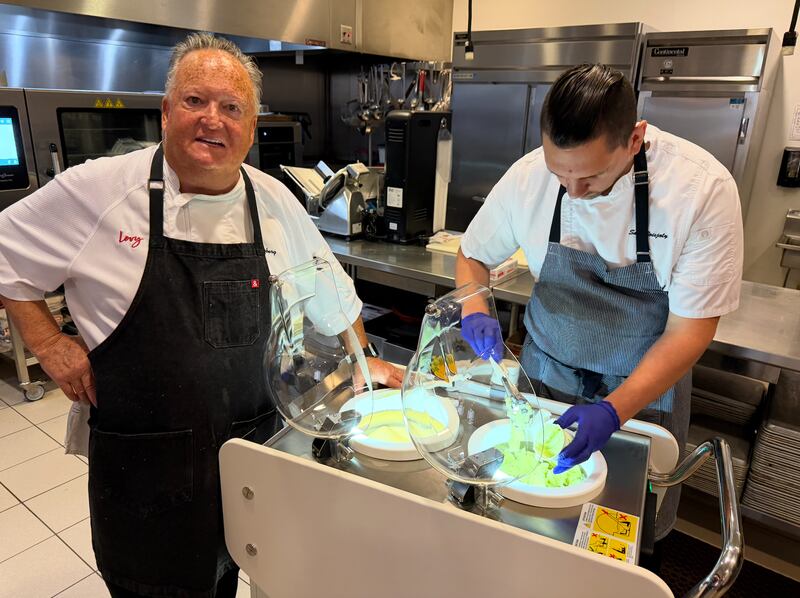
Among the commercial kitchen toys was a $12,000 battery-powered Texas Frozentech Pro Churn V2 gelato machine that Boisjoly had spent part of the week with Rosenberg perfecting. I’d say they’ve gotten close.
One of the machine’s two pots contained a creamy salted caramel gelato, while the other was filled with frozen apple and sugar. The mix of the creamy and the crystalline, with a sprinkle of salt from Boisjoly, produced a caramel apple in my mouth, showing why the machine was a hit when Rosenberg wheeled it into the owners’ suite during February’s Super Bowl.
Dolinsky spends two to three days each week in the test kitchen with Rosenberg. Since Dolinsky was hired, the ideas emanating from the test kitchen often make their way to Levy’s venue chefs via recommendation videos he creates with Rosenberg. The Food Guy uses his TV news background, and his Canon 5D Mark 4 camera, to produce what might be more accurately described as how-to videos, though they’re more suggestive than dogmatic.
Levy’s venue chefs are given leeway to make their own decisions, and sometimes their ideas boomerang from the field to the home office, then back out to the nationwide venue portfolio, like the idea for a cookie dough cart that emanated from Kyle Bowles, Levy’s executive chef at Grand Casino Arena in St. Paul. Innovation is not top-down.
“It’s why I’m in the field literally three nights a week,” Lansing said.

Chicago Twinkie
In recent years, Levy venue clients, including CPKC Stadium and Energizer Park, have opted for almost entirely local restaurant-provided food and beverage programs. The concept doesn’t work everywhere, but is an intriguing one in an era when social media and Food Network have supercharged the average eater’s interest in and understanding of food.
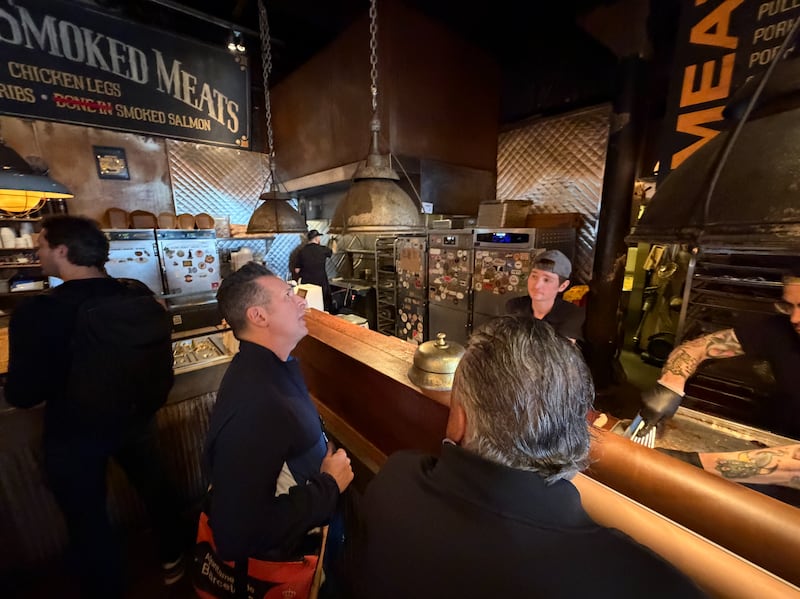
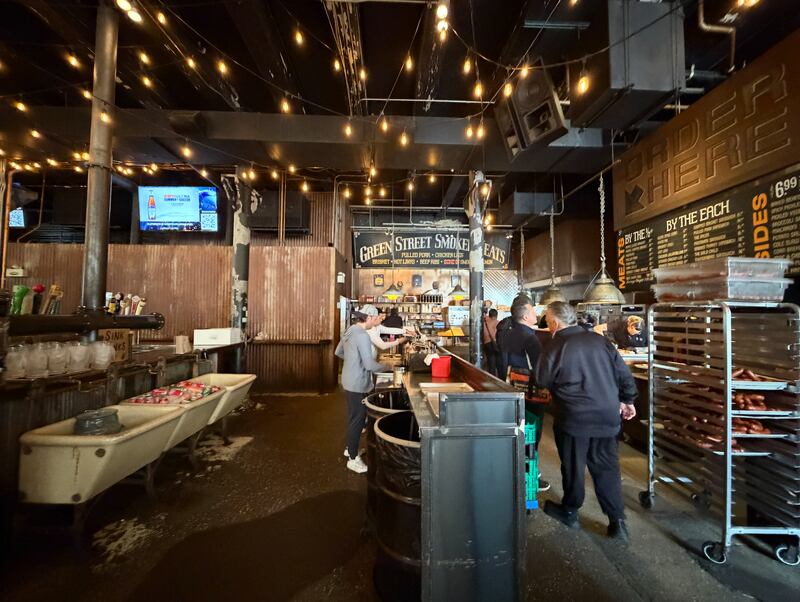
Six of us climbed into a black SUV and headed for the Fulton Market neighborhood and Green Street’s Smoked Meats, a hipster Austin, Texas, imitation that served canned drinks nestled in a mound of ice sitting in a sink. Dolinsky’s order included brisket, pastrami, jalapeno cheddar links, ribs, elote corn, mac and cheese, pickles and a Chicago Twinkie — a bacon-wrapped jalapeno stuffed with brisket, hot giardiniera peppers, cream cheese and Chihuahua cheese. The group unanimously agreed that the ribs were a winner and that the Twinkie, while yummy, was not visually appealing.
After a quick chat with the pitmaster, it was back in the SUV to head south, way south, to Beverly, Ill., 12 miles from The Loop in downtown Chicago. The destination was Sanders BBQ Supply Co., which only last year was named as one of the 50 best restaurants in the U.S. by the New York Times, following a visit and write-up by an unidentified food critic.
We passed through the restaurant to a separate party room in the back. Several tables pushed together were soon covered with trays of food, an almost embarrassingly rich spread — ribs, brisket, rib tips, pulled pork, fried catfish, collard greens, BBQ beans, French fries, white bread, a hamburger made from ground chuck and brisket scraps, and pickles. With owner James Sanders out of town at a wedding, pitmaster Nick Kleutsch told us his, and the restaurant’s story, a marriage of his and Sanders’ ideas (and companies) and their shared goal of bringing craft barbecue to Chicago’s South Side, long dominated by a barbecue tradition centered on ribs and rib tips.
The origin story and the surprisingly good sides (often overlooked in barbecue establishments), sticky rib tips, juicy pulled pork and butter-soft brisket made a positive impression on the Levy team, which liked the idea of getting the up-and-coming restaurant into one of its regional venues.
This was familiar terrain for Dolinsky. He helped put Sanders on the map shortly after it opened in 2024 with an NBC5 feature.
“As Nick tells us his story about being a pitsmoker, that’s the kind of stuff that I get excited about still,” said Dolinsky.
Ice Cream Heaven
We were back in the car, with very full bellies, for the drive to the day’s final stop: Margie’s Candies in Bucktown, northwest of The Loop.
The front door of Margie’s, which opened in 1921, is like stepping through a time capsule. The decor — jukeboxes at every table, crunchy leather banquettes, clamshell serving bowls and Tiffany-style pendant lamps overhead — feels like 1965, coincidentally the year that The Beatles ordered dessert there with some friends after playing a Comiskey Park concert.
The Fab Four ate Atomic Busters, which remain on the third page of a five-page menu composed almost solely of desserts. Margie’s offers throwback soda phosphates and at least six types of turtle desserts (the chocolate candies containing caramel and pecans), ranging from the Turtle Tummy Buster to the World’s Largest Terrapin (and its 15 scoops of French Vanilla ice cream).
Even as we labored under the weight of the two previous barbecue stops, Dolinsky ordered a tableful of desserts, including a classic banana split. When it arrived at the table, everyone whipped out their phone to take a picture and Dolinsky poured the fudge over the dish. Margie’s menu says Atomic Busters “will send you to Ice Cream Heaven.” We took a different route, but were there all the same.
Margie’s hit us with a shot of sweet nostalgia that could crack even the most analytical skeptic. In the time of big data and artificial intelligence, Dolinsky offers a contrasting approach to sniffing out food ideas rooted in the senses — what he hears about, then sees and tastes — that’s blended with any successful journalist’s desire to find something new, and first.
“I think it’s definitely a counterbalance. I’m not looking at any data when I’m doing my work,” Dolinsky told me. “I’m looking for a trend, for a commonality, things that keep repeating. If I see a lot of Basque cheesecake, or we talked a lot about ube, right? That’s the kind of intel that I bring. That’s all it’s really based on for me — fieldwork.”