
I’ve never done the McKinsey crash course in “how to build a sports property” that seems to be fueling the current era of financialized sport, but I imagine there’s a lengthy section in there on professional road cycling, probably titled, “Here’s exactly what not to do.”
The ideal sports property — built for a modern era of consumers with their digital and diffuse consumption habits, and a raft of investors looking for predictable growth and return — would, almost inevitably, lean in on the city-based franchise model. There would be a small group of teams tied to distinct cities, cultivating fan bases with a consistent brand identity and guaranteed participation, and a competitive chance of success.
The sport/product would be short, sharp and entertainment-heavy; made for TV and scheduled to maximize viewership and ticket sales. There would be a commercial structure — a governance setup and revenue split — that incentivized a broad range of investors, with clear routes to revenue and returns in most parts of the ecosystem, from team ownership through event promotion and beyond. There would be scarcity built in, with a season that found gaps in the current media entertainment calendar and a schedule that didn’t overburden athletes. And there would be global appeal to capitalize on international media and sponsorship rights fees, and to provide potential for future growth.
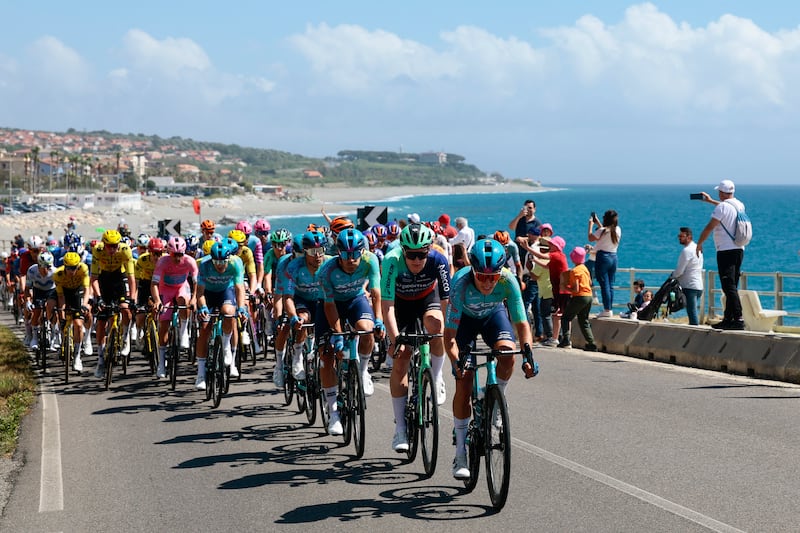
Basically, road cycling is the opposite of all of this. The teams are nebulous, sometimes nominally attached to countries, but rarely competing in them. And they change their name and identity more or less every year, making it very difficult for even avid fans to keep up, let alone for brand equity to build. Races go on for hours and take place largely across the working day. There are around 300 competition days a year, with teams often required to compete in two places at once. There is no ticketing revenue and the teams are almost totally reliant on sponsorship (hence the regular name changes).
The sport is dominated by one event organizer — ASO — and its main event, the Tour de France, for which revenues are not shared with the teams. It’s an ecosystem rooted in Europe, with minimal reach into the major American and Asian markets.
And yet ...
According to an insider at Substack, the most successful British sports writer on the booming platform is a cycling reporter named Daniel Benson. The romance of the sport, the depth — if not breadth — of fandom that exists for it and the singular nature of how sponsorship can work within it make it one of the most compelling sports marketing propositions anywhere on the planet.
Ahead of the start of this season’s Giro d’Italia, the first three-week Grand Tour on the cycling calendar, I spoke to Tom Hill, chief commercial officer at the sport’s most successful team, INEOS Grenadiers. He came down to the Leaders studio in London to record an episode of our “Leaders Worth Knowing” podcast just hours after completing a €100 million ($117 million U.S.), five-year sponsorship deal with Danish tech and AI firm Netcompany that would see the team renamed Netcompany-INEOS.
He told me that top-tier cycling teams operate on budgets between €40 million and €50 million ($47 million to $59 million), with “85 to 90% of that drawn from sponsorship.”
“No other global sport races on close to 300 days a year — cycling gives sponsors relevance almost every day, not just on matchday.”
— Tom Hill, chief commercial officer, INEOS Grenadiers
Despite a tough market, and the necessity of fishing in a pool of potential partners that has to have a Eurocentric market approach, Hill was quick to identify what makes cycling such a compelling proposition when he joined the team, having led commercial setups in rugby and soccer in previous roles. “No other global sport races on close to 300 days a year — cycling gives sponsors relevance almost every day, not just on match day,” he said. “And in cycling, sponsors don’t sit in a hospitality box — they’re inside the race, in the convoy, living the experience alongside the team.”
Suffering is part of the sport. It is bemoaned and celebrated in equal measure. Perhaps that applies to administrative effort just as much as athletic endeavor.
Elsewhere in our conversation, Hill was careful with the words he used to describe a recent effort by various teams — backed by a potential Saudi funder — to get a reform project named One Cycling off the ground. He was careful not to call it a breakaway, since any effort at reform in cycling has to take ASO and the Tour de France with it, not break away from it.
And quite aside from any McKinsey-style template for the ultimate sports property, the fundamental conflict at the heart of cycling is in every other stakeholder’s relationship with ASO. The teams are not entitled to share in the estimated $150 million annual revenue generated by the sport’s biggest event; but they are at the whim of the tour’s organizers because they need a license to compete in it every year to drive the sponsorship revenue they need to survive. Summary: Can’t live with it, can’t live without it.
All previous efforts from cycling entities to break away or build collectives to try growing commercial revenues somehow have foundered for lack of involvement of the sport’s biggest race.
But what if there were another way? What if ASO, a publishing group that built out an event-organizing arm as a way to sell newspapers, had more ambitions itself? Is there a way in which, with investment and a long-term strategy, it starts acting both as event promoter and calendar sanctioning body like Formula 1? Significant change in the sport appears to depend on ASO’s boldness; if it can ever be tempted, watch closely the next turn of professional cycling’s wheel.
James Emmett is editorial director at Leaders in Sport in London. Alongside David Cushnan, he writes the weekly Worth Knowing newsletter on the global business of sport — sign up at leadersinsport.com/newsletters.