

The Final Four this year experienced a precipitous viewership drop as the semifinals saw historically non-competitive games. Saturday's North Carolina-Syracuse matchup averaged 12.9 million viewers in the late window across TBS, TNT and truTV, down 43% from 22.6 million viewers for Wisconsin-Kentucky in ’15, and down 21% from 16.3 million viewers for Kentucky-Wisconsin in '14 (Team Stream telecasts included for each year). Villanova's blowout over Oklahoma in the early window -- which was the largest margin of victory ever for a Final Four game -- averaged 10.5 million viewers, down 31% from Duke-Michigan State last year, and down 10% from 11.7 million viewers for UConn-Florida in '14. The games, despite being just the third time in 50 years both semifinals were decided by at least 15 points, were the fourth- and sixth-most viewed college basketball games ever on cable TV. Turner also won the night across cable and broadcast TV (Austin Karp, Assistant Managing Editor).
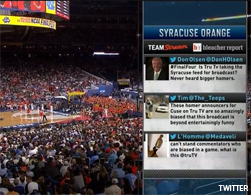 |
| Syracuse's Team Stream announcers fully bought into the homer sentiment |
GOING DOWN: In N.Y., Richard Sandomir writes under the header, "TBS Acquires NCAA Final and Fewer Eyeballs." It is "very likely" that fewer people will be watching tonight's NCAA Championship, and there should be an audience drop of about 20% compared to Duke-Wisconsin on CBS last year. Turner President David Levy said, "I can't predict ratings. But I can predict that this will be one of the biggest programs in the history of Turner television." Levy continued, "If ratings are down, it wont be because they can't find us. ... It's all about story lines and matchups." Sandomir writes those story lines "have not been especially rousing this year." The tournament's value "lies in a combination of viewership, online traffic and social media." Not to be forgotten are "higher monthly subscriber fees, which will rise over the next few years." Levy: "We're looking for double-digit increases for the next couple years" (N.Y. TIMES, 4/3).
MADE FOR TV: DePauw Univ. professor Jeffrey McCall in a special to the DETROIT NEWS wrote given how much money Turner and CBS pay the NCAA for tournament rights, "it is no wonder television's interests reach far into the competition." The influence of TV "doesn't end with bracket expansion," and many decisions are made "with a nod to television." Bracket decisions are made to create "as many made-for-TV matchups as possible" and to make sure "high-profile teams don't knock each other out" too early. The tournament committee asserts that seeding is "driven by complex, mathematically driven, MIT-like calculations," but the calculations that matter most "are projected television ratings." The committee's interest in "setting up a ratings-rich second round matchup between Indiana and Kentucky surely figured into the seeding decisions" (DETROIT NEWS, 4/3).
