

As Electronic Arts goes private with the pending acquisition by the Saudi PIF, Silver Lake and Affinity Partners, this may be one of the final times we see a public quarterly report. And boy, was this one a doozy! EA said it had a record year, with revenue up 9% year over year thanks to the performances of Battlefield 6 and EA Sports FC. For more, please read the coverage from my friends at Game Developer.
Wit, wisdom and vision from gaming’s leaders at ESA’s iicon in Vegas
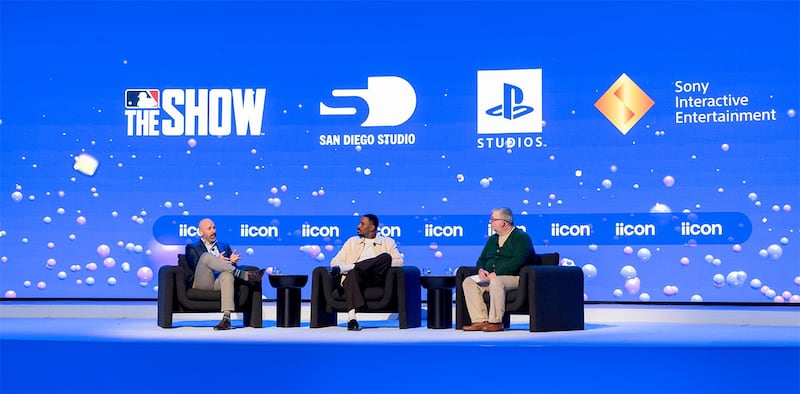
You don’t often get major game leaders such as EA’s Andrew Wilson, Take-Two’s Strauss Zelnick and Ubisoft’s Yves Guillemot in the same city at the same time, let alone the same room. The Entertainment Software Association pulled off the feat last week at iicon, its new game conference in Las Vegas.
Held over two days at the Fontainebleau, iicon showcased a much smaller feel than the ESA’s previous show, E3. I moderated a fun, lively panel on MLB: The Show with Sony’s Ramone Russell and MLB’s Peter Banks. It felt more like the conferences we put on at my previous shop, GamesBeat. And like those, it was full of insightful comments from a variety of leaders in video games. I’ve gathered some of those onstage comments from those leaders. Here’s a sampling of what we learned in Vegas:
EA CEO Andrew Wilson on the future of entertainment: “You [Fox Business’ Liz Claman] said there is a 16-year-old with the right tools that can do things faster than a triple-A studio. I’m actually not sure that’s true. I’m all about tool sets. I’m all about empowering our people. I’m all about empowering our communities to go create. What we’re going to see is similar to what we saw with YouTube and television and movies, which is it will likely be different. Do I think that a 16-year-old in a garage is going to create a Battlefield or an EA Sports FC or a Sims or a Call of Duty or a GTA? I actually don’t think that’s going to happen anytime soon. When we go back to 2000 and the birth of YouTube, there were really two schools of thought. One was, ‘Oh my goodness, we’re going to have a thousand Steven Spielbergs and Steven’s going to be out of a job.’ The other school of thought was, ‘We don’t have to worry about it. It’s all cat videos. How many cat videos can people actually watch? This thing’s a flash in the pan. It’ll be gone before you know it.’ Fast forward today, what we know to be true is neither of those things actually happened. Steven Spielberg is still one of the greatest filmmakers of all time, and there are many like him who create extraordinary content that we all line up to engage in. And Mr. Beast was born … and they coexist and both have grown dramatically. And so I think when I look at this notion of user-generated content and certainly empowering creators with tools, it’s really positive and really important that we do that, but I don’t think it’s going to destroy an existing industry. I think [UCG] is an end.”
Take-Two Interactive CEO Strauss Zelnick on maintaining relationships with sports leagues such as the NBA: “How you keep any relationship going? It’s always the same, which is lots of engagement and communication and making sure that the relationship is a win-win. That’s true for everything personally and everything in business. … We’re very selective about licenses. We really prefer to own and control our intellectual property. So when we enter into a license, the only way it makes sense for us is if it’s long term. The way that we’ve done that is just, first, try to make an amazing game. And secondly, make sure that the interactions are really positive. So, I was actually on the phone earlier with a licensor and a property, and this person is a very close personal friend of mine, but if we did horrible business, that doesn’t mean that he would stay in business with us. What I do to maintain that relationship is communicate early and often, and in a transparent way, take responsibility when stuff doesn’t go well and work together to try to create the best possible result and then do it over and over and over again. And because of that, we have these really terrific long-term relationships, but they’re not based on ... taking them to an expensive dinner and tell them they look good in a suit. They’re based on the fact that we create amazing entertainment, or at least we try to. When we fall short, we take responsibility and try to fix it. … One of the things that I say early and often in licensing conversations is, ‘Remember, we work with your brand, with your permission, but you own the brand. If our deal comes to an end, we don’t own the brand, you own the brand. So our job together is to make sure, minimally, that we do no harm to your brand. And really, best case scenario, we support and build your brand,’ and we look at it through that lens.”
Riot Games CEO Dylan Jadeja on the economic realities of gaming: “We’re in the business of art. We all nurture creative heart. And this challenge of, we talk about it as chaos and construct, the idea of how do you create a space where the left brain and the right brain can coexist, that you don’t suffocate one or the other. And it is really hard to do. The job of executives is often to create the environment where you can put forth that art. Art doesn’t happen on a factory floor. AI is going to feel like a factory. I’m not offending anyone that has a factory, I hope, but ultimately you really want to be in a place where you can put that forward, and that’s on us to create that space. You have to be very responsible in the decisions in terms of how you build a team up, the size of teams, how fast you get there, to live with the belief that success is not guaranteed. So the more conservative you can be in the way that you scale teams and that you think about teams, the more humility you can have in that process to recognize that players have diverse taste. We’re delivering games collectively, so many of us around the world, how diverse is that player base? So how do you develop a level of a conservative enough approach to be flexible enough to serve all those players, not over-invest, not put yourself in a place where you have to take corrective action on the back end. I really do believe it begins right at the front end and a level of humility throughout the process is actually quite helpful.”
Ubisoft CEO Yves Guillemot on the key to operating live-service games: “It’s listen, listen, listen. Meet with players. Work on the tools you have so that you can react to what they want and be able to change the game fast, because in the industry, we now have to come out more often with content because there’s so much competition between games that you have to entertain. It’s a new thing now: Entertain regularly so that players want to stay or come back fast to the experience you do. So, tools and a team that is listening a lot to what players want.”
YouTube Global Head of Gaming Publishers Kendra Johnson on building communities: “We look at Bain Capital, who last year came out and said that creators are the most influential source in purchase intent. So that is a really important way to understand your player. How are your players really listening to the creator community, and why you want to make sure that you understand that creator community. I’ve seen publishers who really understand this and recognize that by investing in creators. They are able to build long-term value and long-term engagement in their game. We’ve been partnering with publishers who’ve been building creator programs, and we’re seeing just really exciting success, whether it’s driving increase intent to play, driving increased player sentiment, and then for the creators, driving more revenue, more watch time, and broader reach.”
NBA 2K VP/Global Marketing Crystal MacKenzie on NBA 2K serving as an entry point for a younger generation of international fans: “It’s really exciting when the game is the first touchpoint for fans for a couple of reasons. One, when we think about internationally and timing, it’s just hard. The games’ times don’t always align with when people want to engage with basketball. 2K allows them to be able to engage, get on the court, engage with the NBA, engage with the teams and the players that they’re fans of on their own schedule and when it makes sense for them. That’s really exciting, because we like to say it’s a court that never closes. The other really exciting thing about NBA 2K being the entry into fandom is, going back to what you said, like being raised in Sacramento, you’re sort of like, ‘OK, I’m a Kings fan because they’re here.’ Or, ‘I’m a die-hard Lakers fan because I’m from L.A.” And so my exposure to the NBA growing up was the Lakers and whoever they were playing. That’s sort of what I thought basketball was. And my exposure to players before my time was sort of lore of what my dad would tell me about the Lakers. What’s exciting about 2K being the first thing that you’re interacting with for the NBA is you can interact with all of the teams and all of the players, present and past. It allows you to have a really deep fandom and allows you to engage with the league in a much more interesting, sort of deeper way than you would of just watching a local team or watching a team that you sort of grew up with. It’s really exciting because it allows that hoop culture to grow and grow and grow. And the more that hoop culture grows, the more sort of a rising tide lifts all boats there. It’s good for us, and it’s good for our partners at the NBA.”
ESL FaceIt Group Esports Chief of Staff Kevin Rosenblatt on building event brands independent of specific games: “So, it’s really easy — a decade- to two-decade- to three-decade-long process. IEM first launched Intel Extreme Masters … almost 20 years ago. DreamHack was launched, I believe in 1994, and it was basically BYOC, or ‘bring your own computer,’ experience where you could come and just play casual games with your friends. Over time, there’s this element of consistency that we’ve had over two to three decades where we’ve been able to really evolve the core experience. The games have changed. Games have come and gone. Experiences have come and gone, but really, the core of what we have created has really been consistent. What that consistency is really made of is really creating a space where legendary moments can happen. Then wrapping that anesthetic that feels familiar to a fan. … You’ll have am amazing sort of walkout ceremony and trophy lift ceremony that’s unique to IEM. So, all these things that we do sort of build legacy in history, and that’s part of the process. The last thing is really diving into local culture. A couple of examples of this are in a Dreamhack a couple of years ago in the U.S., we put Ludwig, one of the top streamers in a glass box and he streamed for 50 hours straight. He slept in the glass box. I’m not kidding. Incredible. And then similarly in Stockholm … we did a podcast with a three-member comedy group called I Just Want to Be Cool. Huge in Europe. I’m sure nobody here has probably heard of them, maybe a couple people have. But really it’s about leaning into that sort of local culture and then building something that’s bigger than the sum of the parts. And you do that and you compound it over time and there you go.”
MLB Senior Director/Games and VR Peter Banks on learnings from the 2026 World Baseball Classic: “Some of the stories that were coming out of that were just so terrific, whether it was the Italian team, obviously the great triumph with the Venezuela team. A lot of these teams are some of our homegrown talent or our MLB talent, just doing what they do best on-field. But then a lot of these teams are guys who are plumbers and electricians and just coming out there and maybe didn’t quite make it, but are just these great talents. And just as far as the lesson, it’s just how much fun there is in some of the stories that come out emergently. When you play any sport, when you play this sport, to see some of these great stories and narratives come out and be able to engage and capture the imagination of our fans is just terrific. And I do think it just gets us excited about how we can continue to evolve our sport and communicate that to our fans, whether it’s through our on-field presentation, our broadcast presentation or our games.”
‘Chompetition’ marks 45th anniversary of Pac-Man

Forty-five years ago, this 7-year-old had a lot of dreams, like becoming a paleontologist or, barring that, driving a bulldozer (both deal with moving around dirt and rock right?). Executives at Namco in Japan no doubt had dreams for their latest game to become a hit. You might have heard of it — Pac-Man.
As part of the historic game’s 45th anniversary, the Paley Museum in New York City is working with Bandai Namco (the company’s grown since 1981, merging with Bandai in 2006) on an exhibition to celebrate its history. (Note: Midway was Namco’s partner in bringing Pac-Man to the U.S.) This includes a tournament: the Pac-Man NYC Chompionship 2026. It runs Saturday, May 16, with qualifying rounds from 12:40-3 p.m. and the finals slated for 3-5 p.m.
“[This is] shaping up to be one of the standout fan competitions of the year — especially in New York City,” said Aimee Householder, the Paley’s VP/public programing. “It’s designed as a multigenerational celebration of one of gaming’s most recognizable icons.”
The Paley is working with Bandai Namco to put on the “Chompetition.” It’s a throwback to the early days of esports, a simple high-score competition. The top prize is a Pac-Man pub table arcade machine (my favorite sort of game cabinet, as it can hold a beer without the can or bottle sliding off). Money isn’t the goal here. “The event is designed less as a traditional esports cash tournament and more as a joyful, high-energy celebration of arcade culture, fandom and gaming history,” Householder said.
The Paley is working directly with Bandai Namco on the event and celebration of Pac-Man, providing memorabilia for the exhibit and prizes.
I don’t often cover game tournaments that aren’t “esports.” I made an exception here because it’s Pac-Man, one of the most important games from the industry’s early years.
Besides, you should never pass up a chance to cover a legend that took a “chomp” out of U.S. culture.
Gaming speed reads
- Borussia Dortmund is the latest sports team to dip into Roblox and its 132 million daily active players, with its 2026-27 Puma kits appearing in Gamefam’s FIFA Super Soccer on the platform.
- While Saudi Arabia may be pulling back on some of its spending in sports (hi, LIV Golf!), its Savvy Games Group signed a deal with Roblox to “support the platform” as it continues to improve its game-making tools.
- As a reminder that just about every big sporting event has a game attached to it now, Nacon is releasing its cycling sim Tour de France 2026 on June 4 for PC and consoles.
- Alliance Studios, a Fortnite Creative dev house that worked on Topgolf’s foray into the platform, is shutting down after seven years, reports GamesBeat.
- Last week, Sony announced that MLB: The Show is going mobile, coming at a future date on iOS and Android. It’s bringing a distinct feature, too: Seasons, a mode with 3-inning games, a good fit for the mobile format.
- The changes at Xbox continue as new CEO Asha Sharma shakes up the leadership ranks, with a slew of appointees and reassignments, per GamesIndustry.biz. The biggest, though, may have nothing to do people, as Sharma (who was an AI exec at Microsoft) said Xbox is ending development of Gaming Copilot for consoles. GenAI remains unpopular with gamers across the board, and I’m surprised Microsoft is giving up on it for gaming. This at least shows Sharma is paying attention to the customers.