

Tonight in Unpacks: The NBA’s offseason begins with several opportunities for owners and the league to cash in, as SBJ’s Tom Friend breaks down the money matters in this week’s magazine.
Also tonight:
- NHL, Dan Friedkin exploring expansion to Houston or Austin in $3.5 billion deal
- K.C.’s World Cup fan fest showcases city’s effort to leave impression
- Scripps Sports looks to continue local buildout
- Op-ed: Colleges celebrate women’s sports — then ask donors to save them
Listen to SBJ’s most popular podcast, Morning Buzzcast, where Abe Madkour offers thoughts on Michigan’s Dusty May leaving an increasingly difficult college sports landscape to coach the Mavericks, the growing sports portfolio of Bill Foley as he seeks an NBA franchise for Vegas, Linda Cohn retiring from ESPN after a storied career hosting “SportsCenter” and more.
Months ahead could bring a cash haul for NBA

If Jim Dolan ruled the NBA off the court as much as his Knicks now rule it on the court, there’s no telling how this offseason would play out.
From his 26th floor office at 2 Penn Plaza, Dolan is the face of the big markets, while the small markets band together in the name of revenue share. It’s made for intriguing board of governors sessions, and, this summer and early fall, the debate over expansion and the intrinsic revenue sharing that comes with it should bubble to the surface.
The arguments for expanding from 30 teams to 31 or 32 — or sticking with 30 — are relatively simplistic. Ownership groups from Las Vegas and Seattle reportedly need to bid between $7 billion and $10 billion to get “yes” votes on expansion from owners such as Dolan. Otherwise, if bids are on the low end, they may not be enough to compensate for splitting the league’s national media rights money one or two more ways.
Dolan — whose Knicks will be on national TV ad nauseam next season and will lose MSG Network game checks every time they are — supposedly doesn’t want to split anything.
That said, Commissioner Adam Silver has said there’s generally harmony in the BOG room, despite what people believe. If expansion is voted down, it will be by consensus. But, make no mistake, this offseason is about cold hard cash.
Take NBA Europe. In a perfect world, the marquee EuroLeague clubs — Real Madrid, Barcelona, Bayern Munich, Fenerbahçe, Asvel or Olympiacos — would submit bids between $500 million and $1 billion to give the fledgling league continental credibility when it launches as planned in the fall of 2027. But EuroLeague CEO Chus Bueno has said his teams shouldn’t have to pay full price, due to the IP and fan bases they bring to the new league. Will the NBA give them a discount? Bueno also wants a full merger if there’s a merger at all. Problem is: There are 13 EuroLeague teams and only 12 permanent NBA Europe slots. The numbers don’t add up, and EuroLeague finances might not, either.
Another revenue question is the local TV riddle of the 13 former Main Street Sports Group teams. This offseason, 11 of them (Hawks, Hornets, Cavaliers, Pacers, Clippers, Grizzlies, Bucks, Timberwolves, Thunder, Magic and Spurs) still have to choose among DAZN, Victory+, the Rangers Sports Network or a local OTA channel for their linear game broadcasts. DAZN’s $20 million minimum guarantee is the high end — although fans may not like its paywall — while everyone else is mostly in the $10 million-$15 million range. Until the NBA unveils its national streaming hub, local TV money will remain subpar.
The last financial equation of the offseason is the Clippers-Aspiration scandal. If the Clippers are found guilty of circumventing the salary cap for their part in paying Kawhi Leonard $28 million for a no-show job, the potential penalties could be harsh: losing three first-round picks, or a $30 million fine, or owner Steve Ballmer and executives being suspended or the league voiding Leonard’s current three-year, $149 million contract.
“At some point, we have to wrap it up,” Silver said at the Finals, presumably meaning sometime before the Knicks begin defense of their championship next fall.
NHL, Dan Friedkin exploring expansion to Houston or Austin in $3.5 billion deal

NEW YORK — The NHL has signed a term sheet with Houston-based billionaire Dan Friedkin that grants him exclusive rights to bring an expansion franchise to either Houston or Austin. Friedkin and the league will jointly explore over the next six months which South Texas market is more feasible based in part on the capability to build a new arena.
NHL Commissioner Gary Bettman, who informed the league’s existing owners of the news Tuesday at a board of governors meeting, said the total investment — including both the expansion fee and cost of building a new arena — would be $3.5 billion, declining to go into further detail.
Expansion would still require a board vote following the six-month exploration period.
“We have been in discussions for the better part of two years with the Friedkin family, principally about Houston as an expansion opportunity,” Bettman said. “But as we continued to focus with them, particularly on the need for a new arena in Houston, the discussions morphed into also a discussion about Austin, which would also need a new building.”
Bettman added, “Both cities will require a new arena. It may be more feasible in one place than the other, and as we dig a little deeper and do the due diligence, we’ll figure out which makes the most sense.”
The Friedkin family issued a statement, saying in part, “Each city brings unique attributes that would make a new team a huge success — both have the infrastructure, passionate fan bases and economic strength needed to support a championship-caliber franchise for years to come.”
Friedkin’s sports holdings under the Pursuit Sports umbrella include Italian soccer club A.S. Roma (Serie A), Everton F.C. (English Premier League) and A.S. Cannes (French Championnat National 2). Forbes estimates his net worth at $11.5B.
A Houston or Austin franchise would be the NHL’s second in Texas, joining the Dallas Stars in the country’s second-most populous state. Bettman said the Stars would not be entitled to compensation in exchange for the addition of another team in Texas, saying franchises’ territorial rights “don’t extend that far.” Both cities are around 200 miles south of Dallas.
The two markets offer different value propositions for the NHL and Friedkin. The Houston–Pasadena–The Woodlands region is the country’s fifth largest metropolitan area in the U.S. by population with 7.9 million people, while Austin–Round Rock–San Marcos ranks 25th with 2.6 million residents. The NHL, however, would be the last of the “Big Four” sports leagues to arrive in Houston, whereas it would be the first to land in Austin (joining MLS’ Austin FC).
Bettman noted the NHL has been successful before by being a first mover into smaller markets, pointing to the success of the Golden Knights in Las Vegas.
The NHL would become the largest of the “Big Four” by expanding beyond 32 teams, but unlike the others, seven of the NHL’s clubs are based in Canada. Bettman has consistently said that NHL has room to grow in the U.S. given that it only has 25 teams in the country. The league’s most recent additions through expansion are the Golden Knights in 2017 for $500 million and the Kraken in 2021 for $650 million.
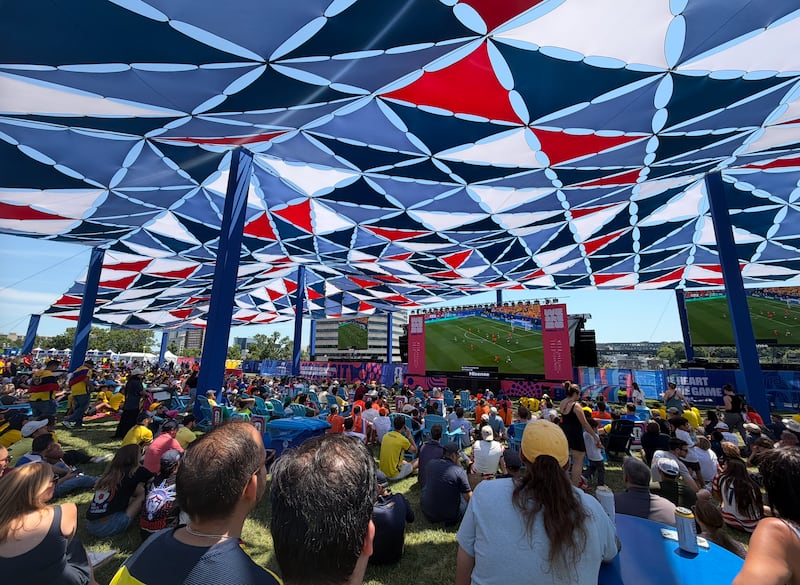
FIFA Fan Festival is indicative of World Cup’s smallest host city’s effort to make an impression

KANSAS CITY -- The only issue with the view Populous created at the entrance of the Kansas City World Cup Fan Festival is the instantly compelling need to stop and take a picture. A 65-foot, aluminum red heart frames a view that includes the WWI Memorial and the city’s skyline behind it, with a giant screen showing World Cup matches in the foreground.
Fortunately, the grassy yard between the entrance and the heart is large enough to accommodate photo opportunities and avoid pile-ups.
In this summer’s World Cup spread across three countries and 16 major cities, K.C. might have been the least known to soccer fans visiting from abroad. Despite being the smallest host market, the city budgeted $165M for tournament hosting. Four of the competing national teams (The Netherlands, Argentina, England and Algeria) are making their temporary homes at the region’s soccer facilities, while six matches are being played at K.C. Stadium.
The 244,000-square-foot Fan Festival, designed by K.C. Host City Supporter Populous, is exemplary of the effort the city, states and host committee have put into the tournament. Where other cities backed off official fan festivals, said Jeff Keas, Senior Principal, Senior Event Architect, K.C. leaned in.
Both Kansas and Missouri -- states in which K.C. resides -- contributed funding to the fan festival, notable at a time when the states’ relationship has frayed after the Chiefs decided to move across the state border from K.C. Stadium to a new venue in Kansas. KC2026, which is managing the festival, declined to share any specific investment figures related to the fan festival. But it’s serving as a front porch for the city to hundreds of thousands of visitors, including hordes of Argentinian, Ecuadorean, and Dutch fans.
One of the overarching design goals for the fan festival, said Bobby Sloan, Populous principal and senior event manager, was to create an experience better than watching at home or in a bar, and as close to in-stadium as possible.
The festival is attracting fans and non-fans, match ticket-holders, and families, and the line before its 11am CT opening on Saturday was substantial. Admission is free with pre-registration. And with 25,000-person capacity, the communal experience that blossoms during a global event like the World Cup is happening in K.C.
The festival is positioned atop the hill near the World War I Memorial and Museum, and just above where the Chiefs’ Super Bowl parade and the NFL Draft have been held in recent years near Union Station. The fan festival is open 18 of the tournament’s 39 days and is easily accessible by the city’s relatively new streetcar, which costs nothing to ride.
Populous started working on the master plan two years ago. The massive red heart entryway was an early starting point, a nod to K.C.’s friendly and hospitable nature. Jason Sudeikis, who plays Ted Lasso in the eponymous show, is from K.C., and it’s that feel-good soccer vibe that the heart represents.
After taking a picture at the heart gateway, visitors moved toward an oversized World Cup match ball for another photo opportunity.

Behind the match ball, sat a linear mall, lined by the FIFA partner activations that are ever-present at each of the official fan festivals, including the wildly popular Bank of America charm bracelet station (the line snaked around the mall). The main area concludes with a screen showing matches on a stage where multiple concerts are being held during the tournament.
Patterning and fabric were everywhere, including on the tall speaker towers and a massive shade structure away from the main linear mall. If nothing else, it suggested an effort to beautify the infrastructure. As with most of the World Cup fan festivals, shade was at a premium.
Populous’ brand group focused its efforts on K.C.’s brand. A central goal was “showing off Kansas City and welcoming the world,” said Populous Brand Activation Director Kelly Holton.
Populous’ own activation consisted of a large blue wall with a mural that’s being updated daily. Fans scan a QR code and upload a video of their favorite sports memory and the mural artist is picking some each day to add to her painting.
Two premium experiences were available for purchase, including the Legacy Lounge, an air-conditioned indoor space with the Chiefs’ Super Bowl trophies on display inside a case and an elevated overlook with ideal views of the mall and main stage/screen.
The Legacy Lounge, built by Infinite Structures, is a kit of parts that previously had been the MSC Yacht Club at the F1 race in Miami; its next stop will be a reconfigured premium space during the U.S. Open Tennis Championships in N.Y. in August. K.C. hopes the soccer buzz it helped create remains well beyond.
Scripps Sports in acquisition mode amid NHL, NBA team offseasons

With NBA and NHL teams now laser-focused on offseason business, Scripps Sports — with local rights to five hockey teams and one basketball team — is in acquisition mode. Scripps already locked up the Pistons last month and was in the running for the Heat.
“We have a business model that’s working really well for us ... in markets that we’re already doing business where we have typically an NBC, ABC, CBS or Fox station,” Scripps Sports President Brian Lawlor said. “We’re in 40-something markets. There’s still other NHL and other NBA markets that check that box, and we’ve gotten a lot of calls from other teams that aren’t in our in markets [where] we might own an ION but we don’t own like an ABC, NBC, CBS.”
However, just because Scripps doesn’t have a Big Four station in certain NBA or NHL markets looking for a solution doesn’t mean it can’t get one set up. “We’ve chosen not to yet,” Lawlor said. “We don’t have a news brand and a sales team and those relationships, and all of that is really important for us in being able to amplify and advance. But down the road — we’re clearly executing on sort of ‘Scripps Sports 1.0’ [right now] — maybe moving to 2.0 with some level of maturity that didn’t exist a couple years ago.”
Scripps does local game distribution for the Golden Knights (whose owner, Bill Foley, launched a bid for an NBA expansion team Monday afternoon), Mammoth, Predators, Lightning and Panthers. Lawlor said that, while many in the media and hockey business were cautious at first, those relationships have turned out to be fruitful.
“Our thesis that the teams were seeking reach and over-the-air broadcast could really dramatically extend their reach was spot on,” he said. “There were things that we believed early on that we got wrong, but we were able to then sort of tweak it and advance it. … We’ve opened up a lot of new sponsorship opportunities. … We’re able to just take a lot of those sponsors and sort of upsell them into sports, and then there’s a whole lot of other businesses that are not traditional advertisers but lean into sports.”
As the NBA and NHL both reportedly look to develop national solutions for local broadcasts, Lawlor, who said Scripps’ relationship with the NHL league office has been great, sees the company continuing to provide a crucial function.
“The NBA obviously floats it all the time that they want to consolidate their digital rights, but still be on linear or potentially down the road roll up on linear,” Lawlor said. “But we’ve proved in the NHL — these games on free, over-the-air television are really valuable and they reach a ton of fans, and that’s not going to be the case tucked behind a paywall.”
===
More from Sports Business Journal
- Rolapp to unveil PGA Tour changes Tuesday
- World Cup sees first weather delay in decades
- Venues for ice events at 2030 Games revealed
===
Start your day with SBJ Morning Buzzcast, bringing you the hottest stories in sports business every morning in under 15 minutes. Sign up for SBJ’s free newsletters, and dive deeper inside the industry with all the latest sports business news here.
Colleges celebrate women’s sports, then ask donors to save them
America is finally falling in love with women’s sports. College athletic programs are dismantling the very system that built them.
Earlier this year, the University of Arkansas announced plans to eliminate both its men’s and women’s tennis programs, citing the financial pressures of the post-NIL era and the escalating costs of major college football. After public backlash and donor support, the university reversed course and retained the programs.
That outcome should be celebrated. But the larger lesson should concern everyone who cares about the future of college athletics.
Women’s and Olympic sports should not exist only at the mercy of emergency fundraising campaigns.
Across the country, athletic departments are quietly reevaluating nonrevenue sports as they absorb the financial pressures of revenue sharing, NIL and the escalating costs of football. Increasingly, programs survive not because universities view them as essential institutional commitments, but because donors mobilize quickly enough to save them.
That is not a sustainable model for college sports.
Donor support has always been critical to college athletics. Many programs would not exist without generous alumni and supporters. But there is a meaningful difference between philanthropy enhancing a program and philanthropy functioning as its emergency life support system.
When universities force Olympic and women’s sports into recurring survival campaigns, they reveal which programs they truly view as foundational and which they view as optional.
The issue is no longer whether universities publicly support women’s sports. Most do. The issue is whether women’s and Olympic sports are treated as permanent institutional priorities or temporary liabilities that must periodically survive emergency fundraising campaigns to stay alive.
This shift is happening at precisely the wrong moment.
Americans consumed a record 46 billion minutes of women’s sports content in 2025. The WNBA’s new media rights agreement is worth roughly $200 million annually. Women’s college basketball, softball, volleyball and tennis continue generating growing television audiences, sponsorships and fan engagement.
This is not a niche movement. It is one of the fastest-growing sectors in American sports.
And yet, many of the very college programs responsible for developing generations of female athletes remain financially vulnerable whenever budgets tighten or football spending escalates.
Tennis is one of the clearest examples.
College tennis has long served as one of the most important developmental pipelines in American women’s sports. Players like Emma Navarro and Peyton Stearns developed through the NCAA system before emerging onto the professional stage. The infrastructure already exists: scholarships, coaching, competition and national visibility.
But none of it works if universities continue treating those programs as expendable assets during financial stress.
The U.S. did not become a global leader in women’s sports by accident. Universities spent decades building developmental systems for female athletes and Olympic sports. That investment created scholarship opportunities, coaching pathways and competitive platforms that transformed American athletics.
That infrastructure cannot survive if schools begin treating Olympic sports as line items that must repeatedly justify their existence through emergency donor campaigns.
Donors should help programs grow. They should not have to repeatedly save them from extinction.
The question is no longer whether Americans care about women’s sports. They clearly do.
The question is whether college sports leaders are willing to protect the future they keep claiming to believe in.
Bryan Sheffield is the founder of the ATX Open, a WTA tournament in Austin, as well as a minority owner of Austin FC and an SMU trustee.
Speed reads
- Purses in women’s golf continue their upswing, with the KPMG Women’s PGA Championship featuring a $13 million purse, the largest ever for a women’s tournament, reports SBJ’s Josh Carpenter.
- Oklahoma State signed a three-year deal with the Osage Nation that will feature an Osage jersey patch added for all OSU athletics teams beginning this fall, writes SBJ’s Ben Portnoy.
- During a ribbon-cutting ceremony Tuesday, Bills owner Terry Pegula gestured to the new Highmark Stadium behind him and revealed that the name of every worker who had a hand in construction — 5,369 and counting — will be inscribed on an external stadium wall, reports SBJ’s Nick Veronica.
- While much is being written about tension on the Fox Sports World Cup studio set between analysts Alexi Lalas and Zlatan Ibrahimovic, Fox’s lead match analyst, Stu Holden, tells SBJ’s Austin Karp that “too much is being made” of the story, noting that “off camera, these guys are all great professionals. ... And I think they understand that this is TV.”
- Soccer marketing agency Name & Number launched a dedicated sponsorship consulting practice led by former MKTG executive David Kemp, notes SBJ’s Alex Silverman.
- TNT Sports says that it has some fresh technology to introduce for its NASCAR coverage alongside its previously announced talent roster as it prepares for broadcasting its portion of the season, writes SBJ’s Adam Stern.