

Tonight in Unpacks: With at least 100 active licensees, FIFA has pieced together its largest retail push ever for the 2026 World Cup. SBJ’s Alex Silverman chronicles how the organization pulled it off in this early look at next week’s magazine.
Also tonight:
- Inside ESPN’s best Stanley Cup Final
- Wimbledon continues push for fan growth in U.S.
- U.S. Soccer reaches adulthood with new home
- Op-ed: What do FCC spectrum auctions mean for sports networks?
Listen to SBJ’s most popular podcast, Morning Buzzcast, where Austin Karp closes out the week with thoughts on the World Cup and other soccer media news, MLB’s proposal to “modernize” player contracts, Kalshi’s latest push to raise funds and more.
How FIFA achieved unprecedented retail reach for World Cup merchandise

Through its work with sponsors, media partners, host city organizers and even the federal government, FIFA has ensured that the 2026 World Cup is front and center in American life. Yet the most visible sign of the event’s commercial reach may be the black cardboard merchandise displays beside the pharmacy counter at CVS.
By working with licensees that specialize in value-oriented and impulse retail, FIFA has put officially licensed merchandise in thousands of drugstores, convenience stores, supermarkets, airports and transit hubs. The World Cup products available in those locations this summer include hats, shirts, tumblers, keychains, bandanas and pet toys.
FIFA said the program is its largest retail effort ever, with results to date “far exceeding expectations and forecasts.”
To achieve such broad distribution, FIFA has pieced together a layered retail network that assigns specific product categories, sales channels and retail formats to different companies. The governing body said it has at least 100 active licensees in the U.S.
Fanatics operates retail at World Cup stadiums and FIFA Fan Festivals, selling a curated selection of products from Adidas and other FIFA licensees. Legends Global operates FIFAStore.com, which offers a broad selection of tournament- and team-specific products. There are also about 40 official pop-up stores across U.S. and Canadian host cities.
To reach the places Americans frequent as part of their daily lives, FIFA has granted channel-specific rights to companies like In Motion Design, whose headwear and drinkware are available in thousands of convenience stores, pharmacies, supermarkets and value retailers. That has allowed chains such as CVS, Walgreens and 7-Eleven to source World Cup merchandise through suppliers and distributors with which they already do business.
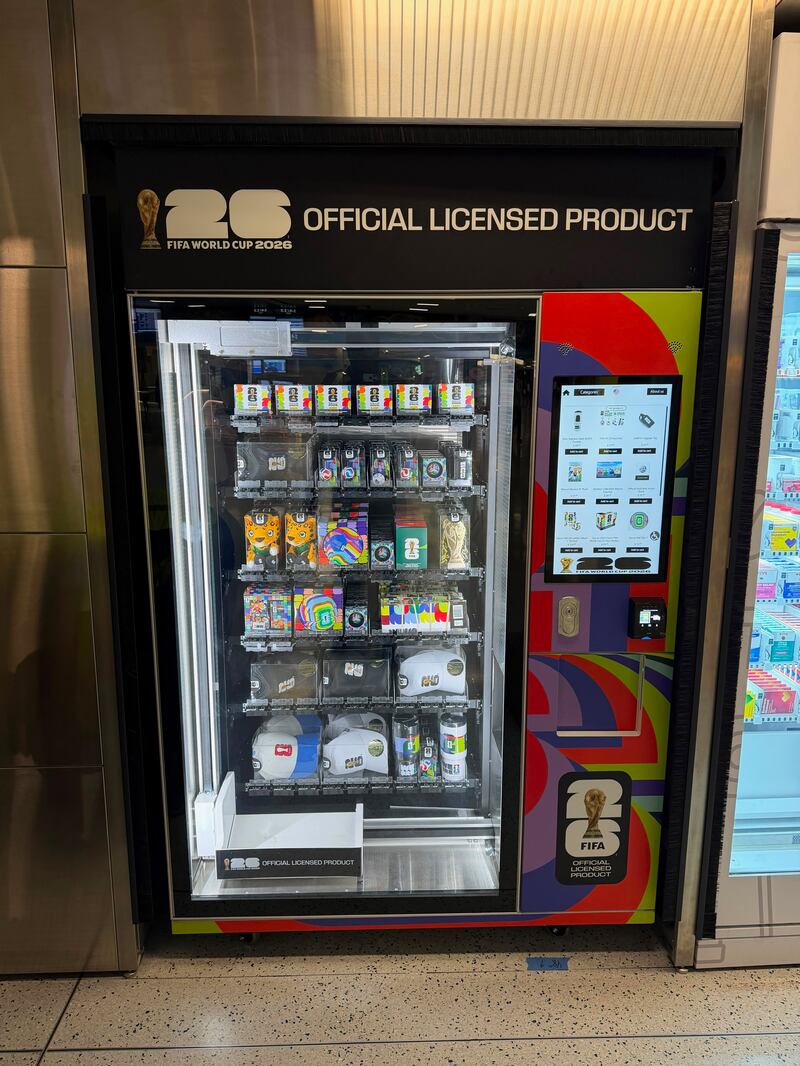
FIFA is also working with automated retail company Prepango to dispense FIFA-branded products from machines in airports, train stations, hotels, shopping centers and other high-traffic locations.
Selling ‘where we specialize’
In Motion Design had never directly held a license for a sports or entertainment property before securing its FIFA World Cup 2026 deal. Instead, the company specialized in developing consumer goods under its own brands for sale through retailers like Kroger and Albertsons. Those brands include Chillmeister headwear, University of Beer Pong ball-and-cup kits and Always and Forever party supplies.
With the World Cup coming to North America, the firm entered FIFA’s bidding process for the right to sell headwear and drinkware through convenience, grocery and drugstores.
“Adidas doesn’t necessarily sell where we specialize — convenience, grocery and drug,” said Nabel Khogyani, vice president of sales for In Motion. “So that’s what opened that door for us and set us apart from them. That was the unlock and that gave us the rights, and then we just went 200%.”
In Motion’s black cardboard floor displays have become ubiquitous across the U.S. this summer, thanks to the company’s established pipeline into some of the country’s largest retailers. FIFA later authorized the company to sell into airport stores and Prepango’s automated retail machines, neither of which was covered by its original license.
In Motion’s products include hats, tumblers, bandanas, squeeze bottles and drink jackets, which carry either general World Cup marks or host city-specific designs. The company said they are available in about 5,500 CVS stores, 4,500 Dollar General locations, 4,000 Walgreens stores, 3,500 7-Eleven locations, hundreds of Albertsons and Kroger stores, airport retailers such as Hudson and numerous regional chains. The four largest retailers alone account for more than 17,500 stores.
Khogyani estimates that In Motion has moved between 2 million and 3 million units of FIFA merchandise, including keychains and pins it distributed for another licensee, Honav USA. It offers its wares in packaged cardboard displays with World Cup marks and an “official licensed product” designation, allowing retailers to easily display product without assembling the assortment themselves or eating into traditional shelf space. In some locations, its products are sold alongside merchandise from other licensees, including Outerstuff apparel, Q-Live hard goods, Ningbo Sincere Holding pet products and Jazwares plush toys.
In Motion’s nimble production capabilities have allowed it to customize offerings for different retailers. After initially designing foam trucker hats with a suggested retail price of $20-$25 and performance hats with a recommended price of $29-$34, Dollar General told the company it wanted a hat it could sell in its stores for under $15 alongside squeeze bottles, koozies and bandanas.
“We just took our trucker hat and we took away a few minor details,” Khogyani said. “On the inside, instead of having this lining with the design, it was blank. Instead of having an extra patch that says, ‘Designed in California,’ we took it out. Then on the front, the graphics that were an embroidered patch were printed instead.”
The firm has also worked with stores to deliver product in a variety of ways to best meet their needs. While a corporate retailer, such as CVS, will order product centrally for thousands of stores, franchises and independent stores may prefer to order through their usual inventory partner, such as McLane or Core-Mark. It has also extensively utilized drop-shipping through FedEx to accommodate last-minute orders.
High traffic, high demand
Licensed sports merchandise is not entirely foreign to convenience stores, supermarkets and pharmacies. Stickers, trading cards, party goods and inexpensive novelties have long appeared in mass retail. What distinguishes FIFA’s 2026 effort is the breadth of the assortment, the consistency of its presentation and the scale of its distribution.
Stu Crystal, a veteran licensing executive who previously led consumer products for MLS, called the rollout “definitely broader than most” and said the store counts described by In Motion would likely make it unprecedented.
“It’s the confluence of the biggest event in the world and a country that looks like this is going to be the tipping point for the sport,” said Crystal, now a general manager at sports licensing company Brevettar.
Along with value retailers, World Cup merchandise is widely available in airports and other transit hubs, reaching international fans traveling in and out of the country. In addition to allowing licensees such as In Motion to sell into travel retailers like Hudson News, FIFA struck an agreement this year enabling Prepango to place automated retail machines in airports, train stations and other high-traffic locations.
The firm said it has deployed more than 50 custom-wrapped World Cup machines, which will be transitioned to other retail concepts following the conclusion of the tournament. Prepango rents the space for its machines in exchange for a percentage of sales revenue. Ian Benson, executive vice president of business development at Prepango, said the World Cup machines have been in high demand from locations, and sales to consumers have beaten expectations.
“We completely ran out of machines,” Benson said. “We had more locations that wanted them that we couldn’t service.”
While an event like the World Cup, with a defined time frame and broad appeal, is particularly conducive to mass-market retail, executives at traditional sports leagues also see opportunity to reach fans in these locations.
Rachel Hoagland, senior vice president of consumer products at MLS, said the league historically has only dabbled in value retail channels due to limited shelf space and the lack of lead time for events like MLS Cup. Given the frequency with which customers shop in convenience, grocery and drugstores, however, she believes a more “always-on” approach could allow the league and its clubs to reach fans where they are.
“As we continue to explore the convenience and supermarket channel as an always-on access and acquisition touchpoint, there’s absolutely a future opportunity to think about how we would show up in the market more thoughtfully,” Hoagland said. “We have the opportunity post-World Cup, with all the attention on the sport, to be more thoughtful in how we are driving discovery for MLS.”
She added that convenience stores “need something that’s turnkey,” pointing to packed, branded displays that can be placed directly on the sales floor.
Brian Jennings, the NHL’s senior executive vice president and chief partnerships and club strategy officer, similarly described high-traffic retail as a way of “fishing where the fish are,” but he acknowledged that evergreen properties like the NHL must be more cautious about oversaturation, conflicts with established retailers and the creation of what Jennings called a “sea of sameness” in which identical products compete primarily on price. Still, he said the NHL could apply lessons from FIFA’s rollout to the 2028 World Cup of Hockey.
FIFA is already extending at least one element of the strategy beyond this summer. Khogyani said In Motion has renewed its license to sell merchandise through the same U.S. retail channels for the 2027 Women’s World Cup in Brazil. The firm is also in discussions with U.S. Soccer following a recommendation from CVS, which became a sponsor of the federation this year.
Khogyani expects retailers that approached this year’s tournament cautiously to order more aggressively next summer after seeing how World Cup products have performed.
“Many retailers may have been conservative with the World Cup,” Khogyani said. “I think people are going to go aggressive on the Women’s World Cup.”
Grand Finale: ESPN enjoys its best Stanley Cup Final presentation

Less than 48 hours after a memorable Stanley Cup Final and shortly after a final wrap-up call with NHL officials, Linda Schulz admitted she was already thinking about her next assignment. Schulz, an ESPN vice president of production, oversees all aspects of her company’s NHL event and studio production, including the Stanley Cup postseason, but other sports fall under her domain, like tennis. It is a quick pivot from Jaccob Slavin to Jannik Sinner.
“I’m transitioning from ice to grass,” Schulz told Sports Business Journal, laughing, as she prepared for a talent meeting with her Wimbledon on-air broadcasters.
The wrap-up call between ESPN and NHL officials was understandably ebullient. The six-game series between the Carolina Hurricanes and Vegas Golden Knights averaged 5.2 million viewers, the most-watched Stanley Cup Final since the seven-game series between the St. Louis Blues and Boston Bruins in 2019 on NBC/NBCSN (5.5 million viewers). This year’s Stanley Cup Final was up 106% from the Final between the Florida Panthers and Edmonton Oilers on TNT/truTV last year (2.5 million), and up 26% from Panthers-Oilers on ABC in 2024 (4.2 million).
Expanding beyond the Stanley Cup Final, the viewership numbers tell a great momentum story for the NHL. ESPN networks averaged 2.2 million viewers for 43 playoff games, the company’s best viewership for the Stanley Cup Playoffs. TNT also had its best postseason since the start of the current deal, as playoff games across TNT, TBS and truTV averaged 1.4 million viewers, up 50% from last year. The league also posted its best regular-season numbers in 14 years.
One of the more interesting data points from this year’s postseason was the rise of female viewership and those between ages 18 and 34. ESPN said the Stanley Cup Final averaged 2 million female viewers, up from 807,000 last year. The average female audience for the entire playoffs was 786,000 per game, up 164% over 2025 (298,000 viewers). The 18 to 34 average audience for the Stanley Cup Final was 839,000 viewers, up from 456,000 from the previous year.
Said Schulz: “What’s been a hot topic recently is, why are there more female viewers coming in? Someone asked me, how do I steer our coverage to the new female audience that is coming into hockey? It was interesting because it was the first time I actually thought of how I’m adjusting, and the answer is I’m not. I’m still very focused on making sure that if a new fan comes in — male or female, young or old — we are including them in the conversation. When we analyze the game, can we speak to hardcore hockey fans and also find opportunities to include those that don’t know the players?”
You can trace the NHL’s momentum back to the 4 Nations Face-Off in February 2025. The final game between Canada and the United States drew 16.3 million North American viewers (and 9.3 million viewers on ESPN alone), thanks in part to the politically charged climate. Then came the Milan-Cortina Olympics men’s gold medal hockey final this past February between USA and Canada that attracted more than 27 million viewers across both countries. The hit show “Heated Rivalry” also brought new eyeballs to the sport.

“If we can make you feel that experience of being on the ice, we have at least half a chance of keeping a viewer that’s never had the opportunity to strap on a pair of skates,” Schulz said.
To that end, Schulz said this year’s Stanley Cup Final presentation — ESPN’s third since it regained NHL rights beginning with the 2021-22 season — was the company’s best when it came to access and technology improvements.
“We’ve spent the entire length of this current contract working with the league to improve access,” Schulz said. “We had sky cam over the ice. We had skate cam [on-ice, shallow depth-of-field rigs] going further and longer on the ice than ever before. We had four Supremo POV cameras at every hash mark or corner. Every game, we had a ref or linesman in a MindFly camera [a body-mounted camera system that records first-person video and audio].
“All of that wasn’t possible the last time we had the Cup Final.”
Shared success
ESPN’s history with the NHL dates back to 1979, when the then-fledgling company aired its first NHL game (Dec. 19, 1979) roughly three months after the network debuted. It was the first U.S. network to produce an NHL All-Star Game (1986) and had the U.S. national rights through 1988 before SportsChannel America acquired them.
After a four-year absence, the NHL returned to ESPN in 1992, and the company held the rights through 2004. Its current seven-year, $2.8 billion deal for the NHL’s top package was an intentional purchase by ESPN leadership who said they were attracted by the league’s younger and engaged fan base — the types of consumers who would be more apt to subscribe to a streaming service.
“When we got the rights to the NHL, I went to Mike McQuade [executive vice president, sports production], who was overseeing it, and requested to be on hockey,” said Schulz, who began with ESPN as a production assistant in 1995. “I was excited about the challenge of bringing the sport back to ESPN. I wanted to see what we could do creating our coverage plan from scratch.”

Lead NHL director Joe Iuliano initially helped build the studio side of the NHL production before moving to the game side. Jeff Dufine, ESPN’s lead game producer for the NHL, worked on college basketball and produced “Sunday Night Baseball” before joining the NHL team.
“In Jeff and Joe, you have an elite producer and director,” Schulz said. “As far as ESPN being committed to hockey, that’s the most clear representation of that. A top producer and a top director working the Stanley Cup Final is a pretty luxurious place to be.”
Schulz said ESPN had 500 or so employees assigned to the NHL during the regular season, including production staffing and crew support. It had approximately 165 people working in some capacity to put on the Final.
“From my standpoint, I can’t think of a stronger business relationship with any other league,” said Ashley O’Connor, ESPN vice president, programming and acquisitions. “I’ve been lucky enough to work with a lot of leagues, and our partners at the NHL are top notch. Whenever one of us has an idea, the other is always open to hearing it, even if it’s completely off the wall.
“We have the kind of open communication where we understand what’s important to them and they understand what’s important to us. We help each other to make sure that we are both seeing success, whatever that success is defined as for both sides.”
Schulz offered a tangible example of how this works.
“We’ve had skate cam before this year, but we wanted to push the access,” Schulz said. “During this year’s playoffs, we recognized there was an opportunity to have skate cam on the ice if a team called a timeout. So we went to the league and requested that access. The league then went to its various groups and checked on how it might work for the teams. The result was a new place for viewers to see the ice.”
“Another example are these little cameras that are buried in the boards where you can get great low-angle shots,” Iuliano said. “We used them during faceoffs and replays. If there was scruff on the glass or too much ice that had been scraped onto them during the game, I was able to talk to a representative with the league and say, ‘Can someone take a look at that when there’s a stoppage?’
“That’s a really great experience when you’re doing a high-level production and you have partners that can make real-time adjustments to make sure that our product, their product, is the best it can be.”
ESPN’s NHL production people shared the collective hope that its broadcasts will continue to add technology that takes viewers closer to the ice. The future of NHL broadcasts will almost assuredly include hyper-personalization options, such as viewing the game from the perspective of a specific player or officials on the ice. Schulz said she uses her 14-year-old son as a focus group for how to attack NHL coverage in the future.
“I immediately think of how he is watching sports — and he’s watching it on his phone while also in the living room on the TV,” Schulz said. “I’d like to see us have a more interactive experience that brings the access part more to his phone. My hope is that we can keep the fans invested in the live coverage part of it and not just looking for highlights after the fact.”

Media rights future
Prior to the start of the Stanley Cup Final, in his annual “State of The NHL” press conference, Commissioner Gary Bettman said he was “excited about the prospects” of future media rights negotiations, considering the viewership metrics and the clear momentum for his sport. The league’s deal with WBD and Disney expires after the 2027-28 season.
“We have exclusive negotiating periods that don’t begin until next calendar year,” Bettman said. “While there have been some casual discussions, we are not at the point where we are in firm negotiations. We will respect the rights that are in the contract and if things materialize sooner, great. If not, we are more than prepared to go through the usual routine of dealing with an exclusive negotiating period, which both Turner/WBD and the Walt Disney Co./ESPN/ABC have at the same time.”
William Mao, a senior vice president of global media rights at Octagon, offered some caution about making a presumption that the NHL is in for a bonanza, since it would be going to market within the relative same time frame as the NFL.
“On the one hand, the substantial rights fee increases secured by other Tier 1 U.S. sports properties, such as the NBA, are encouraging for the NHL’s prospects of achieving a similar outcome, particularly given the league’s strong growth narrative,” Mao said. “However, ongoing market uncertainty and disruption, the continued erosion of the traditional cable television ecosystem and more constrained spending by media companies raise questions about whether sufficient capital will remain available when the NHL’s current media rights agreements come to term.
“These challenges are compounded by the NFL’s active pursuit of early extensions to its broadcast agreements. Given the NFL’s outsized influence on our sports media landscape, any movement by the NFL is likely to have significant ripple effects across the industry, potentially forcing even premier properties, such as the NHL, to reassess their media rights strategies.”
Even with Mao smartly warning for caution when it comes to accessing future media rights, it’s hard not to see the NHL and ESPN/Disney continuing this partnership. Both sides are getting value from the deal.
“We’ve long viewed the NHL as a premier sports property — that’s why bringing it back in 2021 was such a priority for us,” ESPN Chairman Jimmy Pitaro told SBJ during Stanley Cup Final week. “Growth among younger viewers and female fans is outpacing overall viewership. That kind of growth through the Stanley Cup Final tells you something. With ESPN’s reach across platforms and the full power of Disney behind us, we’re uniquely positioned to keep building on this.”
Building is a buzzword across NHL circles, too. Just this month the league signed a term sheet with Houston-based billionaire Dan Friedkin that grants him exclusive rights to bring an expansion franchise to either sunny Houston or Austin. The irony is rich — one of the hottest sports properties in the U.S. right now is a game played on ice.
Wimbledon continues push for fan growth in U.S.

Since 2022, the All England Lawn Tennis Club’s primary touchpoint in the U.S. during Wimbledon was “The Hill in New York,” a viewing plaza hosted at Brooklyn Bridge Park the final weekend of the tournament.
A “happy accident” -- the 2026 World Cup, for which Adidas is activating a Fan Zone in the park -- interrupted that tradition this year. But AELTC CEO Sally Bolton believes the organization has come up with “something more amazing” in its stead: a weekend-long activation called “The Wimbledon Court” at Wollman Rink in Central Park. The free-to-enter (via a ballot process) activation, put on with assistance from N.Y.-based agency The Experiential Group, will include an invitational with retired players Andre Agassi, Caroline Wozniacki, James Blake and Genie Bouchard on Friday; a Wimbledon viewing party during the day on Monday; and a slew of activities in between, including the opportunity for fans to play on the grass court, shop Wimbledon merchandise, and enjoy the tournament’s flagship F&B item, strawberries and cream. Barclays, Wimbledon’s banking sponsor, and Ralph Lauren, its official outfitter, will also stage activations.
“We have a limited capacity here, so there are many millions of people around the world who won’t ever have the opportunity to visit us here at SW19,” Bolton told SBJ. “We’ve got to think about how we can try to take the essence of that experience out to people.”
ACROSS THE POND: Bolton called the U.S. Wimbledon’s top target market for fan growth. An AELTC spokesperson added that the tournament’s U.S. audience has grown 23%, and its digital engagement 81%, since 2022. Bolton cited activations like “The Wimbledon Court”; leaning into organic social media content like its “Overheard at Wimbledon” video series; and work with its U.S. broadcast partner, ESPN, to grow its global audience as the primary ways of capitalizing on that momentum. “Top of the list would be growth of the audience and the quality of the engagement we get,” Bolton said of Wimbledon’s goals in the market. “Bringing people in, keeping them in our ecosystem for longer and deepening that relationship is really the primary objective, rather than the one-for-one style revenue generation of the event.” The AELTC also views concepts like “The Wimbledon Court” as a useful test of its grass-court technology, which Bolton said could be used for additional pop-ups or future grass-court tournaments as it is refined.
ON THE GROUNDS: Bolton framed 2026 as a relatively quiet year around the Wimbledon grounds in terms of new initiatives. But there are a few:
- Work continues on a three-year, multimillion-pound renovation of the Millenium Building, which houses media and player-facing spaces. That project will wrap in 2027.
- One year after implementing live electronic line-calling, Wimbledon is adding a video review process for certain calls this year.
- Expecting hot weather, the tournament has expanded its shaded and sheltered areas.
- There is also the specter of Serena Williams, who will play doubles (with her sister Venus) and singles on main draw wild cards as part of her return-from-retirement tour that began earlier this month at the HSBC Championships in London. Bolton said Williams hasn’t catalyzed any obvious ticketing growth, as the event has no problem with fan demand, but is driving interest. “This build-up to The Championships has had an extra boost with all of the speculation about whether she would play, wouldn’t play, doubles, singles,” Bolton said. “Back to reasons why people might just tune in or pay some attention where they might not have before -- Serena completely transcends tennis, and so trying to get to those audiences that might not be thinking tennis but have their interest piqued.”
The National Training Center has arrived at just the right time for U.S. Soccer

The U.S. Soccer Federation had “never owned a blade of grass in our 100-year-plus history,” Tom Norton told me, as we tooled around the Arthur M. Blank U.S. Soccer National Training Center in a golf cart on a drizzly Tuesday morning.
There was the USSF office in Chicago, but anytime one of the federation’s 27 national teams convened, it was at a different location across the vast United States. The sporting and business sides of the nonprofit USSF were never permanently together in one place.
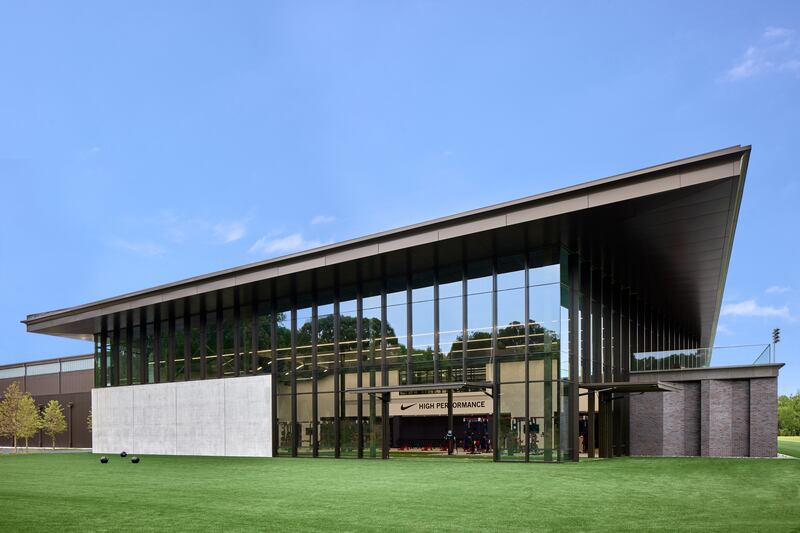
That changed when the $250 million, 200-acre facility opened in May, becoming the sport’s first true home in America. Between 300 and 350 employees, including Norton — the facility’s GM, who joined from a similar role at IMG Academy — now work out of the complex in Fayetteville, Ga.
It represents a hub for everything the USSF does, like training referees and coaches, convening and training the various national teams or raising money for the sport’s growth.
There is some symbolism with the timing of its opening; soccer is ascendant in the U.S., belief in the Men’s National Team is building during the World Cup and the Women’s World Cup is just five years off. In the same way home ownership can indicate adulthood, the National Training Center represents a similar maturation of U.S. Soccer.
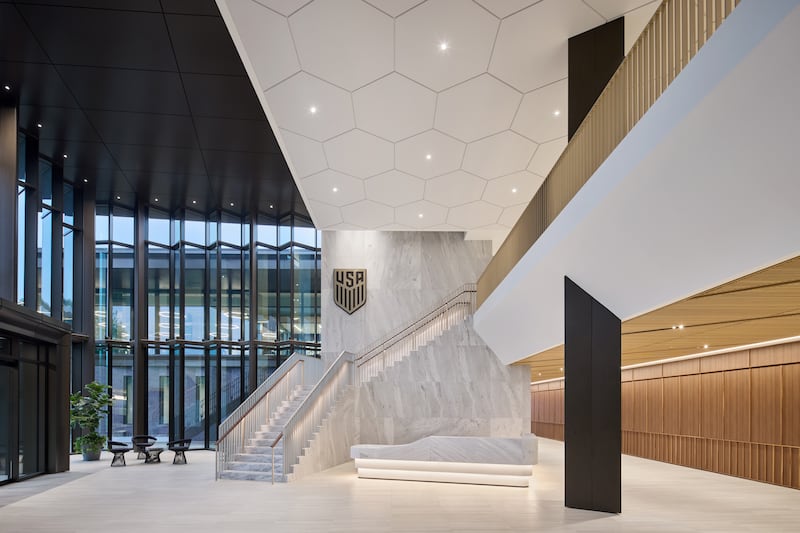
The architecture was modern but somewhat understated, helping the facility blend into its bucolic surroundings. U.S. Soccer worked with the same landscape architects as Augusta National, HGOR. Gensler designed the building, which leans in on wood tones, dark steel and lots of natural light. Everpresent windows offer views of the surrounding training pitches.
“You can see soccer everywhere,” said Norton.
The main building holds several smartly finished hosting spaces where USSF can welcome philanthropic backers and corporate partners (previously, the main option would have been a restaurant in whatever city the meeting was happening in). Impact Development Management managed the project, which was built by Brasfield & Gorrie.
The attention to accessibility was noteworthy. U.S. Soccer has the most national teams (27) in part because of its five teams for players with various disabilities. And the attention to their experience using the campus was evident. A power chair-charging room next to the gymnasium — home to U.S. futsal and power chair soccer teams — features 30 electrical outlets, each with four plugs, a concentration of electrical outlets that’s often difficult for the team to find on the road. The cerebral palsy men’s national team played one of the National Training Center’s first official matches on the full-size indoor field, notable because that match would have otherwise been canceled due to rainy weather. National team camps aren’t very long, and the teams aren’t together that often. Every day they’re together, especially for the amateur players, is valuable.
Sports medicine facilities focus on recovery, not rehab, for the simple reason that injured players are rarely, if ever, called up to national teams (they rehab with their club teams, if they have one). Post-training and match recovery is the priority.
The playing surfaces are immaculate. I visited the National Training Center on a gray, drizzly morning, but several of the 16-member grounds crew were still buzzing around on mowers, including one named Hunter, who made a cameo on a recent “After Hours with James Corden” episode. The expanse of 17 outdoor playing fields sit on either side of the building, with the two competition fields to its right. There are even two beach soccer pitches; apparently, you maintain sand playing surfaces with a good raking, making sure it’s clear of leaves or other debris. (A Lego seems like it could be disastrous?)
Goals, goals, goals ... there are 144 of them at the National Training Center.
U.S. Soccer wants fans to tour the complex. While the National Training Center is only 30 minutes south of Atlanta, it feels like the backwoods. I took the Jeff Foxworthy Highway (lol!) to get there in time for my private tour, which was followed shortly by a paid, public tour. U.S. Soccer hopes it can develop a National Training Center tour business and generate revenue from a campus that’s otherwise not intended to do so. Could they get visitors out to the facility with a tour that included watching the first 10 or 15 minutes of a men’s or women’s national team training session? Soccer fans would traverse the Jeff Foxworthy Highway to see that, for sure.
0 of 9



What do FCC spectrum auctions mean for sports networks?
When it comes to live sports, billions of dollars in rights fees, advertising commitments, carriage agreements and affiliate revenues depend on reliable national distribution. For decades, that distribution has relied on C-band satellite spectrum, the infrastructure that moves live games from venues to networks and out to distributors across the country. For network executives, that transport layer carries just about the entire live sports business, and it’s now under pressure.
The FCC is advancing its auction of additional Upper C-band spectrum, with a ruling widely expected around July. The U.S. government plans to repurpose satellite spectrum used by broadcasters and sell it to wireless carriers for 5G expansion. A similar move in 2021 eliminated roughly 60% of the C-band capacity traditionally used for television distribution, and this next phase could strip away much of what remains. For sports media executives, the issue is supply and certainty. Satellite capacity has offered a stable and predictable way to distribute high-value channels nationally for decades. Planning now protects both.
How sports networks can respond
The most proactive networks are already moving toward hybrid satellite and IP models as an alternative — transporting video over the internet via broadcast-grade transmission technologies — rather than waiting for auction timelines to force the transition. After the 2021 C-band auction, the FCC oversaw a reimbursement program funded by the wireless industry to help satellite customers cover relocation costs. As the agency finalizes plans for this phase, there is active discussion about ensuring any new reimbursement framework is technology-neutral. That would allow networks to fund IP-based solutions that meet live sports performance requirements, rather than being forced into lower-performance alternatives.
While 2027 can sound far away, large networks won’t be able to change distribution paths overnight. Some operate 50 to 200 channels nationally, while others aggregate hundreds of feeds from local stations for digital distribution.
How to tackle the issue of connectivity
One of the most frequent questions from executives is whether IP delivery can match the reliability and reach of satellites, especially in rural and hard-to-serve markets. The concerns are understandable, but the market has moved quickly. There are options for last-mile IP connectivity today, with capacity growing every day. Terrestrial, LEO (low earth satellite) and mobile carriers are all investing heavily throughout North America, which will continue to expand options and decrease costs.
Purpose-built IP video networks operate across every U.S. television market, delivering national, revenue-generating channels daily, with service-level guarantees. Major national brands have relied on IP for international distribution for years, and several regional sports networks have already transitioned primary domestic feeds in response to shrinking C-band capacity. From a fan’s perspective, nothing changes; the game still appears on the same channel at the same time, without the viewer needing to know how the content is being delivered.
Satellite alternatives and the venue shift to IP
As C-band shrinks, Ku-band is often mentioned as an alternative satellite path. Ku-band has applications, but it’s generally more sensitive to weather-related disruption than C-band, often known by broadcasters as “the rain fade problem.” For premium live events, even brief interruptions can have long-term commercial consequences.
Many Ku-band deployments rely on complementary IP backup paths to ensure continuity. Both C-band and Ku-band options remain capacity-bound models, so adding regional feeds, alternate broadcasts or new digital endpoints requires additional fixed satellite resources. IP scales more flexibly for expansion and versioning without securing incremental satellite transponder capacity each time they add a new feed or platform.
While some national networks are taking a phased approach to IP migration, the fastest momentum is being seen at the stadium and venue level. Game feeds that once traveled from venues to origination facilities are increasingly transmitted over managed IP networks. Low-latency IP transport has made this practical and scalable. For sports organizations and venue operators still relying on satellite-only uplinks, securing a dependable, non-satellite path for live game transport is becoming a risk-management decision, and waiting only compresses the timeline.
The upside to declining satellite capacity
When distribution isn’t tied to fixed satellite bandwidth, delivering multiple versions of the same event becomes significantly easier. Networks can support alternate language feeds, team-specific broadcasts, influencer-led watchalongs, and regional versions with local sponsors and market-specific advertising, all from the same core signal.
Instead of treating every market the same, networks can tailor content and sponsorship to different audiences, creating more targeted inventory around high-value events. Regionalization and localization become more achievable, allowing networks to retain greater control over ad revenue and market-specific packaging. As rights costs escalate, that additional control can materially affect revenue performance.
Why sports networks should act now
An IP-first distribution model gives sports networks greater control over how they package, version and monetize live content. It enables faster launch of new channels without requiring scarce satellite capacity. It makes regionalized advertising, alternate feeds, direct-to-digital extensions and FAST distribution operationally simple rather than complex and costly, while reducing long-term exposure to fixed infrastructure costs that don’t scale with audience demand.
As rights fees continue to climb and advertising markets fragment, margin expansion won’t come from doing the same thing more efficiently. It will come from creating more inventory, serving more platforms and responding faster to market opportunities.
Rick Young is senior vice president of global products at media solutions company LTN.
Speed reads
- In his “This week at the World Cup” column, SBJ’s Alex Silverman writes about how the San Francisco Bay Area, which appeared overlooked by FIFA, will have its big World Cup moment with a USMNT game in the knockout round.
- Walmart heir Lukas Walton and his wife, Samantha, acquired a minority stake in the Bulls and the United Center, reports SBJ’s Chris Smith.
- The Big 12 is added Monster Energy as the naming rights sponsor of the league’s 2026 Football Media Days, writes SBJ’s Ben Portnoy.
- The final round of the U.S. Open delivered 5.5 million viewers Sunday afternoon up against the World Cup, as Wyndham Clark won the event for the second time, reports SBJ’s Austin Karp.
- UFC Freedom 250 at the White House reached of 34 million viewers globally, reports SBJ’s Adam Stern from figures it released Friday. UFC says it was one of its most watched events in its history.
- Karp also notes Prime Video wrapped its NASCAR Cup Series slate with the inaugural Anduril 250 from Naval Base Coronado in San Diego, and over six races, Prime Video averaged 2.29 million viewers, which is up 6% from the first year in 2025. For more viewership notes, see Karp’s weekly Audience Analysis.
- Longstanding Paralympics supporter Ottobock signed a sponsorship deal with LA28, making the company the official prosthetics, orthotics and wheelchair service provider of the Games, reports SBJ’s Rachel Axon.
- As the X Games prepares to launch the inaugural summer season of its team-based league this weekend in Sacramento, the organization is positioning the effort as the most significant transformation in its 30-year history, writes SBJ’s Jesse Gordon.