

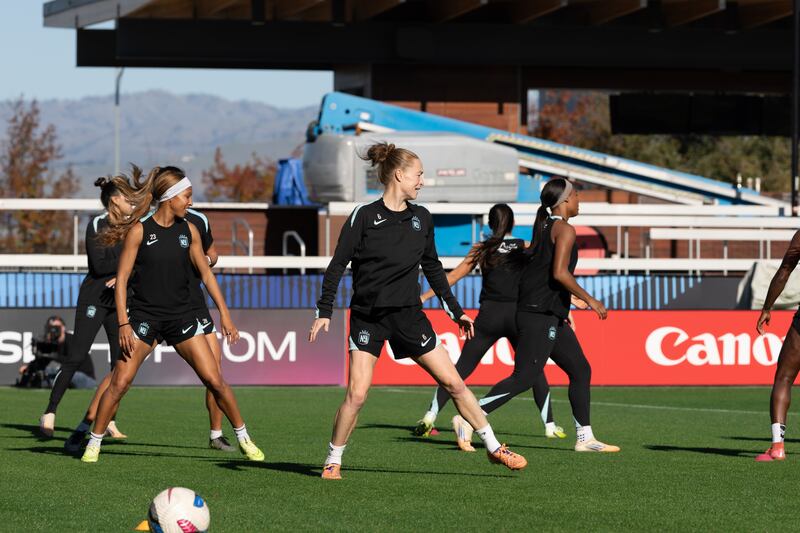
NEW YORK -- The NWSL and its players association have joined Project ACL, the landmark study from FIFPRO, Leeds Beckett Univ. and Nike into the causes of women athletes’ higher incidence of ACL tears.
The Women’s Super League in England was the charter participant into the research, which began in April 2024, meaning the world’s top two women’s soccer leagues are now aligned with the mission.
The three-year program will include a review of research literature, athlete interviews, team performance and medical staffs, data from FIFPRO’s player workload monitoring tool and injury surveillance information from the league. Multiple former players and current stakeholders spoke at the kickoff event, held Wednesday evening at Nike’s N.Y. office.
“What we’ve probably historically done as an injury occurs is we retrospectively look at what influenced that injury,” said Stacey Emmonds, a researcher at Leeds Beckett. “We can start to be more proactive, use the insights to drive system-level change, which therefore makes the ecosystem of the women’s game specific to the needs of female athletes.”
ACL injuries happen more than twice as often in women as in men, with two-thirds of those tears in the women’s game happening in non-contact situations, which are thought to be more preventable. The goal of effecting change will require not only a greater understanding of the mechanisms of injury but also education to team staffs and the athletes to comply with new recommendations.
“Women may be more susceptible, but are there more things that we can do to reduce that susceptibility?” Alex Culvin, FIFPRO director of women’s football, said. “And then also it is really important for us is to just try and be as evidence-informed and distill that information so it’s digestible for players.”
Jordan Angeli, a former NWSL player who tore her left ACL three times in five years, later started the ACL Club as a support group to help athletes preserve through rehab and other challenges they face from the injury. She noted that an ACL injury, which typically requires nine months to a year for a recovery, is not only shortening careers but can be financially detrimental to the athletes.
“We’re going to find ways to keep these players on the field. Therefore, teams are going to compete at a higher level, the game is going to be better and these players are going to thrive,” Angeli said.
Increasing demands
While the NWSL and WSL are widely considered the top women’s leagues, the stakeholders noted a few key differences between the leagues. The NWSL has longer domestic travel, spring-to-fall schedule (for now at least) instead of fall-to-spring, different playing styles, diverging development pathways and a higher average age, mostly attributed to the prevalence of college soccer.
But both leagues are now fully professionalized with robust schedules, and often the athletes are playing in more tournaments and international competitions. Improvements in facilities, training staffs and other resources haven’t yet led to a reduction in ACL injuries.
“Inherently what it causes is demand on the player, and we do not know fully that impact,” said Merritt Mathias, a longtime NWSL player who suffered her own ACL injury. Even though the league and union won’t always align perfectly, she noted the importance of having both as collaborators in Project ACL to protect players, which in turn will help the business grow.
“We are making such incredible strides on the research,” said retired USWNT star Crystal Dunn. “I cannot stress enough that there still is a level of education that needs to be exposed in these markets and for these teams because, with the data collected, you still need to be urging people to use it in the right way.”
Emmonds said there would be a holistic review of the data through causal loop mapping -- in short, it’s a technique that looks at the connection of multiple variables rather than a more straightforward “does A cause B?”
She also emphasized that the research would be done with scientific rigor. The impact of hormonal changes due to the menstrual cycle will be investigated as well, but data from consumer wearables that purport to track it won’t be directly included because they fall short of that high standard of data accuracy.
But this concerted look into the ACL epidemic at the highest level of the sport has a real chance to make an impact.
“Women’s professional soccer across the entire world,” Angeli said, “is going to get better because of this.”