

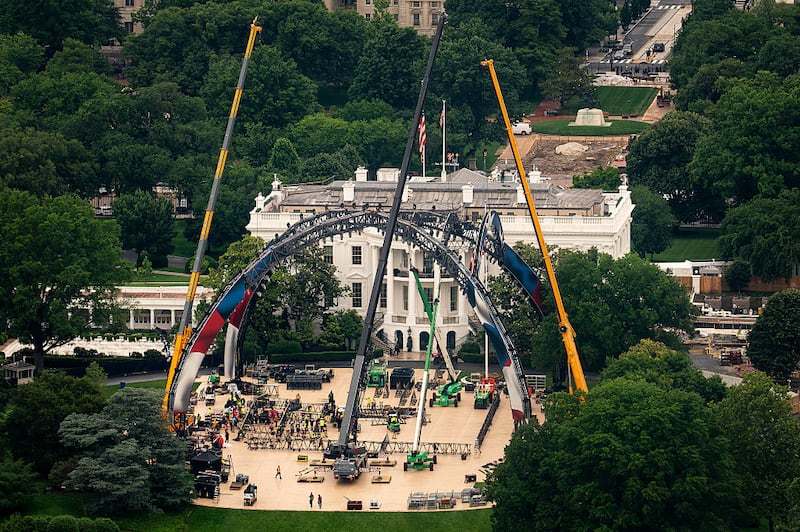
The “claw” overhead structure for the Freedom 250 card that is starting to make mainstream headlines is the product of the UFC trying to find the best way to show fights with unobstructed views of the White House, according to Craig Borsari, UFC’s executive vice president, executive producer and chief content officer.
While construction on the claw started last week, as SBJ previously reported, the structure has started to go viral this week as it rounds more into shape and D.C. media and the White House share images of it. The build-out was the above-the-fold picture on the front page of Wednesday’s Wall Street Journal newspaper with the headline, “White House Lawn Becomes Fighting-Sport Venue.” Combat sports analyst Luke Thomas posted pictures of the claw on Wednesday afternoon, writing: “The arch is enormous. It’s even visible from side streets like 17th. The building crane I could spot all the way back at 5th and Pennsylvania.”
According to Borsari, the claw will be 85 feet tall and 180 feet wide between each leg. It is made fully out of steel and was built by Belgium-based staging events services company Stageco. Borsari previously detailed to SBJ how the South Lawn, where the event will be staged, slopes downward 22 degrees at its steepest point, so UFC is building a 30-foot-high wall to make the main stage area level.
UFC expects to host about 4,300 spectators at the White House, and the card will be broadcast by Paramount Skydance Corp.
‘Final tweaks’
In April, the Lititz Record Express, a small newspaper in Southern Pennsylvania, reported on its Facebook page that Tait Towers, a live-experience expert consultancy that UFC hired for the White House event, had filed a request with the local township to let it build the claw at a facility it owns there to practice for the White House card.
UFC has said it expects to lose $30M on the event, but the exact cost of the claw hasn’t been shared. As for the dry run in Pennsylvania, Borsari said Tait wanted him to come out and see how it was built ahead of time, adding that it was done “for a few reasons.”
“No. 1, [it] was to make sure that we understood how the build would go. We got the timing down on how long it would take to build it out,” Borsari said. “It also was to be sure that the lighting fixtures that we wanted to place inside the claw arms in the trussing were going to be able to be mounted the way we intended, and that they would be able to be moved the way we need them to move, so we did that. ... It was just a really good time for us to get the teams together to look at it, make any final tweaks and then put [the pieces] on the trucks to send them to D.C. to build them for real starting on the 20th.”