

Through its work with sponsors, media partners, host city organizers and even the federal government, FIFA has ensured that the 2026 World Cup is front and center in American life. Yet the most visible sign of the event’s commercial reach may be the black cardboard merchandise displays beside the pharmacy counter at CVS.
By working with licensees that specialize in value-oriented and impulse retail, FIFA has put officially licensed merchandise in thousands of drugstores, convenience stores, supermarkets, airports and transit hubs. The World Cup products available in those locations this summer include hats, shirts, tumblers, keychains, bandanas and pet toys.
FIFA said the program is its largest retail effort ever, with results to date “far exceeding expectations and forecasts.”
To achieve such broad distribution, FIFA has pieced together a layered retail network that assigns specific product categories, sales channels and retail formats to different companies. The governing body said it has at least 100 active licensees in the U.S.
Fanatics operates retail at World Cup stadiums and FIFA Fan Festivals, selling a curated selection of products from Adidas and other FIFA licensees. Legends Global operates FIFAStore.com, which offers a broad selection of tournament- and team-specific products. There are also about 40 official pop-up stores across U.S. and Canadian host cities.
To reach the places Americans frequent as part of their daily lives, FIFA has granted channel-specific rights to companies like In Motion Design, whose headwear and drinkware are available in thousands of convenience stores, pharmacies, supermarkets and value retailers. That has allowed chains such as CVS, Walgreens and 7-Eleven to source World Cup merchandise through suppliers and distributors with which they already do business.
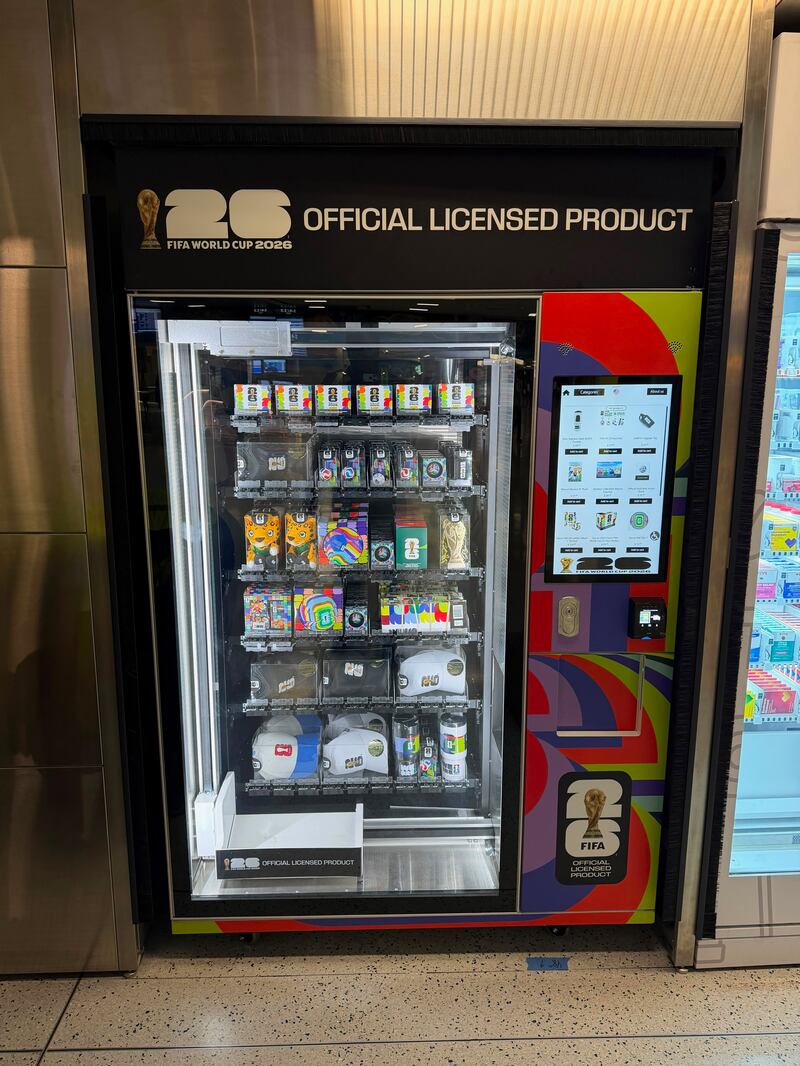
FIFA is also working with automated retail company Prepango to dispense FIFA-branded products from machines in airports, train stations, hotels, shopping centers and other high-traffic locations.
Selling ‘where we specialize’
In Motion Design had never directly held a license for a sports or entertainment property before securing its FIFA World Cup 2026 deal. Instead, the company specialized in developing consumer goods under its own brands for sale through retailers like Kroger and Albertsons. Those brands include Chillmeister headwear, University of Beer Pong ball-and-cup kits and Always and Forever party supplies.
With the World Cup coming to North America, the firm entered FIFA’s bidding process for the right to sell headwear and drinkware through convenience, grocery and drugstores.
“Adidas doesn’t necessarily sell where we specialize — convenience, grocery and drug,” said Nabel Khogyani, vice president of sales for In Motion. “So that’s what opened that door for us and set us apart from them. That was the unlock and that gave us the rights, and then we just went 200%.”
In Motion’s black cardboard floor displays have become ubiquitous across the U.S. this summer, thanks to the company’s established pipeline into some of the country’s largest retailers. FIFA later authorized the company to sell into airport stores and Prepango’s automated retail machines, neither of which was covered by its original license.
In Motion’s products include hats, tumblers, bandanas, squeeze bottles and drink jackets, which carry either general World Cup marks or host city-specific designs. The company said they are available in about 5,500 CVS stores, 4,500 Dollar General locations, 4,000 Walgreens stores, 3,500 7-Eleven locations, hundreds of Albertsons and Kroger stores, airport retailers such as Hudson and numerous regional chains. The four largest retailers alone account for more than 17,500 stores.
Khogyani estimates that In Motion has moved between 2 million and 3 million units of FIFA merchandise, including keychains and pins it distributed for another licensee, Honav USA. It offers its wares in packaged cardboard displays with World Cup marks and an “official licensed product” designation, allowing retailers to easily display product without assembling the assortment themselves or eating into traditional shelf space. In some locations, its products are sold alongside merchandise from other licensees, including Outerstuff apparel, Q-Live hard goods, Ningbo Sincere Holding pet products and Jazwares plush toys.
In Motion’s nimble production capabilities have allowed it to customize offerings for different retailers. After initially designing foam trucker hats with a suggested retail price of $20-$25 and performance hats with a recommended price of $29-$34, Dollar General told the company it wanted a hat it could sell in its stores for under $15 alongside squeeze bottles, koozies and bandanas.
“We just took our trucker hat and we took away a few minor details,” Khogyani said. “On the inside, instead of having this lining with the design, it was blank. Instead of having an extra patch that says, ‘Designed in California,’ we took it out. Then on the front, the graphics that were an embroidered patch were printed instead.”
The firm has also worked with stores to deliver product in a variety of ways to best meet their needs. While a corporate retailer, such as CVS, will order product centrally for thousands of stores, franchises and independent stores may prefer to order through their usual inventory partner, such as McLane or Core-Mark. It has also extensively utilized drop-shipping through FedEx to accommodate last-minute orders.
High traffic, high demand
Licensed sports merchandise is not entirely foreign to convenience stores, supermarkets and pharmacies. Stickers, trading cards, party goods and inexpensive novelties have long appeared in mass retail. What distinguishes FIFA’s 2026 effort is the breadth of the assortment, the consistency of its presentation and the scale of its distribution.
Stu Crystal, a veteran licensing executive who previously led consumer products for MLS, called the rollout “definitely broader than most” and said the store counts described by In Motion would likely make it unprecedented.
“It’s the confluence of the biggest event in the world and a country that looks like this is going to be the tipping point for the sport,” said Crystal, now a general manager at sports licensing company Brevettar.
Along with value retailers, World Cup merchandise is widely available in airports and other transit hubs, reaching international fans traveling in and out of the country. In addition to allowing licensees such as In Motion to sell into travel retailers like Hudson News, FIFA struck an agreement this year enabling Prepango to place automated retail machines in airports, train stations and other high-traffic locations.
The firm said it has deployed more than 50 custom-wrapped World Cup machines, which will be transitioned to other retail concepts following the conclusion of the tournament. Prepango rents the space for its machines in exchange for a percentage of sales revenue. Ian Benson, executive vice president of business development at Prepango, said the World Cup machines have been in high demand from locations, and sales to consumers have beaten expectations.
“We completely ran out of machines,” Benson said. “We had more locations that wanted them that we couldn’t service.”
While an event like the World Cup, with a defined time frame and broad appeal, is particularly conducive to mass-market retail, executives at traditional sports leagues also see opportunity to reach fans in these locations.
Rachel Hoagland, senior vice president of consumer products at MLS, said the league historically has only dabbled in value retail channels due to limited shelf space and the lack of lead time for events like MLS Cup. Given the frequency with which customers shop in convenience, grocery and drugstores, however, she believes a more “always-on” approach could allow the league and its clubs to reach fans where they are.
“As we continue to explore the convenience and supermarket channel as an always-on access and acquisition touchpoint, there’s absolutely a future opportunity to think about how we would show up in the market more thoughtfully,” Hoagland said. “We have the opportunity post-World Cup, with all the attention on the sport, to be more thoughtful in how we are driving discovery for MLS.”
She added that convenience stores “need something that’s turnkey,” pointing to packed, branded displays that can be placed directly on the sales floor.
Brian Jennings, the NHL’s senior executive vice president and chief partnerships and club strategy officer, similarly described high-traffic retail as a way of “fishing where the fish are,” but he acknowledged that evergreen properties like the NHL must be more cautious about oversaturation, conflicts with established retailers and the creation of what Jennings called a “sea of sameness” in which identical products compete primarily on price. Still, he said the NHL could apply lessons from FIFA’s rollout to the 2028 World Cup of Hockey.
FIFA is already extending at least one element of the strategy beyond this summer. Khogyani said In Motion has renewed its license to sell merchandise through the same U.S. retail channels for the 2027 Women’s World Cup in Brazil. The firm is also in discussions with U.S. Soccer following a recommendation from CVS, which became a sponsor of the federation this year.
Khogyani expects retailers that approached this year’s tournament cautiously to order more aggressively next summer after seeing how World Cup products have performed.
“Many retailers may have been conservative with the World Cup,” Khogyani said. “I think people are going to go aggressive on the Women’s World Cup.”
===
More from Sports Business Journal
- Is the NHL’s decentralized draft here to stay?
- All eyes on Serena Williams as she makes her comeback at Wimbledon this week
- SNY’s signature Kidcaster program has served as career launchpad
===
Start your day with SBJ Morning Buzzcast, bringing you the hottest stories in sports business every morning in under 15 minutes. Sign up for SBJ’s free newsletters, and dive deeper inside the industry with all the latest sports business news here.