


The lines separating traditional state-licensed sportsbooks from federally regulated prediction markets have blurred to the point that they’re indistinguishable.
We had questions. We bet you do, too.
What are these things?
The now-common sports betting workaround first popularized last year by Kalshi and online broker Robinhood is based on event contracts — financial derivatives that allow commodities investors to hedge against risks such as a drought that wipes out crops, or an OPEC decision that affects global oil prices. Regulated by the Commodity Futures Trading Commission, they allow investors to take a yes-or-no position on whether something will occur. If it does, those who chose “yes” collect, while those who took “no” lose their investment. Prices fluctuate based on the perceived likelihood of something occurring.
Though allowed since 2004, the contracts didn’t crack the retail investor zeitgeist until 2020, when Polymarket began offering unregistered markets on the Centers for Disease Control and Prevention’s count of COVID-19 cases. Kalshi secured a CFTC license in 2021, initially offering markets on politics, economics and entertainment before stumbling into a tsunami of sports betting ahead of the Super Bowl in 2025. That led to point spreads, which led to props, which led to parlays — and the frenzied entry of a host of online sportsbooks and pick-’em apps now vying for a crack at the 40% of U.S. adults who reside in states that haven’t legalized sports betting.
Though there’s debate around the mechanics behind them and laws around them, prediction markets look identical to a sportsbook to most consumers.
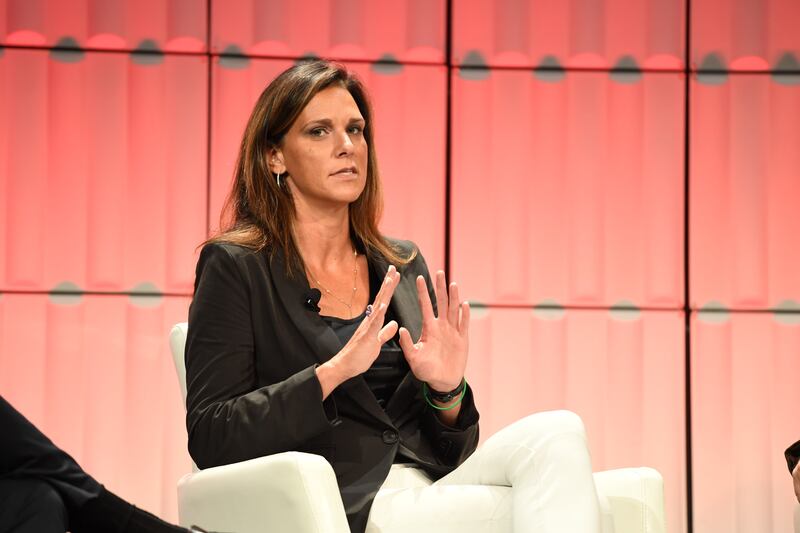
“There’s so much that is so far off base; that this is just the wild, wild west and we have no oversight, no regulation and it’s a free-for-all. It’s just not that way at all.”
— Sara Slane, Kalshi head of corporate development
How do they work?
On the screen of a mobile device? Pretty much the same as DraftKings and FanDuel. But the back of the house differs dramatically.
A sports prediction market is created when an exchange such as Kalshi’s notifies the CFTC that it intends to list an event contract on the outcome of a game or occurrence within a game — for example, whether the Knicks will win or Jalen Brunson will score more than 26 points. Unlike state-regulated sportsbooks, which must get new bet types approved before offering them, exchanges “self-certify” that the contracts meet CFTC guidelines.
There has not been a reported instance of the CFTC blocking or pulling a sports-related contract. But CFTC Chairman Michael Selig has conceded that today’s event contracts likely require more nuanced regulation than their predecessors. He set expectations for what that might look like in March, when the CFTC advised exchanges to confer with the leagues when determining whether a market was “readily susceptible to manipulation.” Earlier this month, the CFTC issued a rules proposal that set up a “public interest” review process that could place restrictions around contracts resolved on “gaming” — aka sports betting — banning bets on officiating and injuries, for example. But it also made it clear that it favored broad acceptance of common point spread, over-under and player prop wagers.
Once an exchange lists a contract, it opens it to market makers; trading firms, such as Susquehanna International Group, which agree to supply the underlying liquidity that allows brokers to fill orders on both sides. Prices rise and fall based on market sentiment. Each contract resolves at $1, meaning those who buy 100 contracts on the correct side are paid $100 if they hold it until the end, while those on the wrong side who hold until the end lose their entire stake. Buyers can attempt to exit at any point to lock in profits or stem losses, paying fees on each trade. The difference between a buy and sell price, or “spread,” is kept by the market maker, which sometimes assumes risk by taking its own position. Those who blanch at Kalshi and Polymarket’s claims that there is no “house” point to sophisticated market makers such as Susquehanna and the many sportsbooks likely to act as market makers as evidence to the contrary.
The manner in which most predictions operators list prices further blurs the line between a contract and a bet. Rather than picking a side based on a 56-cent or 44-cent price commonly listed on exchanges, bettors can set their Kalshi, Polymarket or DraftKings apps to convert those to sportsbook style odds of -127 or +127. That pricing almost always aligns with the prevailing odds at sportsbooks.

“We were given specific authority to review these products and discretion to reject them in certain cases and we’re going to use that authority. And we’re going to put out really clear standards for how we’re going to evaluate the products going forward. We believe that’s how those markets should be regulated and we’ll do so as soon as these rules get finalized.”
— Michael Selig, CFTC chairman
Who’s in?
Who isn’t? Kalshi dominates with an estimated 90% share of U.S. sports prediction market volume. About 20% of that comes through Robinhood, the everyman online retail broker, which launched its own Rothera exchange this month in partnership with Susquehanna. Already popular globally, Polymarket is in the early stages of rolling out its sports offering to U.S. consumers. Crypto.com offers sports contracts directly and as the primary sports predictions exchange used by sportsbooks FanDuel and Fanatics.
Among the traditional online sportsbooks, DraftKings has been the most aggressive early mover, hiring former fintech executive Jeanine Hightower-Sellitto ahead of the March rollout of a rebuilt “super” app that offers users either sportsbooks or predictions, depending on where they are when they log in. It reported about $250 million in predictions volume in May. DraftKings and FanDuel plan to spend more than $200 million pushing their new prediction offerings in the fall. None of the sportsbooks offers predictions in legalized states other than Florida, where many now will compete with Hard Rock, the only state-licensed sportsbook.
Notably absent from the sportsbook rush are BetMGM and Caesars, which thus far have opted to sit out predictions in deference to the many state gambling regulators fighting Kalshi and the CFTC in court.
The player pick-‘em contest operators — Underdog, PrizePicks and Sleeper — are all in. Like Kalshi, those apps have been especially popular in states that haven’t legalized sports betting, and with 18- to 20-year-olds in the many states that set the legal betting age at 21.
The list continues to grow, in large part because the barrier to entry is far lower than for state-regulated sportsbooks, which often pay seven-figure licensing fees and are taxed at upward of 20%.
Some say they plan to graduate to operate their own exchanges, as Kalshi and Polymarket do. DraftKings has begun integrating Railbird, a CFTC-regulated exchange it acquired in October. Underdog purchased the Aristotle Exchange in March.

“Similar to sportsbooks, we have a right to win in this space. We have a right to win because we know the sports audience and have the sports audience. We understand the sports product better than anyone.”
— Paul Liberman, DraftKings co-founder and president of operations
How much money are we talking about?
Before we get there, it’s important to understand the difference between sportsbook handle and prediction market volume. Prediction volume counts both the buy and sell sides of a trade, so what looks like a $100 bet is at least $200 in volume. Because traders — aka bettors — frequently move in and out of positions, that volume on a single market can multiply over the course of an event. In the case of a four-day golf tournament, the monthlong NCAA basketball tournament and the World Cup, the inflation can be significant.
That said, Kalshi is doing whopping business, especially around big events — about $1.8 billion on March Madness, more than $600 million on the Super Bowl and more than $500 million on the Masters. Through May, its sports volume for the year eclipsed $40 billion.
Kalshi would have been the No. 4 sportsbook in the U.S. in March, according to gambling research firm Eilers & Krejcik, which developed a model to convert volume to estimated handle. That would have put it on par with BetMGM for the month, behind DraftKings, FanDuel and Fanatics.
Bank of America analysts estimated that sports-related volume could exceed $1 trillion annually, throwing off about $10 billion a year for operators. They projected $100 billion in volume from sports this year.
“We can argue about how big it is. We can argue about how big it’s going to get. I don’t think we’re really having an argument anymore about whether it has crossed that threshold of big. And that’s important.”
— Chris Grove, partner at gambling research and consulting firm Eilers & Krejcik
How do others in sports make money from this?
As with legalized sports betting, the leagues get a chance to open a new sponsorship category. The NHL signed deals naming Kalshi and Polymarket as its official prediction markets in October. MLB struck an exclusive deal with Polymarket in March. MLS and the UFC also have Polymarket deals.
As part of its MLB deal, Polymarket agreed to buy official league data from Sportradar, a boilerplate item in the authorized operator agreements that most of the leagues created around sports betting. Sportradar recently announced a deal to provide official data feeds from MLB, the NHL, MLS and UFC to Kalshi. An authorized operator designation for predictions operators could be another incremental revenue source for MLB, the NBA and NFL, which require sportsbooks to hold — and pay for — that designation to advertise during game broadcasts and sponsor teams.
A cluster of teams that were left out of the sports betting sponsorship windfall also could see substantial paydays if the leagues allow them to sell the predictions category. Thirty-one teams in the NFL, NBA and MLB play in states that haven’t legalized sports betting, precluding them from making deals that often sold for seven figures annually when states opened. The marquee Dallas Cowboys, Los Angeles Lakers and Dodgers could be among the teams with spots up for bid if the category were to open in the NFL, MLB and NBA.
While making more money from more betting and a resulting bump in viewership is one goal, the leagues also hope to have a say in what sort of contracts can be offered. MLB and the NHL have signed agreements to work with the CFTC on regulation of sports-related predictions. The CFTC has said it hopes to strike similar agreements with more leagues and governing bodies.

“Partnering with professional sports leagues is really important to lend legitimacy to the category.”
— Ari Borod, president of sports business development, Polymarket
What’s the outlook for these remaining legal?
Nobody knows. Worse yet, there’s not even a prevailing theory. More than 20 states have argued in lawsuits and cease-and-desist orders that prediction markets constitute gambling and, like other forms of gambling, should be subject to state regulation where permitted and banned where not. That stance has been supported in court filings by attorneys general in at least 38 states.
Kalshi and the CFTC argue that the contracts are a commodities derivative, falling under the federal agency’s exclusive jurisdiction, which “pre-empts” state regulation. Each side has notched conflicting wins in federal and state courts, making the dispute a likely candidate for eventual Supreme Court consideration. That could be derailed if Congress were to act, as suggested by recent hearings and proposed legislation. But even a bipartisan bill isn’t likely to get past the president, who has supported CFTC lawsuits against seven of the states that have tried to block or regulate prediction platforms.
Among the cases to watch are a 3rd U.S. Circuit Court of Appeals opinion that went Kalshi’s way on the matter of pre-emption in New Jersey, denying the state’s attempt at an injunction, and a soon-to-come 9th Circuit ruling on similar grounds in Nevada. That split alone could be enough for the Supreme Court. But there also are interesting cases that criminalized Kalshi’s business in Arizona and Minnesota, making it a felony in the latter.
Analysts say the matter could make its way to the Supreme Court next year, or even late this year if the lower court judgments accelerate and appellate rulings are divided.
If the court decides narrowly around the pre-emption question of whether the CFTC has the authority to define the markets it regulates, Kalshi likely will prevail. If it looks more broadly at whether this is gambling, it almost certainly will lose.

“In the period of time that it takes those legal issues to get resolved in a definitive way, it’s incumbent on us to do everything we can to protect the integrity of the sport. It’s not going to stop immediately even if the states win in all the litigation.”
— Rob Manfred, commissioner of Major League Baseball