

Tonight in Unpacks: On the heels of a standout campaign, the NHL enters the summer preparing for a new CBA to take effect, a larger schedule next season and a rising salary cap that will have ripple effects beyond 2026, reports SBJ’s Alex Silverman.
Also tonight:
- Why Adidas, Nike, Puma designed pink World Cup cleats
- Lift Management emerges as NBA Draft winner
- An audience everyone wants
- Op-ed: F1’s real asset isn’t speed — it’s IP
Listen to SBJ’s most popular podcast, Morning Buzzcast, where Abe Madkour discusses the NHL’s expansion plans for Texas, a boutique agency cleaning up at the NBA Draft, radical changes happening for the PGA Tour and more.
NHL enters transitional offseason

The Carolina Hurricanes’ long-awaited Stanley Cup victory capped a record-setting season for the NHL, which Commissioner Gary Bettman said is expected to generate between $7.5 billion and $8 billion in revenue.
The victory ushers in a pivotal offseason that will culminate in a new collective-bargaining agreement taking effect and the regular-season schedule expanding by two games.
Here’s what you need to know heading into the break:
• Two more games: The NHL will adopt an 84-game regular-season schedule in 2026-27, an increase of two from the 82-game format that had been in place since 1995-96. The shift ensures a balanced schedule in which each team plays all its divisional opponents four times. The start of the regular season is expected to be moved up to late September. The change means one more home date per season for each of the league’s 32 teams to monetize, replacing less valuable preseason inventory.
• New CBA: The collective-bargaining agreement ratified by the NHL and NHL Players’ Association last summer will fully take effect on Sept. 16. While the changes are modest compared to prior deals, the CBA will usher in a new revenue-sharing system likely to benefit mid-tier revenue-generating teams. This summer also will provide the final window for eight-year player contract extensions. Beginning Sept. 16, maximum terms will be reduced by one year to seven years for players re-signing with their teams and six for players signing with a new team.
• Tip of the cap: The upper limit of the NHL salary cap will increase by another $8.5 million per team to $104 million, while the lower limit will rise to $76.9 million. With the cap rising by at least $7.5 million for a second-straight year and projected to climb another $9.5 million in 2027-28, there is potential for a larger gap between team payrolls than the NHL saw during the flat-cap era, when most clubs spent to the upper limit. The Hurricanes’ championship run, which came despite the club carrying more than $8 million in unused cap space, offers owners a fresh case study showing it is possible to win without spending to the limit.
• Canadian media: The NHL’s new 12-year Canadian media rights agreement with Rogers Communications takes effect in 2026-27, more than doubling the league’s average annual haul to C$917 million per season, or about US$655 million. The NHL and Rogers are still jointly negotiating a sublicensing deal for French-language rights, which will likely provide additional media rights revenue. The league’s U.S. deals with ESPN and TNT Sports run through 2027-28, with renewal negotiation windows opening in 2027.
• Local media: As part of a major restructuring, the NHL intends to produce and distribute local telecasts for an undetermined number of clubs beginning next season, following a model pioneered by MLB. The move follows the wind-down of regional sports networks owned by Main Street Sports, which has left several teams without an in-market home for their games. The Hurricanes are among the teams that have yet to announce their broadcast plans for next season, along with the St. Louis Blues, Minnesota Wild and Columbus Blue Jackets, making them the most likely candidates to work with the league.
Editor’s Note: This story has been revised from the print edition to clarify that the NHL and Rogers are negotiating a sublicensing agreement for French-language rights, rather than an entirely separate agreement.
Why Adidas, Nike, Puma all designed pink World Cup cleats – and how they differentiate their similarly colored products

The Brazilian yellow and Moroccan red soccer kits typically offer a striking color splash against the green pitch, but their vibrancy was muted during the countries’ group stage match to the bright pink on the players’ feet.
At one point during the second half, 17 of the 22 players were all wearing pink soccer cleats interjecting 34 splashes of neon-tinted fuchsia onto the field of play. Similar adoption has been seen across the World Cup.
This isn’t just one model of footwear dominating the sport, either, but the independent choices of its three biggest apparel providers -- Adidas, Nike and Puma -- all opting for similar hues during the same tournament.
All three brands noted that design cycles for these elite-level products are typically around two years, meaning this shared fashion perspective is a coincidence dating back to roughly 2024 for the cleats, or boots, as most of the world calls them.
“Pink works on a football pitch in a way few colors do,” said Dominique Gathier, VP/Teamsport at Puma. “It reads immediately against green, photographs brilliantly, and carries a cultural energy right now: confidence, self-expression, personality. Players at this level want to be seen.”
Gathier added that, for Puma, pink is part of a broader “unified brand moment” spanning running, basketball and golf launches from earlier in 2026. He noted that the color is more a heritage than a trend, citing the 2014 Tricks model that packaged one electric blue shoe with a pink one. Nike echoed a similar theme, pointing back to its 1998 R9 Mercurial cleat that first broke the tradition of the black boot and said the modern Mercurial is created to enhance the athlete’s speed and mimic the faster, more intense game play and cultural identity.
“The athlete should understand what the boot is built to do without explanation,” said Odinga Nimako, Director of Global Football Footwear at Nike. “That extends to color. Hyper Pink signals energy and speed. It is visible, it is immediate, and it matches the intent of the product.”
Nicolas Roche, Adidas Category Director for Football, added that “pink sits at the intersection of visibility, energy and self-expression,” while noting it combines a feeling of being both premium and performance-driven.
Reuters tracked the footwear worn by the starting 11 for all 48 World Cup participants and determined that Nike was most popular with 232 players, followed closely by Adidas at 218 and Puma in third with 44; all other brands combined for just 34. In other words, 94% of athletes are wearing boots from the three top brands, all of whom chose the same primary colorway.
Not all players have the same palette, of course -- Adidas made Lionel Messi custom shoes in Argentine colors -- but the product differentiation becomes a bit more challenging when competitors have a shared sensibility.
All three brands, of course, emphasized that color is but one factor in marketing and storytelling to a consumer audience. Product innovation and brand ambassadors play a role, too.
Some of Nike’s biggest names are superstars Kylian Mbappé from France, Cristiano Ronaldo from Portugal and Vini Jr. from Brazil. In addition to Messi, Adidas has Spain’s Lamine Yamal, Germany’s Florian Wirtz and France’s Ousmane Dembele. Puma is represented by the biggest U.S. star, Christian Pulisic, as well as Portugal’s Diogo Dalot and the Netherlands’ Cody Gakpo.
For the first time since 2018, Nike’s two sub-brands are fundamentally different: “Two distinct tools for two distinct kinds of speed,” Nimako said. Vapor borrows its form and function from sprint spikes for the player operating in tight spaces with quick feet, short bursts, he added, while the Superfly uses the same ZoomX foam found in marathon super-shoes.
Nimako made the point that its color and innovation are intertwined, choosing to be intentional in applying “the brightest colors to areas of our key technologies with an intense amount of depth.” The Superfly shoe has a white heel accentuating the pink covering the front 3/4 of the shoe to signify its speed; the Vapor has a vertical color fade, from pink on top to white below to suggest weightlessness.
The Adidas F50 Hyperfast Evo is its lightest World Cup model yet and was revealed just after Adidas fitted the first two marathoners to break the two-hour mark with 97-gram (3.4-ounce) shoes, while the soccer cousin weighs 130 grams (4.6 ounces). Its F50 Elite product line, with both laced and lace-less options, is only slightly heavier while adding what Roche described as an “a precision-grip coating” to help a player’s touch on the ball.
Gathier highlighted Puma’s three offerings by noting that the Future 9 is designed for playmakers, the Ultra 6 is built for speed and the King 20, the brand’s flagship, is an all-around offering with a soft TotalTouch+ upper.
Lift Management emerges as NBA Draft winner with five first-round selections
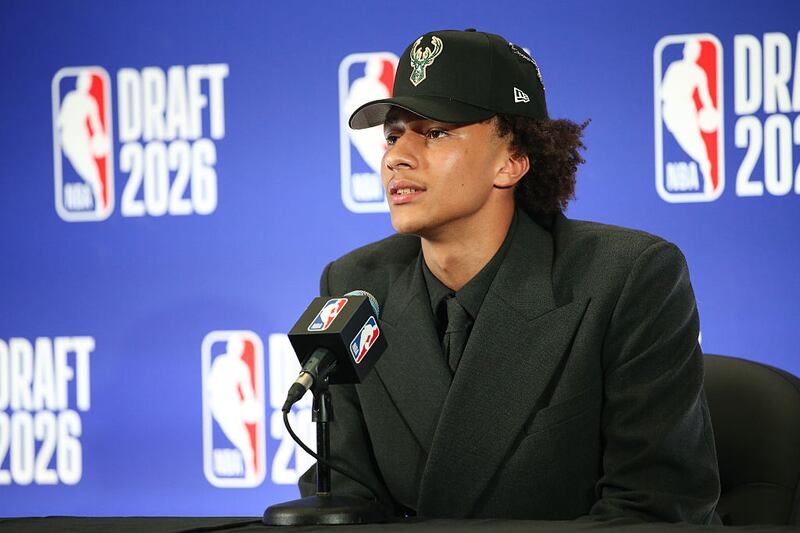
In a notable upset for the talent representation world, boutique firm Lift Management rose above Hollywood titans and some of the industry’s most established agencies on Tuesday night. Lift led all firms with five first-round picks in the NBA Draft -- Tennessee F Nate Ament, Stanford G Ebuka Okorie, Kentucky C Jayden Quaintance, Alabama G Labaron Philon Jr. and Iowa State F Joshua Jefferson -- giving the N.Y.-based agency more selections than any of its larger rivals.
The agency, founded in 2020 by former NBAer Mike Miller and retired overseas pro Donnie McGrath, headed into the night looking to capitalize off what McGrath believed to be its strongest and deepest draft class yet. The agency’s rise makes this year’s haul even more striking given its relatively modest draft history. Since its founding, Lift has produced just five first-round picks, including Magic F Paolo Banchero, Pistons G Wendell Moore, former NBAer R.J. Hampton, Pelicans G Jeremiah Fears and Bulls F Noa Essengue.
Early on, though, Lift was largely watching as its rivals populated the top of the board. Klutch Sports was the only agency to land two picks in the top 10, with North Carolina F Caleb Wilson and Arizona G Brayden Burries going fourth and 10th, respectively, both represented by Rich Paul and Lucas Newton. Within the top 15, Klutch, Excel, WME Basketball and CAA were the only agencies to have more than one pick.
Klutch finished the night tied for third with Excel at three first-rounders apiece. Excel’s class was spread across a wide swath of agents, with Jeff Schwartz, Mike Lindeman, Jared Mucha and Michael Tellem -- son of longtime executive Arn Tellem -- each responsible for at least one draftee.
Last year’s winners, CAA and Wasserman (now known as The Team), each had different stories. CAA continued its strong showing through professional drafts, tying with WME for second place with four selections. However, The Team had its weakest showing since 2022, representing only one round-one pick.
BYU F AJ Dybantsa continued a recent trend among No. 1 overall selections in pro sports by opting to go without traditional representation. In the NFL, Bears QB Caleb Williams and Titans QB Cam Ward took similar paths in 2024 and 2025, respectively. Dybantsa is the first recent No. 1 pick in the NBA to do so, though he is hardly operating alone: His father, Anicet “Ace” Dybantsa, and veteran executive Leonard Armato are expected to help guide his long-term business.
Houston G Kingston Flemings’ selection at eighth also marked a milestone, as he became the first NBA lottery pick represented by a women-owned agency in Primera Sports.
Klutch’s Paul and Newton and CAA’s Aaron Mintz and Maxwell Saidman all tied for first place among individual agents to represent the most round one clients with three each. In total, 14 different agencies represented at least one client in the first round.
LA28 and its huge women’s sports opportunity

If you asked me to draw a Venn diagram of what works in marketing in women’s sports and what works in marketing in the Olympics and Paralympics, it would nearly be a circle.
- Compelling storytelling ✅
- Athletes largely without significant financial support ✅
- Massive cultural relevance and brand lift ✅
Now, those are not exclusive to both of those spaces. But I do think they’re part of why both resonate so much.
I was reminded of that in reporting my “Buying the Games” story on sponsors looking to get in around LA28. (Not of the Venn variety, but we have a diagram that is 😍.)
The Games coming to the U.S. for the first time in more than 30 years is a massive brand opportunity. But come with me as I show you why it’s a massive women’s sports opportunity.
Numbers don’t lie
Yes, the Games “are” a co-ed event. Men will compete, sometimes even alongside women.
But all the numbers line up for women to shine. It’s the first time women will receive more than half the quota spots in the Games, making up 50.5% of Olympic participants in LA28. That’s due, in part, to expanding the soccer tournament to have more women’s teams than men’s — a lift both in opportunity and in a country where the women’s game is already more popular than the men’s.
That’s in part due to success, another place we should check receipts. If you’re a U.S. brand, betting on the U.S. women overall is a safe one.
The U.S. women have brought home more medals than the men in every Summer Olympics going back to London in 2012. You have to go back to Athens (in 2004!) for the last time the men brought home more medals.
“Sport is the vehicle. It’s not the output for me,” said Laura Correnti, founder and CEO of Deep Blue Sports + Entertainment. “If you’re a brand who’s invested in the women’s sports space on the biggest stage in our backyard, what a tremendous miss to not participate in that.”
Building on women’s sports strategies
Getting into the Games is complex but not impossible, and there are myriad options for brands already sponsoring in women’s sports to get in.
Critically, they can use some of the same skills and approaches. Already we know consumers trust women athletes more. And like athletes in other women’s sports, Olympians and Paralympians bring depth and connection to sponsorships that set them apart.
“My expectation, and we’re seeing this already, is that brands are now looking to align with athletes in their journey to the Games, which then in turn leads to that sort of being this women’s sports moment for them,” said Alana Casner, chief operating and athlete officer at Parity. “It’s not really a hard sell. I think more brands just have to realize it’s possible.”
Some of the opportunities are clear, especially in categories that haven’t traditionally sponsored around the Games. To take one example, rugby star Ilona Maher competed in the Tokyo Games and got asked what lipstick she wore that was not transferring as she tackled opponents.
She shared it online, told Maybelline that it should sponsor her, and the brand did. (FWIW, I bought it in two colors, and it really does stay.)
“We keep talking about women’s sports marketing, who are the brands who have never been in sports, have never used female athletes, how there’s a massive opportunity for the ones who do it right,” said Cosette Chaput, co-founder of Always Alpha.
“Is it beauty? Is it makeup? Is it fashion? Let’s take track and field - top eyeballs, top stories. We know that’s always the upper echelon of the Games. These women are competing in a full face of makeup.”
An audience in demand
The build-up has appeal to an Olympic audience that, at least domestically, has historically skewed more female. During the Paris Games, women accounted for 55% of NBC’s audience.
That’s valuable from brands sponsoring at the highest level in the movement to those doing much smaller national governing body or athlete deals.
Circe Wallace, EVP of action and adventure sports, women’s sports and Olympic sports at The Team, said she expects brands with deals in the Olympic movement to find where their “women-forward stories” are and invest accordingly. But sponsors don’t need to be in that ecosystem and still have opportunities to find their women’s sports moment through deals with the athletes themselves.
“For those brand marketers who are willing to get creative and play between the margins, I think there’ll be those little moments with breakout stories or really interesting highlights,” she said.
F1’s real asset isn’t speed — it’s intellectual property
Formula 1 is among the most technologically advanced sports in the world. It is also, structurally, an intellectual property (IP) business. Its commercial architecture has the power to transform a city, as the recent Miami Grand Prix demonstrated, with its impact continuing to reverberate across South Florida weeks after the race concluded.
Strip away the cars and the circuits and what remains is a portfolio. A deep bench of active trademarks across the sport, the teams, and the drivers. A global licensing operation that monetizes nearly every commercial surface. Sponsorship inventory priced with surgical precision. And almost no patent activity at the core: Formula One Licensing B.V., the entity that controls the F1 mark, holds no patents of record. That structure is deliberate. In F1, the technology is downstream. The IP is the product.
First, the regulatory architecture of Formula 1 makes patenting counterproductive. A patented competitive advantage can be reviewed and engineered out through Fédération Internationale de l’Automobile (FIA) technical regulations, as early as the following season — neutralizing the very edge the patent was meant to protect.
Second, patent protection requires public disclosure. In a sport where engineering margins are measured in thousandths of a second, disclosure operates as a roadmap for competitors. Trade secret protection aligns far better with the competitive dynamics of the paddock.
Third, the pace of innovation in F1 outruns the pace of patent prosecution. By the time a patent issues, the underlying technology may already be obsolete or affected by regulatory change.
What Miami witnessed is the F1 model in operation. Over a grand prix weekend at the Hard Rock Stadium complex, the entire IP structure of the sport was on display. Formula One Licensing B.V. and its affiliates control the F1 name and the global broadcast rights — the rights that delivered millions of viewers to a venue most of them hadn’t heard of three years ago. The track operator licenses the race designation and runs its own brand operation alongside it. Sponsors buy specific commercial real estate on cars, suits, helmets, and signage, each piece negotiated independently. Each of the 10 constructor teams operates its own trademark portfolio, livery, and merchandise program. And every driver sits on top of it all: a brand business stacked on a brand business.
Five layers of IP. One race weekend. None of it accidental.
The driver layer is where this model resonates most for the broader sports business. A modern F1 driver is not simply an athlete. He is an IP and licensing platform. The contrast among current drivers is instructive.
Lewis Hamilton operates the most developed driver-IP structure in the sport. His holding company controls more than 100 trademark registrations across nearly every commercial category that matters — clothing, cosmetics, jewelry, entertainment, film, financial services, his charitable foundation, and his personal venture entity. His name. His signature. His racing number, registered in multiple configurations. Even his catchphrases. The coverage extends across dozens of jurisdictions. The result is a brand business with a Formula 1 driver at the center, rather than a Formula 1 driver with a brand attached. Whatever happens to his racing career, the underlying asset endures.
Max Verstappen has registered the fundamentals. His name in major markets, his logo, the core merchandise classes. Defensive coverage rather than expansive, but well ahead of what most professional athletes hold anywhere in the world.
Andrea Kimi Antonelli, who won the Miami Grand Prix, appears to hold no trademark registrations in his name at this time — not in the United States, not in the European Union, not in any jurisdiction a public search reaches. He is 19 years old. The commercial value of his name and image is being captured by the teams and partners around him.
The gap between Hamilton’s portfolio and Antonelli’s is the story of how modern sports value gets built — or doesn’t. It is not a function of talent or trajectory. It is a function of who started the protective work, and when.
The implications extend well beyond Formula 1. The American sports landscape is full of athletes operating from the Antonelli position — professional athletes whose team contracts bundle rights of publicity without meaningful carve-outs, college athletes building NIL brands reactively after the first offer arrives, agents treating trademark protection as something to address once revenue materializes. By that point, much of the brand value has already been captured by parties who moved earlier.
The athletes who will hold genuine leverage over the next decade are the ones who treat their IP the way Formula 1 treats its IP: as the asset, not the afterthought. Brand frame first. Trademarks early. Licensing structures in place before deals surface. Image rights carved out, not absorbed. The work is protective and proactive, or it isn’t worth doing.
So what is Formula 1 actually selling? Not the race. The rights to it.
The IP infrastructure that makes the Formula 1 season possible will continue rolling from city to city, transforming venues into global commercial platforms along the way. The question for every athlete, agent, and sports business watching is whether they treat it as entertainment — or as a model. Because in Formula 1, the next race, the next market, and the next licensing opportunity are already underway.
Janet F. Moreira, Esq. is a board-certified intellectual property attorney and partner at Caldera Law, where she represents athletes, brands, and creators on trademarks, NIL, and licensing. Geraldine Orlando is a patent attorney and associate at Caldera Law.
Speed reads
- Olympic athletes will now be able to receive money for their participation in the Games, one of several reforms approved by IOC members at their session in Switzerland on Wednesday, reports SBJ’s Rachel Axon.
- The Cardinals elevated Bill DeWitt III to CEO and Anuk Karunaratne to president of business operations, with DeWitt III overseeing both baseball and business operations, writes SBJ’s Mike Mazzeo.
- Arkansas’ two-year journey toward a new naming-rights sponsor for its football stadium wraps up with a 13-year deal with CommunityAmerica Credit Union beginning in 2027, reports SBJ’s Ben Portnoy.
- The Greater Williamsburg Sports & Events Center in Virginia held a ribbon-cutting Wednesday. The $80 million, 200,000-square-foot can be configured to hold 12 basketball courts, 24 volleyball courts, 36 pickleball courts, one full-sized football field or three indoor soccer fields, writes SBJ’s David Broughton.
- The group of top tennis players lobbying for a greater share of Grand Slam revenue in prize money will continue their public push during Wimbledon, reports SBJ’s Rob Schaefer.
- Mexico-South Korea in the World Cup group stage Thursday put up NFL-level numbers across English and Spanish broadcasts, but for Telemundo, the superlatives attached to the match come amid heightened scrutiny for NBC’s internal streaming measurement after a correction was needed for early numbers, notes SBJ’s Austin Karp.
- Mobile TV Group — which was the production backbone for all of Main Street’s FanDuel Sports Network broadcasts — announced a full-stack, turnkey platform Wednesday that it can offer directly to teams, which SBJ’s Tom Friend notes might be of interest to the 11 NBA refugees of Main Street still in need of local TV solutions for next season.