
Geena Davis and Susan Sarandon’s titular characters offered each other a subtle glance and a smirk before speeding their 1966 Ford Thunderbird over the ledge of the Grand Canyon as the classic crime drama “Thelma and Louise” faded to black.
The horde of law enforcement on their tails could only watch in awe.
College sports — at least in former Alabama football coach Nick Saban’s mind — may well be heading for a similarly dramatic end without congressional action.
“If you had the biggest, baddest Ferrari that you could ever have, and it was going 150 miles per hour toward the Grand Canyon, someone needs to tap the brakes,” Saban said on Wednesday. “That’s what we all need to do here.”
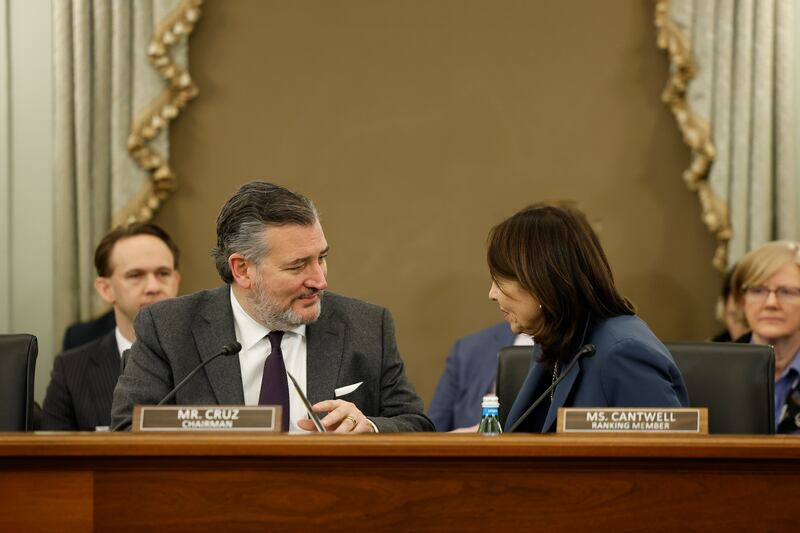
The Protect College Sports Act authored by Sen. Maria Cantwell (D-Wash.) and Sen. Ted Cruz (R-Tex.) has been months in the making. Its release last week -- in the middle of the SEC’s spring meetings -- set off a week of posturing and pontificating.
On Wednesday, Saban, Notre Dame Athletic Director Pete Bevacqua, Pac-12 Commissioner Teresa Gould, ex-West Virginia President Gordon Gee and Utah defensive end Lance Holtzclaw sat before the Senate Commerce Committee to spell out the current realities of a system in flux.
It amounted to a three-plus-hour lens into two worlds and a crossroads between the longstanding lobbying efforts by the Power Four (particularly the SEC and Big Ten), their current desires and whether core tenets of the Protect College Sports Act marry up with the help industry stakeholders actually desire.
“Has the current system failed?” Cantwell asked Gee.
“Absolutely,” Gee said. “That’s the reason we’re here today.”
Wednesday’s hearing before the Senate Commerce Committee included its share of hyperbole and sidebars: Saban’s Ferrari analogy; references to “Rudy” in conversation with Bevacqua; and a quip from Gee that at 82 years old he ought to be playing canasta on a beach.
Chaos, though, was the operative word amid discussion of the Cruz-Cantwell bipartisan effort — even as the Big Ten and SEC stand in opposition to its current construct.
The Protect College Sports Act touches on everything from the transfer portal and athlete eligibility to the consolidating of media rights and stipulations that would protect against the creation of a so-called super league.
The bill includes specific language around:
- Re-instituting the one-time transfer policy while allowing wiggle room for athletes whose programs have been discontinued or head coach changes jobs;
- Creating a five-year athlete eligibility clock that also prohibits professionals from participating in college sports if they earned money beyond prize money as pros;
- Allowing for the pooling of media rights should at least 75% of FBS schools agree to do so;
- Giving the NCAA and College Sports Commission grounds to create scrutiny around and prohibit third-party NIL deals.
“My colleagues know that there are 25 things Sen. Cruz and I don’t agree on -- and that’s just on this committee,” Cantwell quipped. “So, saying that it’s an accomplishment for him and I to agree on this is saying something.
“We agree today that college athletics are in crisis, and we agree that the system is broken and unsustainable.”
Those efforts were lauded by lawmakers on both sides of the aisle during Wednesday’s hearing. But for all the Cuban coffee sipped and late night meetings Cruz and Cantwell alluded to, the Big Ten and SEC loom large in further discussion.
On Tuesday night, those conferences issued a joint statement opposing the bill over concerns that it doesn’t meaningfully preempt state NIL laws, shifts rule-making to Congress and that altering the House settlement revenue sharing framework would lead to less direct funds going to athletes.
Other reasons for opposition from the SEC and Big Ten include specific language targeted at both leagues, effectively protecting against further consolidation of power while limiting expansion and supporting the idea of pooling media rights.
Pooled media rights are a pillar of reform efforts by billionaire Texas Tech booster Cody Campbell, a Cruz ally and an integral part of discussions on Capitol Hill. Campbell -- who’s had his share of spats with the Power Four commissioners -- contends the divisive nature of television deals across college sports has led to millions, if not billions being left on the table.
The SEC and Big Ten enjoy a significant resource advantage over the rest of the ecosystem on through their lucrative deals with the networks. Merging deals would flatten the curve — not to mention the existence of current contracts that make such a move inherently challenging in the short-term.
“I do think it could be difficult,” said Bevacqua, a longtime former media executive. “That’s why I like the fact that it’s voluntary. My concern with that area of the bill is there are agreements in place ... the longest of which extends into the mid 2030s. Unless you interrupted the major media deals across the country, nothing could really be done roughly for a decade.”
There have been nearly two dozen hearings related to college sports on Capitol Hill over the last two years. That has amounted to little actionable legislation, no votes and a college sports ecosystem that feels poised to take governance into its own hands.
There are also political hurdles to be cleared if the Cantwell-Cruz effort is to ever reach a vote. The 60 necessary votes in the Senate pose a challenge. Even a simple majority in the House could prove difficult after the Congressional Black Caucus -- a crucial voting bloc for any legislation’s passage -- released a statement against the bill minutes before Wednesday’s hearing began.
Time, too, is of the essence. Congress heads for recess in August. Midterms loom in November. That leaves effectively just three to four months to move this forward.
Consider college sports are on the Capitol Hill clock. The cliff’s edge is nearing.