
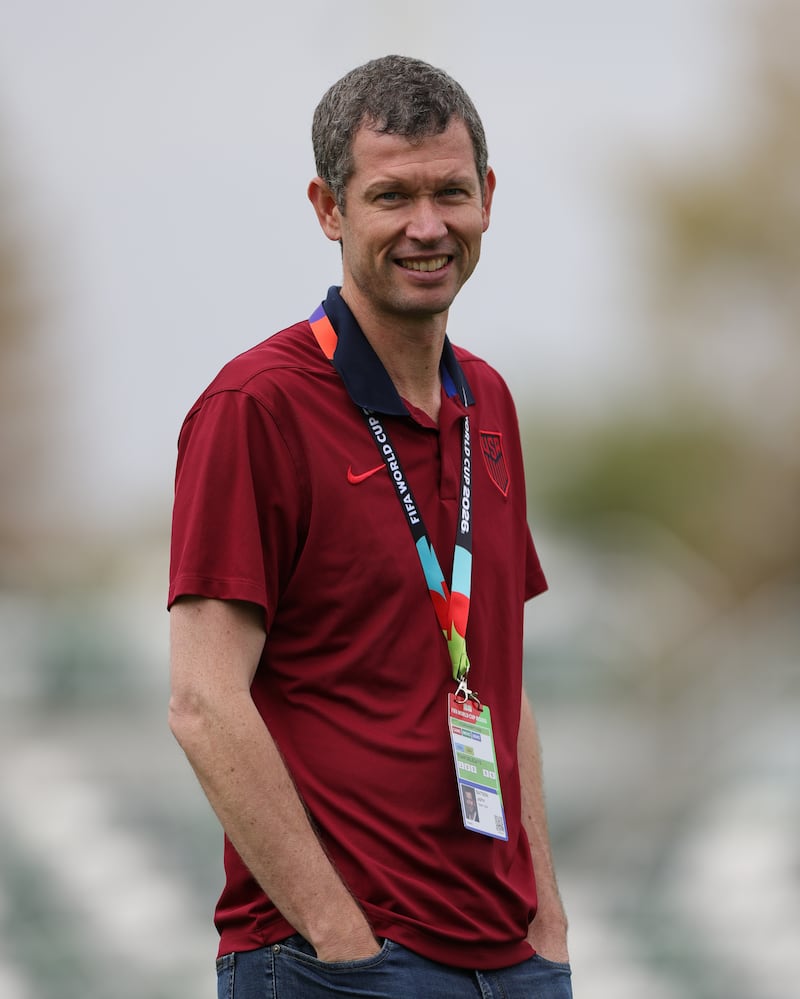
Since joining U.S. Soccer as its CEO and secretary general in 2022, JT Batson has overseen immense commercial growth, a reimagining of the country’s approach to developing soccer talent and the construction of the federation’s first National Training Center. He also was tasked with positioning the men’s national team for success at the 2026 World Cup on home soil.
With that watershed moment now behind him and a contract extension secured, Batson sat down with Sports Business Journal to discuss takeaways from the World Cup — including the Folarin Balogun red card — and what’s next for soccer in America. This interview has been edited for clarity and brevity.
Did the level of viewership and fan interest meet or exceed your expectations?
BATSON: I’d always believed this was where we’d be, but we’d never been there before. This is rarefied air in terms of TV ratings. Our game against Belgium had over 50 million people, and tons of games had 20, 30 or 40 million viewers, often at times of day that make those numbers even more unbelievable.
Beyond the official fan fests, you had events big and small across the country. We had over 600 Soccer Forward Fests in all 50 states that combined watch parties with opportunities to play.
It was what we’d always dreamed was possible, but this puts us in a totally new place in terms of what’s possible for soccer in this country.
How is U.S. Soccer positioned to convert this moment into sustained interest and growth?
BATSON: We’re already seeing people make the structural changes required for us to become one of the world’s great soccer countries. L.A. Unified School District announced it is rolling out soccer in every school. Oakland and Atlanta did the same, and a number of other cities and counties are preparing announcements. In L.A., we’re scaling a recreational program that costs $10 a month.
You’re also seeing sponsors step up in new ways, and youth organizations, adult organizations, leagues and clubs align around creating clear, accessible pathways. Between this summer, the 2028 Olympics and the 2031 Women’s World Cup, we should be able to transform what soccer looks like in this country.
What I’ve focused on most is whether the people whose support is required to build a great soccer country are now more likely to say yes. Resoundingly, the answer is yes. We had clarity before the summer about what was required to achieve our long-term ambitions. What this summer gave us is the conviction that we can run faster and harder toward them.
Has this World Cup given you confidence that the approach U.S. Soccer has taken to player development is correct, or are there changes that need to be made?
BATSON: Those are the same thing. We believe changes are needed and that we have to build a new system that is clear, accessible and aligned, with great coaches in every community. We knew that before the tournament; the excitement around it gives us confidence that we can move faster and bring the necessary resources to bear.
Every American park and school seems to have a basketball court. We spend $3 billion to $5 billion a year on high school football. Imagine how many academies we could have for $3 billion a year. The scale of what we could do if we channel more public resources toward soccer would have an unbelievable impact. The tournament showed people that the demand is real, the country is excited and the juice is worth the squeeze.
Is lobbying for that public investment now a priority?
BATSON: We just hired J.R. Kenny, who has a background in state and local government engagement, as our first full-time head of government relations. We want to support more states and municipalities in building fields, creating safe places to play and offering low-cost recreation, while working with school districts, local organizations and professional clubs to make pathways accessible.
Think about London or Paris — two good comps for big American cities — and how many professional clubs they have there. That means how many academies they have for young players. In our two largest cities, New York and L.A., we have two each. We should have at least double digits.
When you say there should be more than two teams in New York and L.A., is that in terms of professional clubs or academies?
BATSON: Academies, for sure. Of course, there are more than two professional teams in New York. You’ve got Brooklyn FC, you’ve got Long Island; you’ve got others in Jersey; Westchester has teams. But those teams don’t have academies.
The opportunity is to work with USL teams, MLS Next Pro teams, college programs and others so that, no matter where you live, you have an accessible pathway to play at the best level possible. Creating more local opportunities also reduces travel, which is one of the biggest drivers of cost in youth soccer.
What will drive clubs to invest in these academies? Is it profit motive of selling players?
BATSON: The beauty of this is both the benefit of driving general participation, which of course creates more fans, and then there’s a clear market for player development globally. Whether players reach your first team or move elsewhere, tapping into that global market for solidarity payments and/or player transfers is a major opportunity to better fund development.
We’ve had some early wins, but it’s something we collectively need to lean into more.
Do you consider the men’s national team’s World Cup performance a success?
BATSON: Our goal was to inspire the country and make many more people want to put on a U.S. jersey or hang the flag on their front porch. I think they crushed that.
Of course, we want to compete to win World Cups. One legacy of this summer is that the discussion around player pathways broke into the mainstream. That is what is required for us to win World Cups, so it’s exciting that so many people are talking about it.
The deferral of Folarin Balogun’s red-card suspension was a defining off-field story. Did U.S. Soccer handle the situation appropriately?
BATSON: I’ve been a part of a number of high-profile tournaments since I’ve been here. In every instance where we’ve had a red card in those games, we have followed the appeals process, and we did so in this instance. Our legal team scoured the FIFA codes, identified the best path and argued through the disciplinary process that a suspension was not warranted, which ultimately is how it played out.
The broader point is that the reaction proved how much people cared, and that is ultimately what is required for us to win.
Some people in soccer wished U.S. Soccer had kept the federal government out of the process. Was there any collaboration?
BATSON: I can’t comment on what happened outside of U.S. Soccer. We communicated to a number of different stakeholders that we were following the process. That was the extent of our communication with alumni, donors, sponsors, members of Congress who are huge fans — anybody.