

Tonight in Unpacks: Youth sports streaming offers a number of benefits, from making it easier for family, friends and scouts to watch games to analyzing video for training purposes. But it’s also a $10 billion industry, an under-the-radar asset class in sports business, reports SBJ’s Joe Lemire.
Also tonight:
- Pittsburgh Business Times publisher talks city prep ahead of NFL Draft
- NFL’s sponsorship triple play
- New ticketing features boosting speed, revenue
- Op-ed: Teaching athletes to be global ambassadors
Listen to SBJ’s most popular podcast, Morning Buzzcast, where Abe Madkour discusses the NFL Draft serving as a showcase for Pittsburgh, the Royals’ plans for their new ballpark and mixed-use district in downtown K.C., interest growing in a 24-team College Football Playoff and more.
Fueled by family viewing and recruiting purposes, youth sports streaming is now a $10 billion business

As the offensive coordinator of Concordia University, an NAIA school a half-hour west of Lincoln, Neb., Greg Nelson used to spend every Friday night traversing the state for recruits. He’d watch the first half of one high school game, then drive to a nearby school to take in the second half of another.
Nelson still gets on the road some for those invaluable in-person looks and conversations with a prospect, but just as often he’ll hunker down in his living room. Two games will be streaming on his computer, a third on his iPad perched on the coffee table and a fourth on his phone, which he’ll rest on his lap.
“I can watch four games in the 7 o’clock hour, and I can watch four totally different games in the 8 o’clock hour,” he said, noting that the western third of Nebraska is in the Mountain time zone, “and cover a huge part of our recruiting base.”
Instead of seeing four teams play in person and spending the night away from home, Nelson can see 16 teams — greatly widening the funnel of possible recruits — and not be so far from his family.
Nelson is uniquely positioned to appreciate the growing media exposure for youth sports as he has helped create the supply through his day job as a senior vice president at Hudl, the tech provider that started as a coaching analysis company. Over time, Hudl began helping athletes use the platform to compile and publish highlights for recruiting purposes, which in turn fed the demand for full-game feeds. Hudl acquired streaming provider BlueFrame in 2022 to power that service and offer better production value.
“Obviously during COVID it took off,” he said. “The need to be able to provide greater access to content for those schools and groups was the No. 1 thing that drove our streaming side.”
Millennials and prior generations were lucky to have a family member or coaching assistant bring a camcorder to their sporting events so that athletic memories could be preserved on VHS. But at high school, club and youth competitions these days, you’re likely to find an AI-powered camera and any number of handheld smartphones recording multiple angles, often sharing the footage live through an app or on YouTube.
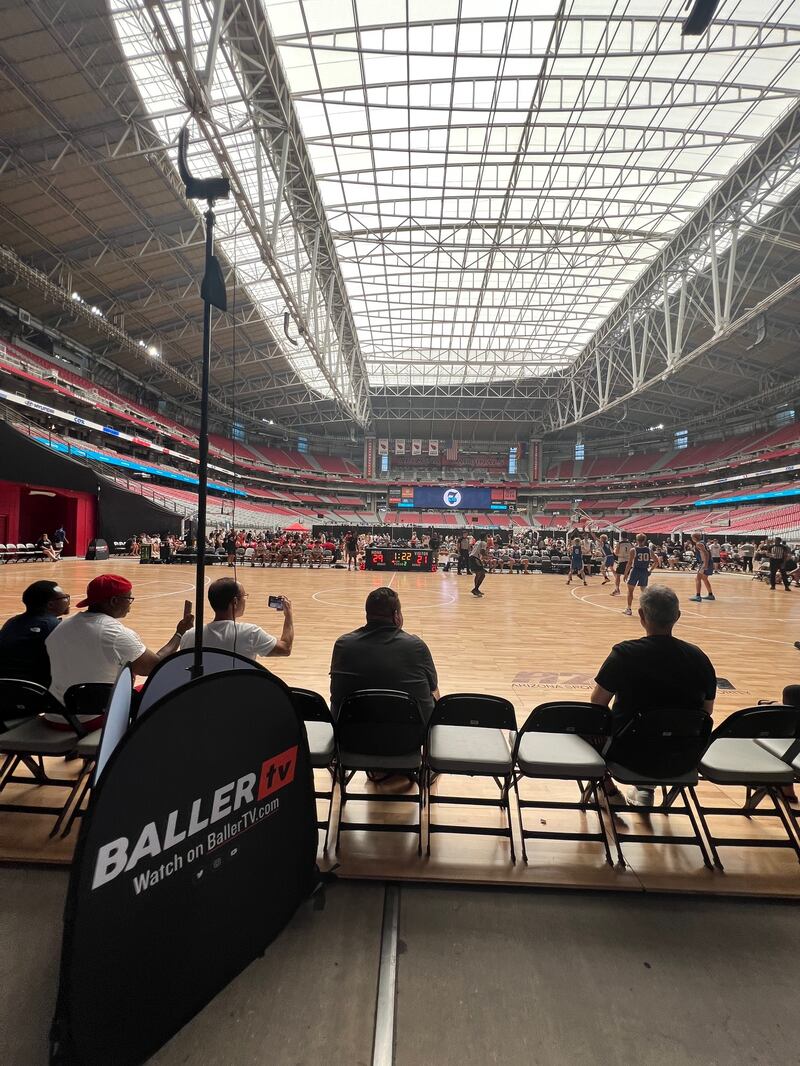
“In 2016 when we started, it was like, ‘OK, now high-level high school games could be produced,’” said Sandeep Hingorani, BallerTV EVP and co-founder. “Now we’ve reached a place in society where every game needs to be produced.”
The numbers are staggering:
- TeamSnap CEO Peter Frintzilas described youth sports streaming as a $10 billion market “that not many people are talking about outside of those that are covering youth sports.”
- Pixellot streamed about 1.5 million games across 14 sports in 2025; Hudl eclipsed 1 million, a number that has doubled in the last two years.
- Roughly 600,000 of those games are through Pixellot’s NFHS Network collaboration with PlayOn Sports, at times attracting 100,000 viewers for the designated games of the week. NBC SportsEngine Play is another major Pixellot partner.
- BallerTV will stream up to 50,000 games on peak youth sports weekends.
- ESPN’s Wide World of Sports near Orlando has 25 Spiideo cameras installed to capture video from just about every competition on its sprawling Disney World campus.
- Hockey streaming company LiveBarn sold for a reported $400 million to private equity firm GTCR as the first of what’s expected to be many investments in the youth sports space. KKR made a major investment in PlayOn in 2022.
“Youth sports was a sleeping giant asset class,” said Scott Bushman, director of media partnerships for Spiideo, an AI-powered sports performance and video broadcasting firm. “Maybe for a long time, it flew under the radar.”
Proliferation
The landmark deal shaping the future of youth sports distribution began in 2013 when the National Federation of High School Associations worked with PlayOn to launch the NFHS Network, a subscription-based digital aggregator of scholastic sports. That accelerated in 2017 when Pixellot joined as a partner, making its AI-powered cameras available at a discount to schools that signed onto the NFHS Network. By 2020, terms changed, and those cameras became free to users, leading to nearly 10,000 installations in the U.S. alone. In 2025, the partnership was extended for five more years.
The benefit of AI automation — BallerTV, Hudl, FloSports, PlaySight, Spiideo, Trace and Veo are among the other entrants — is that high school athletic directors, club administrators and tournament organizers can “set it and forget it.” There’s no need for a camera operator to track the action, as the AI has been trained to do that, or for a producer to add graphics. The goal is to make the technology reliable and ubiquitous because there are no do-overs.
“When you capture a game, that needs to work. You can’t miss a moment,” Pixellot CEO Doron Gerstel said. “In a teenager’s life, at this period of time, this moment is everything.”
Viewership is a volume proposition. Most streams may only attract a dozen folks tuning in, all of whom share a last name with a participant, but that adds up the with the scale of these streams. And there are exceptions.
“Parents are going to be your core audience regardless of sport, regardless of level,” PlayOn Sports President BJ Pilling said, but added, “It wasn’t uncommon to have over a hundred thousand viewers for some of those big marquee games, which was awesome to see. It’s that broader recruiting fan base. It’s that sports fan that’s home on Friday night that’s watching those bigger marquee games.”
BallerTV’s rise followed a key event in 2016. This was around the time that Facebook Live and YouTube were growing, as was Periscope and other user-generated content streams, but they were all disparate — the thesis was to centralize and commoditize the availability.
Two California powerhouse high school programs — Mater Dei and Chino Hills when LiAngelo and LaMelo Ball were starring at the latter — were meeting in Platinum Division final of the Tarkanian Classic in Las Vegas. BallerTV provided fans a place to watch from in the Golden State.
After that, Hingorani said, “We had people knocking down our doors to get this technology to their events, and so we quickly had to figure out how we scale this thing, how do we monetize this thing? And eventually settled on a model where all the content lived behind a paywall.”
Monetization
There are a dozen youth sports streaming services, and nearly as many business plans. BallerTV’s goal is more straightforward: content for its own sake. Annual prices range from $95 to $239 depending on the tier and available features. BallerTV also created a product, BallerCam, that turns an iPhone into an AI camera.
“We never got in this to solve a recruiting problem,” Hingorani said. “We never got in this business to help coaches win games. We got in this business because of a connection that sports provided to our life, to our family, to our relationships. We like to say of our product road map, we’re in the happiness business.”
While BallerTV typically works with the event operators to provide a livestream, other services such as SidelineHD let parents use their own phones and share games to Facebook or YouTube for free. Its monetization comes in the form of premium features: unlocking HD resolution, automating highlights and receiving advanced stats. Acquired by Diamond Kinetics in 2024, SidelineHD is being integrated into the company’s player development platform for more advanced instruction.
“SidelineHD fit really well for us because it’s very focused on the athlete, the family, the parents,” Diamond Kinetics CEO CJ Handron said. “It’s not an organization platform. We call them hero parents because we have parents who are outside the dugout who become the champion of that team, and they become the livestreamer.”
Rematch is primarily a short-form highlights tool in which users follow the action in the app but do not need to press record until after the play. That saves critical storage space and helps parents not miss a key moment. This flashback ability is its core IP that is generating interest from clubs not wanting to be left behind in a crowded youth sports market.
Hanna Howard, Rematch U.S. CEO, said clubs are recognizing untapped value from content. “Even where we’re talking with club organizations who may not have a really strong social media identity yet, they know they need to in order to keep up,” she added. “You can’t be in this youth space and not be celebrating the content and your own community through the play that’s happening on the field.”
It’s not just a marketing tool. Howard said larger clubs, such as Lonestar SC in Texas, generated more than 1 million views related to its Rematch content in just six months. Armed with that data, clubs can sell sponsorships to local businesses.
Most streaming platforms equip the user with choices for monetization based on their comfort. That could be through subscriptions, sponsorships or other advertisements.
When Hudl charges a subscription fee, Nelson said the schools receive 70% to 80% of the revenue. The company maintains a dedicated Hudl for Brands division that has produced collaborations with Gatorade, Nike, Chase and T-Mobile.
One thorny issue gaining increasing scrutiny is the idea of broadcast rights for youth sports. If a media provider is streaming a tournament behind a paywall, for example, can parents also share live video of their children from where they sit in the stands? Generally, the stance has been similar to what you might find at a pro sports game — attendees are welcome to record as much of the game as they want for their personal use, but not for wider distribution. But getting folks to follow that policy is not an easy task.
“That comes with its own enforcement concerns, which has been in the media lately of, how do you monitor all of those facilities?” Nelson said. “How do you go tell a parent that they can’t take a video of their own kids?”

Production
Just capturing youth games on video used to be enough: plop a camera in place, click record and preserve the memories. But stationary, low-res videos lacking stats or even the score weren’t going to placate viewers forever. “Internally, I say, ‘No more security feeds,’” FloSports founder and CEO Mark Floreani said. “What used to be, ‘Hey, I don’t care what it looks like. I just want to see my kid or see this event’ has now evolved, and people do care about it.”
FloSports has deep roots in wrestling, so for that sport — and, later, to expand to others — the company invested in developing its own AI algorithms to automate the production. The year-old product is called VPZ for virtual pan and zoom, as it tries to replicate natural broadcasting techniques. Of its 1 million total subscribers, about 100,000 receive FloWrestling, which carries a bounty of high school and college wrestling.
Along with PlayOn, Pixellot introduced virtual yellow first down lines in high school football games. Pixellot, PlaySight and Spiideo are among the providers that have invested in multi-camera systems for several sports, in which the stream automatically cuts to the better angle based on the action.
“We’re in the midst of a tipping point when it comes to youth and amateur automatic production of sports,” Pixellot’s Gerstel said. “The technology very much allows doing it in the quality that is expected and, at the same time, the price of streaming is being dropped significantly.”
GameChanger recently partnered with youth sports organizer Unrivaled (related story, Page XX) to sync additional angles to its streams. Anyone at the field — starting with Rocker B Ranch in Texas — can scan a QR code and have his or her phone’s stream added to the full game production. AI incorporates the new viewpoints for a more comprehensive viewer experience. This follows an earlier GameChanger update in which new compression technology enables full 1080p HD resolution on all games.
Executives with LiveBarn and Spiideo underscored the need for high-quality video because, with computer vision algorithms, it can be utilized for content, player development, scouting and a host of other use cases.
“Video is the starting point of a lot of the experiences that people want to deliver,” Spiideo’s Bushman said.
The consensus is that, as long as the original objective of celebrating and preserving memories remains the most important goal, the continued proliferation of video serves the industry well.
“At the end of the day, as the tech operator in the middle of this, the parent on the other side of it, I have been in the space for a long time — it’s such a net positive,” Diamond Kinetics’ Handron said. “That’s the thing that makes us feel the best about this, is you just get this overwhelming, consistent feedback from folks who are like, ‘Hey, if I couldn’t do this, we couldn’t watch the game. We wouldn’t have the memory.’”
Pittsburgh Business Times publisher talks city prep, business opportunities ahead of NFL Draft

Pittsburgh is stepping onto one of the biggest stages in sports Thursday as the city hosts the NFL Draft for the first time in 78 years, an event local leaders view as both a chance to elevate the market’s profile and a one-of-a-kind business opportunity.
Pittsburgh Business Times Market President & Publisher Evan Rosenberg discussed how the city is using the NFL Draft to showcase recent investments, create opportunities for local businesses and how success will be measured.
Answers have been lightly edited for clarity and length.
Q: What do you hope visitors notice most about Pittsburgh this week, and what does the city most want to showcase?
Rosenberg: “Most people will be surprised by the natural beauty of the place, the topography … these hills and three rivers. We’re somewhat famous for the view as you come through the Fort Pitt Tunnel and the city is right there in front of you. There’s the stadium, there’s the ballpark, there’s the skyline and the rivers. … It’s a very welcoming community … friendly, accommodating people. I think all of those things would surprise people who’ve never been here before.”
Q: Where has Pittsburgh invested most ahead of the NFL Draft in terms of infrastructure, beautification and overall visitor experience?
Rosenberg: “To all of those things, the Draft deadline was able to push people to get things accomplished. Back in November, you had a brand-new airport terminal open, state-of-the-art, everything that will greet people when they come into Pittsburgh. There’s a brand-new park called Arts Landing, a stunning riverfront downtown four-acre park with a playground, amphitheater stage and public art. Market Square got a total renovation. Point State Park also got a refresh. Most importantly, those are investments in infrastructure that will last long after the Draft ends … permanent changes to this community that residents will benefit from.”
Q: How is the local business community preparing, and what do they hope comes from the event long term?
Rosenberg: “No matter where you go, it seems as though people are embracing it in one way or another. [The corporate community] are bringing clients or potential clients into town, they’re hosting them. Just about everywhere people are hosting a watch party or a pre-event celebration. It also allows city, county and regional leaders to really show off the region. Site selectors, looking for places to relocate or locate businesses, those tours are happening.”
Q: What are the biggest execution challenges this week that come along with hosting an event to this magnitude?
Rosenberg: “Certainly people are concerned about parking and traffic and crowds because that just seems to be what people freak out about … but if Pittsburgh can handle 250,000 people for the St. Patrick’s Day parade, I have no doubt it can handle that number of people per day over three days.”
Q: When the NFL Draft is over, what would make this a success for Pittsburgh?
Rosenberg: “Success at this level, on this scale and magnitude, absolutely demonstrates to others that we can handle it. … Some of the business development parts of this, talking to people about locating, relocating or expanding their businesses here, those things don’t typically happen overnight. It’s a longer play. But the event is the event. Let’s face it, standing in line, going to get a drink, chit-chatting with somebody with some downtime, that’s when some of the magic gets made. But think people will absolutely measure the success based on the reviews that happen with all of those millions of eyeballs on a global television stage.”
NFL parlays Visa deal into three-headed sponsorship bonanza
For all the decades we’ve been parked at the corner of sports and commerce, a single truth has been most constant: No one runs auctions as successfully as the NFL.
So, when you’ve read here first about the NFL’s tripartite sponsorship triumph in transforming its 30-year-old Visa corporate sponsorship into three separate deals — AmEx for credit/payment cards, U.S. Bank for retail banking and PayPal for peer-to-peer payments — the most cogent fact is rooted in that original notion about NFL auctions. Sources involved in the deal say the league upped its return from one deal that became categories at between 3:1 and 4:1. That’s a healthy improvement regardless of the payment method employed.
In an unusual move in early 2025, the NFL originally issued a broad RFP across the category. Given its success, that probably shouldn’t be considered uncommon anymore.
Financial services as a whole remains the largest sponsorship category, and we continue to see additional fintech brands hatched daily, adding to the abundance of traditional banks, insurance brands, brokerages, exchanges, financial advisories, accounting firms and real estate concerns which have long comprised the sector.
According to sources involved in the deal, early competitors for a consortium were Mastercard, PayPal and another bank. When that didn’t work, PayPal reemerged solely seeking peer-to-peer rights. One source said PayPal pursued these NFL rights for 18-24 months.
Now, there’s a scramble to claim credit for the notion of division — which resulted in multiplication. The whole exercise was a vibrant showcase of how broadly the sector has evolved over those three decades in which Visa had exceptionally broad NFL sponsorship rights, which now might be considered archaic.
Swimming in the proper lane
The difficulty in having three where there were one (1.5, if you count Truist’s pass through from Visa) will be intriguing to track. Designation-wise, AmEx gets “Official Payments,” U.S. Bank was christened as the league’s “Official Bank and Wealth Management” sponsor, and PayPal garnered “Peer-to-Peer (P2P) Payments.” IP sellers and activators often refer to their overlapping sponsors as “staying in their swim lanes.” Which one of these categories doesn’t involve payment? And that’s just the most obvious of the business conflicts.
Those lanes had better be broad ones, with sufficient room for NFL storytelling by each brand.
“Not simple for anyone involved,” said a marketer who worked on the deal. “There was a lot of needle threading, because over 30 years it changed dramatically — from category to categories, for one.”
Added another involved marketer: “The reason this took so long was being thoughtful about defining swim lanes that will work, so that everyone is satisfied.”
Agencies involved: The Team (formerly Wasserman) handling both AmEx and U.S. Bank; Art & Science Partners negotiating the deal for PayPal; and Horizon Sports & Experiences handling PayPal’s activation.
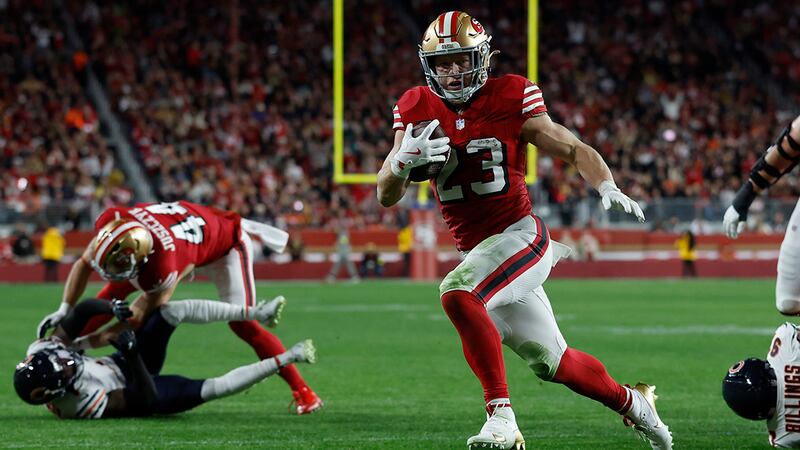
Meanwhile, activation surrounding these deals started long before this week’s NFL Draft, which will see some from the fin-services trio. U.S. Bank shot an ad in L.A. last week with 49ers RB Christian McCaffrey. AmEx has snapped up stadium/team sponsorships in Atlanta; East Rutherford, N.J. (home of the Giants and Jets); and Miami Gardens (site of the Dolphins’ Hard Rock Stadium). NFL club marketers have noticed how “more vibrant” the credit/payment sponsorship category has become after many desultory years.
Wicket graduates in college sector with Paciolan integration
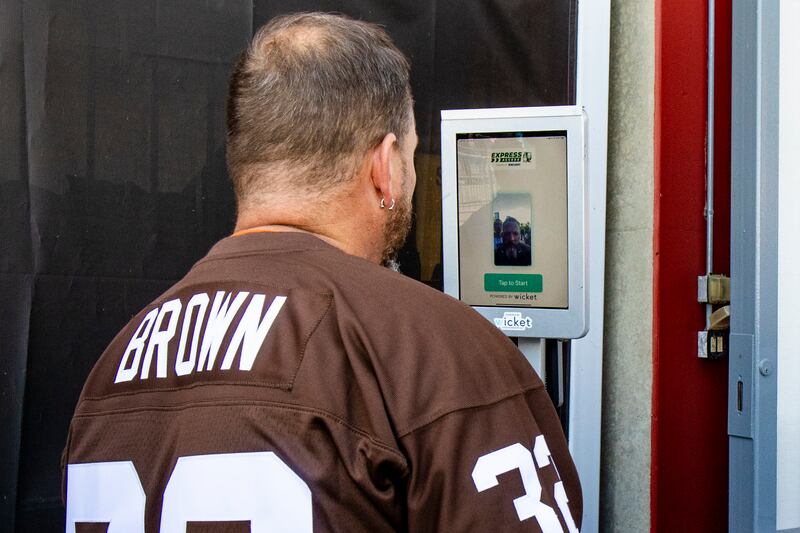
Earlier this year at Paciolan’s annual PACnet event, attendees were greeted by more than just the registration table. That entry point featured a Wicket pedestal so those interested could test out the facial authenticator’s tech for themselves.
“We did the check-in right at the registration booth,” said Paciolan President Brendan Lynch. “So, that was a little bit of fun we had.”
I’ve seen this setup before. When Golfweek Tech Lab visited Charlotte last year, Wicket had a similar welcoming role. It’s an effective demonstration that quickly shows just how much the startup can boost ingress.
We may start seeing that quickness spread through college sports with the latest integration between Wicket, a 2024 honoree of SBJ’s 10 Most Innovative Sports Tech Companies, and college ticketer Paciolan.
Wicket has seen serious potential in colleges over the last couple of years. Through its Ticketmaster integration, Wicket built relationships through deployments at Florida, Ohio State and Boise State. Ohio State, Wicket COO Jeff Boehm mentioned, has been particularly creative in using Wicket not only for events but also for access to an athlete-only cafeteria (which is similar to its league-wide deployment for the NFL credentialing system at venues). While Wicket doesn’t share pricing, it varies based on the number of pedestals a school wants to use.
There’s a wider potential now with Paciolan, which works with more than 170 schools. The collaboration means Wicket’s technology can integrate with Paciolan’s entry platform. Lynch sees Wicket as a product that can offer quicker entry for students (which is a population that often floods gates close to game time, no matter the school) and provide an upscale-feeling experience (due to the name recognition shown on the screen) for even the donor class.
While it’s too early to cite a number of colleges interested in working with Wicket — pilots will begin taking place in the spring and summer — Lynch shared the outreach has been massive.
“Our conversation before PACnet was, ‘OK, what if a hundred people want it tomorrow?’” Lynch said. “And there’s been more demand there than even the schools themselves are ready for. And so it’s been more about managing their processes, making sure they’re ready for it.”
Lynch said his hope is that schools will pilot with situations requiring lesser demand — spring sports don’t approach the foot traffic of a football game day— to ramp up and get more comfortable with Wicket as a new addition to the fan experience toolbox.
These recent developments with Paciolan-affiliated schools have also opened another sector for Wicket: Boehm mentioned that some schools are already using it for performance art centers. That’s been especially useful for returning visitors, like those with a season pass for shows. But 2026 sounds like many college sports fans around the country will be checking out the experience soon — similarly to those attendees at PACnet.
“The hope is that we’ll certainly be fully productional and ready to go well before football season this fall so that we can get some of these big football programs up and running,” Boehm said. “The college space is definitely a big opportunity for us.”
If athletes are global ambassadors, we need to teach the playbook
“Athletes know how to execute plays all day. We rely on our coaches to draw up the right plays to win games. Sports diplomacy is no different. If our communities look to us to be global ambassadors of the game and our culture, we need the right plays. We need support in understanding how to be the best ambassador and have an impact for our countries.”
That was the response from Houston Texans fullback Jakob Johnson, an eight-year NFL veteran from Germany, when asked what athletes need to meaningfully engage in sports diplomacy.
The conversation took place during a panel hosted by Maven Strategy Group during Super Bowl week in San Francisco. The room included athletes, executives and more than a dozen consuls general, all focused on a topic rapidly shaping the future of global sport: sports diplomacy.
Johnson’s point was simple. If athletes are expected to represent their countries, teams and leagues on the global stage, they need preparation.
And increasingly, they are stepping into that role in real and tangible ways.
From concept to action: The Huddle Abroad — Dominican Republic
This vision comes to life through The Huddle Abroad: Dominican Republic, a first-of-its-kind initiative bringing together the U.S. Embassy, the Dominican Republic’s Ministry of Sports and Recreation, and the Ministry of Public School Physical Education.
The program is designed to go beyond introducing flag football. It positions the sport as a vehicle for youth development, education access, gender equity and long-term economic mobility.
Through youth clinics, leadership engagement and cross-sector collaboration, the initiative demonstrates how flag football can create structured pathways not only into sport, but into opportunity.
It is a deliberate effort to ensure that flag football is not viewed simply as recreation, but as a tool of soft power, one that builds bridges between nations, expands access for underserved communities and creates tangible futures for young athletes.
For athletes like Bayron Matos, a member of the NFL’s International Player Pathway Program and offensive lineman for the Indianapolis Colts, this work is deeply personal.
“Being able to share the sport that I love with my country is an unbelievable feeling. But being able to show how this sport can open doors to education, economic opportunity and development feels like a responsibility. I want to make sure the youth in my country know what is available to them and how American football can lead to so much more.”
His perspective reflects a broader truth: Athletes are not just participants in global expansion, they are catalysts for it.
The missing infrastructure
We talk frequently about the value of sports diplomacy. We celebrate international games, global tournaments and athlete exchanges.
But we spend far less time discussing the practical skills required to actually practice diplomacy through sport.
Where are the athlete-focused resources? Where are the workshops, playbooks and structured frameworks that prepare players to engage globally?
Teams invest heavily in preparing athletes for competition. Players study playbooks, review films and refine their craft daily.
Yet as the game globalizes, athletes are also entering a second arena, one that extends far beyond the field.
That arena is diplomacy.
The NFL as a platform for soft power
The NFL’s international growth has helped transform American football into a global product. Through international games, grassroots initiatives and programs like the International Player Pathway Program, the league is expanding its footprint across continents.
But alongside that growth, the NFL is also evolving into something more: a powerful instrument of soft power.
Programs like The Huddle Abroad demonstrate what is possible when sport is intentionally aligned with government, education systems and community development.
They show how leagues can move beyond market expansion to create meaningful, lasting impact rooted in access, equity and opportunity.
Preparing athletes for the moment
Our work with the NFL’s International Player Pathway Program offers a clear example of what intentional preparation can look like.
For the past two years, we have supported players from countries including the Dominican Republic, Fiji, Mexico, Australia, Nigeria, Germany, Zimbabwe and beyond.
The training focuses on cultural competence, communication and professional adaptation. Players learn how to navigate locker room dynamics, engage with leadership and understand the expectations of competing in the United States.
But the objective is not assimilation.
The goal is empowerment.
Players are equipped to remain authentic representatives of their cultures while developing the skills needed to build relationships, bridge differences and lead confidently across cultural contexts.
In essence, they are learning the same skills diplomats rely on every day.
A call to build the playbook
Diplomacy in sports does not only happen at embassies or international summits.
It happens in locker rooms. It happens in youth clinics. It happens when athletes return home and invest in their communities. It happens when teams enter new markets and represent their cities on a global stage.
In each of these moments, “athletes’” are not just competitors, they are representatives.
The next phase of sports diplomacy must focus less on celebrating the concept and more on building the infrastructure that allows it to function.
That means:
- Developing formal training and curriculum
- Creating practical resources for athletes and teams
- Preparing stakeholders to engage across cultures
- Aligning sport with education, policy and economic development
Because in today’s global sports ecosystem, athletes are among the most visible ambassadors a country has.
If we expect them to lead in that role, we must prepare them accordingly.
In sports, success rarely happens without a playbook.
Sports diplomacy should be no different.
Scarlen Martinez is founder and CEO of Maven Strategy Group, specializing in sports diplomacy, athlete engagement and global strategy.
Speed reads

- This week’s SBJ Sports Media Podcast features co-host Austin Karp diving into the NFL Draft with Bleacher Report’s Bennett Spector. Co-host Josh Carpenter also joins Karp to discuss Mike Tomlin’s move to “Football Night in America” and questions about LIV Golf.
- In this week’s Audience Analysis, Karp writes that Manchester City-Arsenal on Sunday morning delivered a record Premier League audience in the U.S., with NBC drawing 2.6 million viewers for the matchup with major title implications.
- LA28 sold more than 4 million tickets in its first round of sales earlier this month, with a majority of the lowest-priced tickets being bought by L.A. and Oklahoma City locals, reports SBJ’s Rachel Axon.
- The NWSL Players Association took an equity stake in OneTeam Partners, the athlete group licensing and sponsorship firm that has managed its group licensing rights since 2022, notes SBJ’s Alex Silverman.
- Kubota signed on with NASCSAR as the racing property continues to dial up deals with blue-collar brands, reports SBJ’s Adam Stern.
- The PGA Tour rolled out a program at a handful of events targeting select sponsors and highlighting their community impact throughout the year, not just during tournament week, notes SBJ’s Josh Carpenter.