

Tonight in Unpacks: Iran was eliminated from the FIFA World Cup, and Homeland Security Secretary Markwayne Mullin said he was “so glad they’re gone” as he defended the Trump administration’s actions to require the team to be based outside the U.S. for the tournament, reports SBJ’s Alex Silverman.
Also tonight:
- What America thinks of sports at 250
- Türkiye-U.S. is second-best English soccer audience
- Is the NHL’s decentralized draft here to stay?
- Op-ed: The NIL gold rush is over, and that’s good for athletes
Listen to SBJ’s most popular podcast, Morning Buzzcast, where Abe Madkour opens the week with takeaways from his visit to Nashville and CAA’s new office, more cheery numbers for the World Cup, a Walton scion purchasing a minority stake in the Bulls and more.
DHS secretary: ‘So glad’ Iran is out of World Cup

WASHINGTON, D.C. -- With Iran officially eliminated from the FIFA World Cup, U.S. Homeland Security Secretary Markwayne Mullin defended the administration’s treatment of the team during the group stage and said he was “so glad they’re gone.”
Iranian soccer officials complained before and during the World Cup that restrictions imposed by the U.S. government amid the ongoing military conflict between the countries placed the team at a competitive disadvantage. Those restrictions included requiring Iran to move its base camp from Tucson, Ariz., to Tijuana, Mexico; allowing the team to enter the U.S. only one day before its matches; and requiring it to return to Tijuana immediately afterward.
Mullin expressed little sympathy for the Iranian team on Monday. During a World Cup security briefing at the government’s Special Event Coordination Center, he told interagency personnel that he was “very happy they’re going back because there wasn’t a single team that we dealt with more than them.” Speaking to a small group of reporters afterward, he expanded on that sentiment.
“I’m just glad they’re done, and they’re not coming back,” Mullin said. “I was so happy when we were able to pull their visas and said they could leave the U.S. soil, and I might’ve sung a song or two or maybe even danced a happy dance.”
Mullin denied that Iran’s team had anything to complain about, citing the proximity of its base camp in Tijuana to its first two matches in L.A. and its ability to arrive and train in the U.S. the day before each match. He also said Customs and Border Protection officers screened the players before boarding their plane in Tijuana to mitigate their concerns about being harassed while going through U.S. customs.
Asked whether there was a specific security utility for requiring Iran to depart immediately after matches, Mullin did not identify one.
“That was just an agreement we had -- to just go ahead and let them go,” Mullin said. “The game was over, let them get back to the hotel, their base camp where they’re at. They’re more comfortable there. That was just an agreement we worked out with FIFA before the games started.”
Mullin also reiterated allegations that “almost half” of Iran’s proposed World Cup traveling party had direct ties to the Islamic Revolutionary Guard Corps, including two proposed media members who were connected to IRGC intelligence and one proposed traveler who was wanted on international warrants and unable to enter Canada. The Iranian federation has previously called Mullin’s claims “completely unsupported by any evidence.”
What America thinks of sports at 250

Football remains America’s sport. The New York Yankees, not the Dallas Cowboys, are America’s team. Pittsburgh is America’s second-best sports city. And while sports properties and sponsors have spent years preparing for America 250 celebrations, fewer than a quarter of U.S. adults say they are very likely to support a brand that actively embraces them.
Those are among the findings from a CivicScience/SBJ Sports Consumer Insights survey from April 8 through May 26. The survey of U.S.-based sports fans age 18 and older included a series of patriotic-themed questions tied to America 250, the congressionally appointed nonpartisan organization overseeing the federal government’s semiquincentennial celebrations this summer.
The number of respondents ranged from 2,945 to 4,614, depending on the question. CivicScience also has tracked league-specific fandom for more than a decade, allowing comparisons between 2021 and 2026 on questions related to sports engagement.
The timing of the survey was intentional. Earlier this year, SBJ heard from industry executives that many America 250 activations would not become visible to fans until closer to Memorial Day. The survey was launched once those campaigns began appearing across the sports landscape.
Activations that gained exposure during that period included the debut of America 250 ad campaigns by multiple sports sponsors; commemorative patches were visible on the players’ jerseys during the NBA and NHL playoffs; and MLB debuted its “For the People” marketing campaign with Tom Petty and the Heartbreakers’ “American Girl” playing in the background.
To be sure, there has been evidence of such planning in the sports business world since 2019, when Major League Baseball awarded Philadelphia next month’s All-Star Game.
And there were certainly other indicators along the way: Last summer, NASCAR announced that its 2026 calendar of patriotic-themed celebrations would be highlighted by a race at Naval Base Coronado in San Diego; and UFC announced that it would stage an event at the White House (both events took place earlier this month). Additionally, the NFL used a replica of the Libertas Americana silver me9dal commissioned by Benjamin Franklin in 1783 to celebrate America’s victory in the Revolutionary War for the Super Bowl LX coin toss; and multiple MLB and Minor League Baseball teams revealed celebrations when they released their 2026 promotional calendars.
More from SBJ’s America 250 series
- Yankees claim ‘America’s Team’ crown
- Football is America’s sport, but baseball may still own the pastime
- Pittsburgh punches above its weight in ranking of America’s best sports cities
- Brands are all in on America 250; fans may not be
- Where patriotism still works: MLB leans into its roots
- For America 250, the merchandise opportunity may belong to younger fans
===
Start your day with SBJ Morning Buzzcast, bringing you the hottest stories in sports business every morning in under 15 minutes. Sign up for SBJ’s free newsletters, and dive deeper inside the industry with all the latest sports business news here.
Türkiye-U.S. group stage game marks second-best English soccer audience

Fox drew just over 17 million viewers for Türkiye-U.S. in the third game of the FIFA World Cup group stage on Thursday night, and the 10pm ET match is now the second-best World Cup telecast ever in English, behind only the USMNT match against Paraguay to open the tourney. That opener did just over 18 million on Fox alone. The second USMNT match against Australia on a Friday afternoon did 16.2 million on Fox. Türkiye-U.S. also had head-to-head competition on FS1 from Paraguay-Australia.
Türkiye-U.S. peaked at 19.5 million viewers in the first half from 10:30-10:45pm. K.C. once again led all markets, followed by San Diego, St. Louis, Denver and Dallas-Fort Worth.
After the first two USMNT games had double-digit percentage jumps from preliminary numbers to Big Data figures (highlighting out-of-home), this game saw only a 7% increase with the 10pm ET start.
The 17 million viewers for Türkiye-U.S. beats out other big events like the most recent SEC Football Championship (16.9 million viewers), or Games 1 and 2 of the Knicks-Spurs NBA Finals (16.9 million and 16.4 million, respectively). Türkiye-U.S. just missed beating out the Indiana-Oregon CFP semifinal on ESPN/ESPN2/ESPNU (18 million), but beat out the Miami-Ole Miss semi (15.8 million).
===
SBJ’s America 250 series
- Yankees claim ‘America’s Team’ crown
- Football is America’s sport, but baseball may still own the pastime
- Pittsburgh punches above its weight in ranking of America’s best sports cities
- Brands are all in on America 250; fans may not be
- Where patriotism still works: MLB leans into its roots
- For America 250, the merchandise opportunity may belong to younger fans
===
Start your day with SBJ Morning Buzzcast, bringing you the hottest stories in sports business every morning in under 15 minutes. Sign up for SBJ’s free newsletters, and dive deeper inside the industry with all the latest sports business news here.
Is the NHL’s decentralized draft here to stay?
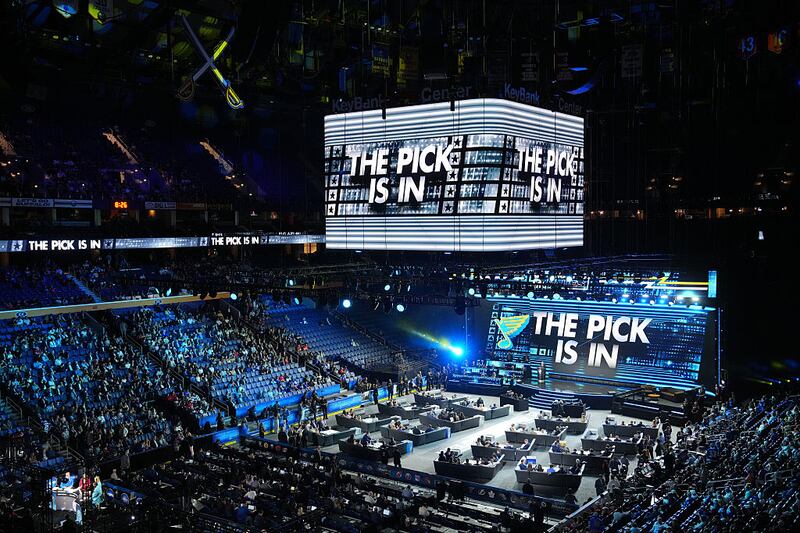
BUFFALO, N.Y. -- The NHL’s decentralized draft format appears likely to remain in place unless numerous clubs voice concern with the way this year’s event unfolded or develop a strong need to return in person.
“My sense is that decentralized is here for at least a while to stay,” NHL President of Content & Events Steve Mayer said Saturday during the waning rounds of the event, which saw front offices work remotely for the second year in a row.
That echoed a comment from Commissioner Gary Bettman at the Stanley Cup Final: “Unless we hear from a lot of clubs that they want to make a change, which is how the change came about in the first place, I don’t see the need to poll every year,” he said. “If a bunch of clubs call Bill [Daly, the Deputy Commissioner] or me and say, ‘You know what, we’d like to go back,’ then we do that. But I don’t anticipate that. I think the clubs like the format.”
The league resolved most of the tech issues that plagued the decentralized draft in its first go-around, but the remote format is not universally beloved. Many still long for the in-person event.
“The decentralized draft is a self-inflicted disaster for the NHL,” prominent agent Allan Walsh of Octagon posted on social media. “The Draft used to be a unique event with a mystical atmosphere bringing together the entire hockey world to one place for a special weekend. Almost everyone I speak to hopes it goes back to an in person draft.”
The Canadiens would prefer it that way.
“I always liked it better being in person,” GM Kent Hughes told The Athletic. “I made my vote. I find it’s easier for us to do our business. The agents are all there, and you get a chance to talk to them. Sometimes it’s not easy to get back when the draft is close to July 1, so I understand the reasons why certain teams want to stay local, but I’ve always preferred being in person. But no one listens to me.”
ESPN’s John Buccigross finds it’s a better experience both in-arena and on television when GMs and scouts are on the floor. He contrasted that with the “pep rally” vibe of the NFL’s decentralized draft.
“I think it really does come down to the players and the GMs and the game and picking players, and the drama and the pressure around it,” Buccigross said.
“We can take a close up of these GMs making trades. We can see facial reactions … You can just paint that picture a little better for the television viewer.”
If teams prefer to work from their own war rooms, it may fall to the league to find new ways to replicate the drama and mystique many miss.
“The clubs are more comfortable … doing it that way, and we’re OK with that,” Bettman said earlier this month. “I mean, if that’s what’s most efficient for our clubs, and we can still put on an event, we’ll be fine.”
Kalshi posts $1 billion-a-day volume from coast-to-coast World Cup betting

It appears the Californians, Texans, Georgians and others who have been boxed out of legal online sports betting have discovered Kalshi’s World Cup prediction market offering. And, based on the girth of the numbers, there’s a decent chance some consumers and deep-pocketed market makers in legalized states have been drawn to the rhythm of its swaying soccer prices, too.
Kalshi recorded $1 billion to $1.25 billion in sports volume each day from June 17 through Wednesday, according to tracking data from crypto news site The Block. The NBA Finals concluded June 13, meaning that volume likely was almost entirely from the World Cup. It was during the Finals that Kalshi posted its first $1 billion day.
Converting prediction volume to sportsbook handle is something between a developing science and the toss of a dart. But the model that well-regarded gambling research firm Eilers & Krejcik is working on estimates that U.S. prediction markets had generated the equivalent of $1 billion in sportsbook handle from World Cup matches through June 24.
Heading into Friday, about 42% of the tournament’s 104 scheduled games remain.
In a research report issued earlier this week, analysts from Bank of America’s global research division estimated that Kalshi was doing about $125 million in volume per World Cup match, including parlays, which they said accounted for about 35% of Kalshi volume.
Friday morning, Kalshi announced that it would add its branding to the rotating World Cup signs of FIFA official sponsor ADI Predictstreet, an offshore site not licensed to operate in the U.S. The announcement also teased future U.S. expansion for Predicstreet through Kalshi’s CFTC-licensed exchange.
“Bottom line, Kalshi’s sports penetration is accelerating,” analysts wrote, “and is potentially on pace to do more equivalent ‘handle’ on the World Cup than all of online sports betting, as compared to Kalshi reaching (about) 20% of OSB handle during March Madness.”
BofA said Kalshi’s overall prediction market share was 80%, with Polymarket at 7%, Robinhood’s Rothera exchange at 7% and Crypto.com at 2%. It estimated DraftKings registered $175 million to $200 million in prediction volume last week.
Those hungry for a deeper dive into World Cup prediction numbers, including an interesting rundown of the more popular parlay constructions from Kalshi, can find a good one here from sports betting news site InGame.
Per that report, the eight most popular parlays all lost.
The NIL gold rush is over, and that’s good for athletes
Five years after House v. NCAA accelerated the economic transformation of college sports, the industry is finally entering a phase that mature financial markets inevitably reach: correction.
That is not bad news for athletes. It may ultimately be the healthiest thing that could happen to them. However, this may mean that institutions and their leaders need to adjust their reactive behavior and demonstrate confidence in development.
When NIL first exploded in 2021, the market behaved less like a sustainable ecosystem and more like a speculative bubble. Fear of missing out overtook discipline. Recruiting pressure overtook strategy. Universities, collectives, brands and donors began operating with the urgency of day traders chasing momentum instead of investors evaluating long-term value.
It’s becoming apparent that attention was mistaken for equity, visibility was confused with brand power, social media traction was confused with actual marketability and athlete value was confused with informational fear instead of institutional data.
Ray Dalio has often written that bubbles form when markets begin pricing emotion and future assumptions over underlying fundamentals. We convince ourselves that current momentum is permanent or inevitable, but eventually, the market recalibrates to reality and that same cycle has emerged in NIL.
Emotion, public pressure, booster competition and institutional panic fueled the first phase of the NIL era. Schools feared falling behind. Collectives feared losing recruits. Athletes feared missing their financial opportunity. Coaches feared losing their jobs. As a result, money moved faster than infrastructure, and promises moved faster than systems.
But as a good economist knows and recognizes, markets mature. They always do, and what we are seeing now is not the decline of NIL. It’s the professionalization of NIL.
The irrational spending phase is beginning to cool, not because the industry suddenly became disciplined, but because market forces are slowly forcing discipline into the system. Universities are becoming more selective, brands are demanding clearer return on investment and revenue-sharing discussions are exposing just how unsustainable reactionary spending can be long-term. If you are paying close attention, you can already see the correction taking place beneath the headlines.
The clickbait NIL frenzy that fueled the early years is starting to lose momentum, and the market is gradually shifting away from short-term visibility toward more sustainable forms of value, fit and long-term brand alignment.
The most visible athletes will not simply be the ones who create the most long-term value in this next phase. They will be the most trusted, most authentic and most professionally prepared ones. Communication skills, leadership, consistency, emotional intelligence and entrepreneurial thinking are beginning to matter more than temporary social relevance.
Recent NIL Forum research by Bill Carter reinforces how necessary this correction may be. In a survey of more than 5,000 college athletes, 58% said at least three promises made to them during the NIL process did not hold up, while only 19% said everything they were promised turned out to be true.
That is not the sign of a stable marketplace. It is the sign of an immature one.
Even more revealing is the fact that 58% of athletes surveyed said career development was the area they most wished schools provided more support in. Not additional exposure or more content production, but career development. That distinction matters because athletes are beginning to recognize that NIL is not simply about monetizing attention during college; it’s about building transferable long-term value through communication skills, leadership, network equity, and authentic personal positioning that compounds long after eligibility ends.
That is where the market is quietly heading next. The institutions and athletes that win over the next five years will likely be the ones who understand that NIL was never truly about quick cash but an early signal of a much larger shift toward athlete-driven intellectual property, identity-based branding and long-term human capital development. The first wave of NIL was simply speculation.
The next wave will be infrastructure, and the athletes and institutions that recognize that before the rest of the market catches up will be the ones who create lasting value, stronger alignment, and sustainable opportunity long after the gold rush headlines fade.
Stephen Bienko is CEO and co-founder of 42U, which partners with collegiate athletic departments to build roster brands and maximize revenue sharing for athletes and programs.
Speed reads
- Oak View Group and Mountain America Credit Union struck a deal to name the new 5,000-seat multipurpose events arena in Draper, Utah, the Mountain America Event Center, reports SBJ’s Bret McCormick.
- Red Bull created a NASCAR-related limited-edition can for retail for the first time in 15 years, with the new product featuring the likenesses of Trackhouse Racing drivers Connor Zilisch and Shane van Gisbergen, writes SBJ’s Adam Stern.
- PrizePicks signed on as the first pick ’em and prediction market operator to sponsor an NBA team, striking a comprehensive deal with the Hawks, notes SBJ’s Tom Friend.
- FlexWork Sports, which operates youth sports camps led by athletes like Saquon Barkley, Jordan Love and Vladimir Guerrero Jr., acquired rival ProCamps, writes SBJ’s Chris Smith.