

Tonight in Unpacks: The U.S. has the largest network for private aviation in the world, and it’s been flexing this infrastructure during the World Cup, as SBJ’s Bret McCormick reports.
Also tonight:
- PBR Teams sponsorship revenue jumps 386% since launch
- Sports analytics market primed for growth
- MLB sponsors prepping for All-Star Game activations
- Op-ed: Inside Inter Miami’s equity-driven strategy
Listen to SBJ’s most popular podcast, Morning Buzzcast, where Abe Madkour discusses the growing competition for an NBA expansion team in Las Vegas with Jerry Colangelo entering the fray, Greg Maffei wanting to bring an F1-like team model to horse racing, how Wimbledon got tennis players to call off a protest and more.
North American private aviation system getting a World Cup workout

Fans and broadcasters visiting North America for the FIFA World Cup have put a positive public spotlight on the continent’s impressive stadium infrastructure.
In the background, the tournament has highlighted another strength of Mexico, Canada and the U.S. -- their private aviation networks.
The U.S. is the largest private aviation market in the world, and it’s getting an extra workout this summer from the visiting fans, celebrities, performers, dignitaries and heads of state, as well as the teams themselves, that are flying private all over the World Cup’s vast footprint.
Elevate Jet is one company doing much of the flying. It was founded by Greg Raiff, who sold an early business of flying college students to MTV Spring Break in Florida to Bain Capital in 1999, but kept the Boeing jets he had accumulated.
He soon connected with his first sports team clients, including the Celtics, Reds, Yankees and Blue Jays, in the early 2000s, and has grown that business to now roughly 40 teams. Individual players and player unions are also passengers on the company’s smaller planes.
“We still own and operate a fleet of Boeing 757s because sports teams only travel with more people, more trainers, more crap,” Raiff said laughing.
Elevate Jet’s client during the World Cup is FIFA itself, and the governing body is handling (and paying for) all of the countries’ travel during the tournament. With some variation, chartering an airplane costs roughly $50,000 per hour of flight time. All that flying in a post-Iran war environment has undoubtedly been more expensive.
The national teams typically have larger parties than average pro teams, with up to 65 people because of all the ancillary delegates tagging along. They fly through major airports because the planes tend to be too big for small private airports.
Unlike commercial airlines, Elevate Jet accounts for America’s unpredictable summer weather issues by not overscheduling its aircraft, which prevents delays from rippling through the system.
“I know that weather is going to happen today, tomorrow and the day after that,” said Raiff, the CEO of Elevate Aviation Group, Elevate Jet’s parent company. “We’ve been dealing with weather since the Wright Brothers.”
The private aviation jumping off point
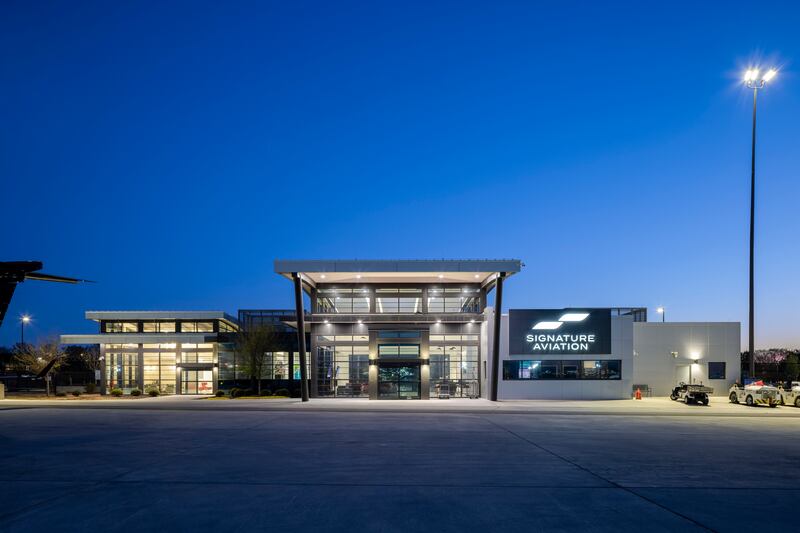
Guests boarding such flights are more than likely passing through one of Signature Aviation’s 220 global private aviation hubs, which are located in airports of all sizes.
Signature Chief Commercial Officer Derek DeCross said the company has hosted France, Germany and Argentina among the 130 national team charter operations it’s been involved with since June. Signature has been working with FIFA since 2024 to coordinate these high-profile flights.
The World Cup is “a unique operational challenge because of its duration and the geographic spread and how quickly teams are shifting,” DeCross said.
Fans are a significant part of Signature’s bustling World Cup-related business. Signature had 2,000 flight operations related to the tournament in just its first week.
Private aviation’s popularity has surged since COVID-19. Security and privacy, customized handling and requests, and the immense time-saving are three big reasons. Signature customers’ average time passing through the facility is just 192 seconds, compared to roughly three hours for regular commercial airline passengers. In some cases, guests drive right out to their plane.
DeCross wouldn’t disclose the expected financial bump, but it should be significant. The number of flights that Signature had projected for the entire tournament was achieved in June alone.
“As big of an event as we had planned for the World Cup to be, it’s exceeded those expectations,” he said.
DeCross couldn’t confirm whether FIFA President Gianni Infantino, who has at times appeared at multiple games on the same day, has passed through their spaces or not, other than to say “we’re the world’s largest.”
“If he does,” DeCross added, “he will receive our usual outstanding exceptional hospitality.”
PBR Teams sponsorship revenue jumps 386% since launch

Professional Bull Riders’ team-based league is entering its fifth season with sponsorship momentum continuing to accelerate, underscoring growing corporate interest in one of the fastest-growing properties in western sports.
PBR Teams will open its 2026 season this weekend at Canvas Stadium on the campus of Colorado State Univ., marking the first time the league has launched a season at a neutral site and building on PBR’s first stadium competition, a sold-out Unleash The Beast tour at Florida State’s Doak Campbell Stadium in March.
Ahead of the season opener, PBR officials said sponsorship revenue has increased 386% since the team league debuted in 2022, including a 13% year-over-year increase as existing and new partners expand their investments in the property.
The league now counts 21 national partners, alongside a growing roster of team-level sponsorships that have become an increasingly important revenue driver.
One of the emerging trends is the rise of team presenting sponsorships, highlighted by the Oklahoma Wildcatters’ partnership with Auris; Arizona Ridge Riders and Energy Transfer; N.Y. Mavericks and Go Bowling, and the extension of Texas Rattlers’ presenting sponsorship deal with Ariat that began in the league’s inaugural season.
The roster also now includes Ram Trucks, which in December singed a three-property deal with TKO Group Holdings, owner the PBR, UFC and WWE.
PBR Teams’ regional partners are Morgan & Morgan, South Point and Texas Pete, with Crypto.com, Mack Trucks, Scotts, Texas Capital Bank and World Liberty Financial joining this year.
The sponsorship growth comes as PBR continues preparations for expansion. The league has previously announced plans to grow from 10 teams to 12 teams beginning with the 2027 season and is in discussions with prospective ownership groups across North America.
The upcoming season will receive broad national exposure through a media package that includes CBS, Paramount+ and The CW. The schedule features a 12-event regular season and playoffs, with approximately 100 hours of live coverage planned. All 175 regular-season games are slated for distribution, along with the November’s postseason at T-Mobile Arena in Las Vegas, which will host the PBR Teams Championship for the fifth consecutive year.
The PBR-LVCVA partnership is one of the most-tenured in U.S. sports.
Sports analytics market projected to grow to near $10 billion by 2030

The sports analytics market will reach $9.64B by 2030, nearly triple its current size of between $3B and $4B, according to a new report from research provider Research and Markets.
Growth factors cited in the report include the proliferation of artificial intelligence-enabled statistics, wearables, fan experience technology and cloud-based analytics platforms, which help sports organizations with performance optimization, injury mitigation and business strategy.
The report estimates that the size of the sports analytics market will be $3.86B by the end of 2026, up from $3.05B in 2025.
The sports wearables market, in particular, has experienced a massive influx of capital recently. Leading biometric-tracking wristband Whoop raised $575M in new funding at a $10.1B valuation in March, while smart ring maker Oura raised $900M at an $11B valuation last fall. Both companies are reportedly planning IPOs, with Oura having confidentially filed for one in May.
Analytics startups PlayerData (which makes GPS wearables), GameRun (a movement/performance analysis platform) and Hexis (a personalized nutrition app) were also among sports technology firms to close seven-to-eight-figure raises in Q2 of this year.
Sponsors look to go deep at MLB All-Star Game

MLB’s corporate sponsors are finalizing plans for activation around next Tuesday’s All-Star Game in Philadelphia. CMO Uzma Rawn Dowler noted MLB has “lots of buy-in from partners wanting association and support of America 250.”
T-Mobile faces the first season integrating its ABS “robo ump” system into an MLB jewel event — the All-Star Game. After years of testing, ABS has played to good reviews, both technically and as a branding device.
“It’s surpassed our highest expectations,” said Mike Gendreau, director of sports sponsorships at T-Mobile. “We knew the technology was ready for prime time, but most intriguing to us has been the fan response — and how quickly and easily fans have adjusted to this being part of the game. We love how natural it feels.”
There aren’t balls and strikes to be arbitrated in the Home Run Derby that T-Mobile has title-sponsored since 2016. T-Mo is breaking in an ad, along with a patriotic in-stadium moment commemorating America’s 250th and MLB’s place therein, and it will again leverage with player appearances and swag offerings at its “Club Magenta” customer hospitality near Citizens Bank Park. It also will be presenting sponsor of the Fan Zone activation area near the ballpark.
New sponsor Pepsi will be extending its “Baja Blast” promotion into Monday’s Home Run Derby, in which any dinger over 420 feet unlocks a free Mountain Dew at retail. Pepsi will do exit sampling as well.
Unilever’s Nutrafol, MLB’s “official hair growth” sponsor, is also leveraging the Derby. A consumer insight indicated that 90% of men have donned a hat to hide their hair deficiencies, so accordingly, a TikTok creator will be stationed in outfield seats with an oversized branded cap for a “Hat It Here” promotion. If a home run lands in the hat, it prompts fan giveaways. Nutrafol, handled by Octagon, will get branding in both bullpens, too.
Air Force, another sponsor, has tied in with parachute jumpers who will deliver the first-pitch ball. Official water Deer Park has commissioned an artist to paint a mural matching the label art on their ASG bottles. Booking.com has a sweeps, with first prize being a stay in what they imagine the Phillie Phanatic’s apartment would be. Included are game tickets and wall-to-wall green fur.
Capital One is back as sponsor of the All-Star Village fan fest, which is supported by express lanes for cardholders and spotlights small businesses in the area.
Mastercard, a 29-year MLB corporate patron, is commemorating a decade as the All-Star Game’s presenting sponsor, which was packaged with ASG logo inclusion. Activation plans include sponsorship of the annual ASG Red Carpet parade. There’s also a local small-business competition in which the winner receives $10,000 and the opportunity to throw out the ceremonial first pitch.
As always, the payment card brand is sponsoring the poignant “Stand Up to Cancer,” an integration with TV rights holder Fox. Mastercard says it has donated more than $80 million over the 15 years of programs with Stand Up to Cancer.
New vehicle sponsor Ford is underwriting a number of experiential efforts under a “Ready, Set. Ford” thematic. Vehicles on display will include Broncos and F-150 trucks, and Ford will supply a fleet of 50 courtesy vehicles. The carmaker will also launch a spot in the game, as will Google Cloud.
===
More from Sports Business Journal
- First-ever World Cup Round of 32 averages 16.9 million viewers across Fox, Telemundo
- European lawmakers call for investigation into FIFA’s Infantino
- WNBA to hold All-Star Weekend events at Obama Presidential Center
===
Start your day with SBJ Morning Buzzcast, bringing you the hottest stories in sports business every morning in under 15 minutes. Sign up for SBJ’s free newsletters, and dive deeper inside the industry with all the latest sports business news here.
SBJ Tech Funding Round(up): Q2 2026

Hello! Welcome back to the SBJ Tech Funding Round(up), where we break down the previous quarter’s investments in sports tech.
Today, we’re looking at Q2. Let’s hop into the trends we noticed:
Two significant sums of investment
It’s hard not to immediately lock onto the two largest numbers on the graph above, associated with Cosm and Professional Sports Authenticator.
Sony Pictures Entertainment’s $100 million injection into Cosm is the latest significant cash boost for the shared reality venue operator, which was recognized by SBJ as one of our 10 Most Innovative Sports Tech Companies in 2025.
Cosm continues to grow its location footprint. If you aren’t keeping score at home, Cosm has venues in L.A., Dallas and Atlanta, which are rolling thanks to the company’s various sports deals across leagues and broadcasters. Its Detroit location is slated to open later this year, with Cleveland following suit sometime in 2027.
This is the latest nine-figure investment for Cosm, which also raised a $250 million round in 2024. SPE will use this connection with Cosm, which came with the placement of SPE Chairman/CEO Ravi Ahuja on Cosm’s board, as a new avenue for its IP.
I can’t help but wonder if films and other types of content (SPE has a relationship with Netflix, which is only increasing its live sports focus) will soon hit the curved Cosm LED walls. Dorothy and Toto went to The Sphere, so anything is possible.
And in the collectibles world, Collectors, the huge umbrella organization within sports memorabilia and trading cards, shifted $200 million into Professional Sports Authenticators. That will go toward expanding physical capacity for PSA, the dominant card grader/authenticator in the hobby, as it deals with massive consumer demand. That said, some of that money will go into more technological enhancement for the grading process.
The bolstering of athlete support
As far as I’m concerned, biomechanic analysis and athlete tracking are pockets of this industry that are always running hot. I feel like I write a blurb about it every quarter.
GameRun is a movement and performance analysis platform that builds incredibly detailed player reports with AI. Its capabilities have already caught the attention of USA Baseball, which uses the company’s tech for regional talent evaluation.
PlayerData, which started as a producer of GPS wearables, has grown out its offering portfolio and will continue to do so with its latest $12 million raise. Its tech is being worn by every official in the FIFA Men’s World Cup, and PlayerData has also helped Puma and Mitre develop a soccer ball with GPS tracking capabilities.
Hexis, a personalized nutrition app, is boosting its development and scale. The company works with half of Premier League clubs and has a significant customer base in professional cycling (it worked with 40% of the riders who participated in last year’s Tour de France).
The content machine keeps whirring
AI-powered or enhanced content continues to be an easier pitch to investors as well.
Sportway is another player in the growing youth sports streaming sector. And its lead investor for this $22.7 million round, Gamma Waves Partners, is likely going to be an investor to watch in Europe going forward.
The firm emerged this year — co-founded by former Juventus chairman Andrea Agnelli, entrepreneur Rocco Benetton and retired Italian soccer star Giorgio Chiellini — and has positioned its focus on tech platforms with the opportunity to scale. They are so new that they don’t have a portfolio page on their website yet.
PressBox, which pulled in $2 million, is helping to bolster the efforts toward one-to-one fan personalization for rights holders, media partners and other sports content-producing organizations.
Other rounds covered by SBJ in Q2:
Inside Inter Miami CF’s equity-driven partnership strategy
The most revealing aspect of Inter Miami CF’s new partnership with Prenetics — the NASDAQ-listed parent of health and longevity brand IM8, co-founded by David Beckham — is not the deal itself. It is the revenue Inter Miami chose not to take.
The partnership could have been structured as a standard fixed-fee sponsorship agreement — the model most clubs around the world would have accepted. Instead, ownership approved a structure that carries real obligations: shares in a public company, exposure to market volatility and no guaranteed return. This decision signals that Inter Miami increasingly sees its commercial platform not merely as inventory to monetize but also as leverage capable of generating enterprise value beyond sponsorship fees alone.
For decades, sports sponsorships have functioned as linear transactions. Brands purchased exposure — jerseys, signage, hospitality, digital content — while clubs delivered impressions and cultural association. The economics were predictable, and for most organizations, appropriately so. Guaranteed fees offered planning certainty, reduced risk and a return structure that matched how clubs were built to operate.
The industry has generally produced three recognizable commercial models. In the first, the club sells sponsorship inventory for cash. In the second, an investor or sponsor acquires equity in the club itself. The third — the one Inter Miami and Prenetics selected — is the club taking equity in the partner. That third model is still rare in professional sports.
Inter Miami will integrate IM8 products into its training ecosystem, secure NIL rights involving first-team players and distribute the brand across its facilities and global media platforms. By placing IM8 inside the daily performance and recovery environment of world-class athletes, the club delivers something no conventional media placement can replicate — functional credibility at the highest level of the sport. What is unconventional is what Inter Miami received in return: equity participation in the enterprise it is helping scale.
For Inter Miami, this is the continuation of a philosophy the club has pursued since its founding in 2018. Jorge Mas has described the organization as operating with an entrepreneurial mindset. The Prenetics agreement shows what that mindset looks like when applied not just inside the organization but to capital allocation itself.
Naturally, David Beckham is central to the story. He co-founded IM8 while also serving as a co-owner of Inter Miami, creating a direct bridge between both organizations. His presence made the partnership possible. But it does not fully explain the commercial structure of the deal. The decision was institutional, approved by ownership groups on both sides. Beckham created the conditions for alignment. The organizations themselves chose the model — and that distinction matters. It suggests the deal was not merely relationship-driven but reflects a broader commercial thesis shared by both sides.
IM8 itself is built around growth trajectory rather than legacy scale. Launched in late 2024, the brand crossed $100 million in annualized recurring revenue within its first year — a pace Prenetics describes as the fastest in recorded supplements industry history. With more than 800,000 customers across 40 countries and projected revenue approaching $200 million for fiscal year 2026, the growth curve is aggressive by any measure. Inter Miami, with its global visibility and access to elite athletes, gives the brand something no advertising budget easily buys: credibility inside the performance ecosystem it is trying to reach.
The strategic fit is coherent for the same reason. Inter Miami’s commercial footprint — global soccer culture, the Latin American diaspora and Miami’s position as a hemispheric hub — maps naturally onto IM8’s international ambitions. Both organizations appear to share the same underlying belief: Modern brands are built through community, identity and cultural relevance, rather than advertising alone.
Whether this structure travels beyond Miami is the harder question. Few organizations combine Beckham’s dual-role alignment, a fan base with genuine global reach and ownership willing to absorb equity risk in place of guaranteed fees. What makes the model instructive is not that other clubs lack the resources to replicate it — it is that Inter Miami was built, from the start, to think differently.
The Prenetics agreement did not invent a new commercial model. Equity alignment between platforms and the brands they help scale is well established in venture capital, media, and celebrity-driven enterprises. What Inter Miami did was apply that logic from a place of genuine entrepreneurial conviction — not imitation. This deal is not the beginning of something new. It is a manifestation of what the club has always been.
Mauricio Ríos is an international sports business adviser and director of strategy at Global Field Sports Consulting. He holds an LL.M. from Cornell Law School.
Speed reads

- On this week’s SBJ Sports Media Podcast, Austin Karp and Josh Carpenter discuss the World Cup viewership and the exits of the U.S. and Mexico from the tournament. They also talk Versant’s acquisition of Full Swing and the upcoming MLB All-Star Game. Sticking to baseball, Karp talks with MLB Network’s Matt Vasgersian, who is calling Netflix’s debut of the Home Run Derby on Monday.
- Karp also reports that CNN will roll out its latest effort in the “Decades” franchise on Aug. 2, with a number of high-profile athletes, broadcasters, journalists and authors looking at the past six decades of sports.
- Boxing star Shakur Stevenson signed with TKO Group Holdings’ Zuffa Boxing as arguably the biggest name yet to come aboard the venture headed up by combat sports power brokers Dana White and Nick Khan, reports SBJ’s Adam Stern.
- Learfield reached a long-term deal with SaaS platform SponsorCX to aid its 140-plus college clients with managing the expanding portfolios of sports sponsorship deals, notes SBJ’s Ethan Joyce.