

Tonight in Unpacks: The 2026 FIFA World Cup comes down to Argentina and Spain at N.Y/N.J. Stadium on Sunday in a matchup featuring two of global soccer’s biggest stars, Lionel Messi and Lamine Yamal, who represent some of the biggest brand sponsors in sports, reports SBJ’s Alex Silverman.
Also tonight:
- World Cup Media Spotlight: Modelo leads June TV sports sponsors
- World Cup continues strong run on TV with quarterfinal records
- Halftime show at World Cup final expected to be 30 minutes, double original time allotted
Listen to SBJ’s most popular podcast, Morning Buzzcast, where Joe Lemire discusses his takeaways from the stands of Dallas Stadium and Spain’s win over France in the World Cup semifinals, thoughts on Fox Sports’ coverage of the MLB All-Star Game, Bundesliga moving from ESPN to Versant and more.
Argentina’s semifinal victory sets up Messi-Yamal showdown in World Cup final

ATLANTA -- The 2026 FIFA World Cup delivered yet another classic Wednesday, with Argentina scoring twice in the final minutes to stun England 2-1 and advance to the World Cup final. The victory sets up a meeting with Spain on Sunday at N.Y. N.J. Stadium, a match featuring two of the world’s most recognizable sports stars: 39-year-old Lionel Messi and 19-year-old Lamine Yamal.
The matchup is a marketer’s dream, as evidenced by the robust lineup of brands featuring the two players in World Cup-related campaigns. Messi has worked with Adidas, Michelob Ultra, Lay’s, Mastercard, Duracell and Lowe’s, while Yamal has represented Adidas, Visa, Powerade, McDonald’s and American Eagle.
EMW Global founder & CEO Michael Rocha-Keys told SBJ before Wednesday’s match that the star power of Messi and Yamal has helped his agency secure commercial partnerships for the Argentine and Spanish federations in distant markets such as China. Among those deals is a deal between the Spanish federation and Chinese kitchen appliance brand Vatti, which has promised to reimburse customers for all purchases made during the tournament if Spain wins, just as it did in 2018 when it partnered with the French federation.
Wednesday’s semifinal clash inside Atlanta Stadium had all the intensity of a championship match. Argentina fans outnumbered their English counterparts roughly 3-to-1 among the sellout crowd of 68,239, Atlanta’s sixth consecutive full house to cap its run of eight World Cup games.
Argentine supporters were loud enough to drown out the English national anthem before the match, something veteran Atlanta soccer journalist Doug Roberson said he had never witnessed at the venue. Thousands remained in the stadium for more than half an hour afterward, celebrating with Messi and his teammates.
Beyond the stadium, Atlanta made a strong case as a host of major global sporting events. Its compact downtown footprint allowed visiting fans to easily walk among hotels, restaurants, the FIFA Fan Festival at Centennial Olympic Park and the stadium.
The Atlanta World Cup Host Committee hosted several hundred guests before and after the match at ATL House, a pop-up hospitality space at The CTR, while FIFA and On Location used State Farm Arena for pregame hospitality. With the Centennial Yards mixed-use development beginning to come online, the city offers a campus-like feel that few other U.S. cities can match.
“When you have a campus like we do where everything is connected — the proximity, the walkability, and it’s organized by people and organizations that have been doing it for a long time and just know how to work well together — that’s an incredible combination,” said Atlanta Sports Council President Dan Corso.
Atlanta is one of 14 U.S. markets identified as proposed host sites in the joint bid for the 2031 Women’s World Cup. After this summer, it’s easy to imagine the city receiving serious consideration to host the final.
World Cup Media Spotlight: Modelo leads June TV sports sponsors, spending big on Telemundo

Modelo was the top spender on live sports programming on linear TV last month, splashing an estimated $20.7M on ads, according to data from iSpot.tv. Even with Anheuser-Busch holding the title of official beer sponsor of FIFA and U.S. Soccer, Constellation Brands-owned Modelo, a sponsor of several players on the Mexican National Team, rolled out its biggest soccer spend for the FIFA World Cup. That was centered on pregame show sponsorships for Telemundo games, which draw big audiences, especially for El Tri.
Bank of America, which became the first banking sponsor of FIFA ahead of the World Cup (and is also a U.S. Soccer sponsor), was No. 2 overall on TV ad spend in June with $16.6M. That was followed by another FIFA/USSF sponsor in Home Depot ($16.3M), which was also one of six brands that did creative with David Beckham. Rounding out the top five were FIFA sponsor Verizon ($15.4M) and USSF sponsor Volkswagen ($15M).
Beyond the World Cup, other big sporting events in June were the NBA Finals, Stanley Cup Final, golf’s U.S. Open, College World Series, Women’s College World Series, Roland Garros, Belmont Stakes and NBA Draft.
In terms of likeability of ads, Papa John’s scored the highest in June with an ad themed around “Toy Story 5.” The pizza brand had a spend of just $2.3M for the month. Others with high-scoring ads were Dairy Queen (“Fulfillment That Tastes like FulFULLment”) and Wendy’s (themed around the “Minions vs. Monsters” movie).
World Cup continues strong run on TV with quarterfinal records

The strength of the World Cup continued to be on display over the weekend, with quarterfinal matches setting more viewership records. The quarterfinals, even without two host nations in the U.S. and Mexico competing, averaged more than 26 million viewers across Fox, Telemundo and Peacock.
Fox’s match coverage in the round averaged more than 15.6 million viewers, while Telemundo (Spanish language) and Peacock combined for 10.4 million viewers, pushing the total average over 26 million. That combined number is the best ever for World Cup quarterfinals in the U.S. (English or Spanish language).
Not surprisingly with the U.S. exit, England’s win over Erling Haaland and Norway on Saturday afternoon led the pack of quarterfinal matches with 21.8 million viewers on Fox. That was the most-watched, non-USMNT, English-language match in U.S. history for the World Cup, peaking at more than 28 million viewers late in the contest. Meanwhile, Argentina’s late win over Switzerland on Saturday night came in at more than 18.1 million viewers on Fox.
France-Morocco (10.2 million on Fox, 8.0 million on Telemundo/Peacock) and Spain-Belgium (9.9 million on Fox, 7.3 million on Telemundo/Peacock) rounded out the quarterfinal matches.
The quarterfinal average for Fox (15.6 million) was up 150% from the 2022 World Cup, which was played in Qatar in December (6.2 million). Telemundo and Peacock’s average for the quarterfinal (10.4 million) was up from 4.1 million in 2022.
Halftime show at World Cup final expected to be 30 minutes, double original time allotted
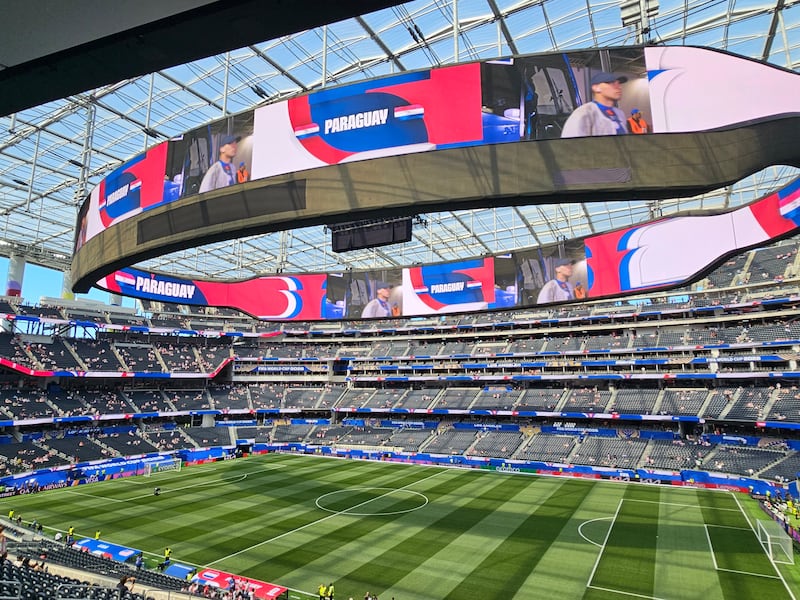
The World Cup halftime show during the final is “expected to be about 30 minutes long to accommodate Fifa’s star-studded show,” which means it will be “breaching the maximum time of 15 minutes permitted under the Laws of the Game,” according to Martyn Ziegler of the London TIMES. FIFA has a “history of ignoring the permitted 15 minutes” as its halftime break in the Club World Cup final last year stretched to 25 minutes. It has “declined on several occasions to confirm the total expected length of the break” at the World Cup final in N.Y./N.J., but broadcasters are “expecting it to be around 30 minutes.” CONMEBOL has previously “proposed extending the maximum half-time length to 25 minutes but that was rejected” by the International FA Board, the law-making body, in 2021. Singers Madonna, Justin Bieber, Shakira, BTS, Burna Boy, Gustavo Dudamel and the PS22 Chorus featuring Coldplay are due to perform at the “Super Bowl-style half-time show.” There will also be a closing ceremony show starting 90 minutes before the 3pm kick-off involving singer Robbie Williams, actor Tom Cruise and singer Nicole Scherzinger (London TIMES, 7/14).
BREAK IN TIME: THE ATHLETIC’s Sheldon & Crafton wrote it is “highly unusual for the 15-minute break to be extended,” so it will “create a unique challenge for the players and coaches who are not accustomed to a longer interval.” This is the first time FIFA has held a halftime show at the World Cup, but it did have one during last summer’s Club World Cup final. A key difference for the World Cup final is that the show “will take place on the pitch, meaning a stage will need to be erected and collapsed before and after the performance” (THE ATHLETIC, 7/14).
CHANGING THE GAME: In London, Jason Burt writes FIFA appears to “be on a mission to Americanise football into soccer.” With the addition of hydration breaks, it all “seems part of the determination to wring every last bit of revenue out of the World Cup as it allows TV companies to cover the cost of rights by selling more airtime to advertisers.” It also “plays to the theory that everyone has the attention span of a gnat, especially young people, and the prospect of them watching one uninterrupted 45 minutes is unthinkable.” For players, there is “little regard for how much hanging around they are now doing” (London TELEGRAPH, 7/15).
World Cup speed reads
- The big winner from Wednesday’s World Cup semifinal between England and Argentina could be Jude Bellingham, the English midfielder’s star has been ascending with brands. He’s already secured deals with the likes of Adidas and Skims (Financial Times).
- Argentina doesn’t have the support of much of Latin America, as the nation has long viewed itself apart from its neighboring countries (N.Y. Times).
- FIFA President Gianni Infantino is facing a compliant lodged with the IOC about alleged violations of neutrality rules when it comes to his dealings with President Trump (London Independent).
- K.C. is setting its sights on major international events coming to the U.S. after showcasing its hosting capabilities during the 2026 World Cup (K.C. Star).
Elsewhere in the industry
- The Texas Rangers abandoned the digital platform Victory+ effective immediately and will instead stream their games on the freshly designed DTC service BZZR, reports SBJ’s Tom Friend. In another move reflecting the financial challenges inside Victory+, sources tell SBJ’s Alex Silverman that the Ducks informed the streaming platform that they intend to terminate their local streaming agreement.
- Sources tell Friend that WNBA Commissioner Cathy Engelbert was not planning to suspend Alyssa Thomas for burying a fist into Caitlin Clark’s throat three weeks ago until NBA Commissioner Adam Silver implored her to reverse course.
- ESPN enjoyed a record audience for the 2026 Wimbledon women’s singles final, as Linda Noskova’s dramatic three-set victory over Karolina Muchova averaged 1.9 million viewers, up 48% from Iga Swiatek’s straight sets win in 2025, reports SBJ’s Rob Schaefer.
- Schaefer also writes that the ATP is rolling out an activation of the marketing deal it signed with Spotify last November branded “Tour Sounds.”
- NBA Commissioner Adam Silver expects the league’s streaming hub for local broadcasts to launch in time for the 2027-28 season, with sources telling Friend that YouTube is a leading candidate to house it. Friend also reports that Silver expects the league will resolve the Clippers-Kawli Leonard case before summer’s end.
- Over the next three weeks, the Savannah Bananas and their five spinoff teams will combine to play three games at Wrigley Field, three more at Target Field and games at a college football stadium and eight minor league ballparks, reports SBJ’s David Broughton.
- Five months after a congratulatory phone call from President Trump triggered backlash against the U.S. men’s hockey team, the women meant to be the butt of the joke are getting a celebration of their own, with Flavor Flav and a host of top brands stepping in to honor them, writes SBJ’s Rachel Axon.
- Paciolan launched PAC SMS Marketing, an integrated text-messaging channel that client schools can access in the existing Paciolan Marketing Automation platform, reports SBJ’s Grace Kut.
- Rights holders and brands are fighting distraction on just about every level as multiple forms of entertainment pull at the attention spans of sports fans. Wednesday’s op-ed examines the future of branded content in this environment.