

Tonight in Unpacks: New York City remains the epicenter for finance and media in the U.S. But this weekend, it’s the epicenter of global soccer, from business to fandom, as SBJ’s Joe Lemire reports on how the city has embraced its status as the home of the 2026 FIFA Men’s World Cup championship game.
Also tonight:
- Analyzing the star power of Messi and Yamal
- Fox Sports’ Brad Zager dishes on World Cup ahead of blockbuster final
- MLS narrows commissioner search to three
Listen to SBJ’s most popular podcast, Morning Buzzcast, where Abe Madkour wraps up the week with thoughts on the Argentina-Spain matchup in Sunday’s World Cup final, Texas Tech’s big 15-year naming-rights deal for its football stadium, MLB showing how it’s at its best when producing big events and more.
New York City thrives as World Cup final host, epicenter of global soccer business
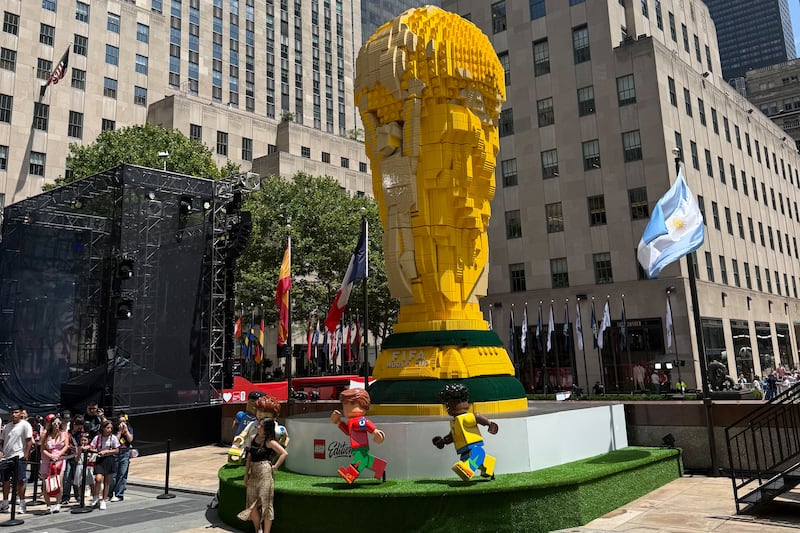
NEW YORK — Two days before the World Cup final, Andrew Giuliani had a pitch to see.
The executive director of the White House Task Force on the 2026 FIFA World Cup had just exited 30 Rock, with the revolving doors opening directly into the NYNJ World Cup 26 & Telemundo Fan Village. Giuliani stood nearly in the shadow of a nearly 28-foot-tall Lego replica of the World Cup trophy, and at this moment, he wasn’t off to see the actual match pitch in New Jersey, but, rather, a small soccer field staged in the same sunken space occupied by the famous ice rink every winter.
The temporarily named New York New Jersey Stadium may be hosting Spain and Argentina for a couple hours Sunday, but Friday, New York City was the epicenter of the global soccer business.
“When FIFA ultimately selected New York to host the final, there were other cities that had fantastic bids and fantastic ideas, but you’re talking about a city that might not be the capital of the state of New York, might not be the capital of the United States of America, but it is the capital of the world,” Giuliani told SBJ, marveling at “how the United States of America over the last 37 days has been shown in its greatest light.”
Populating Rockefeller Center were booths from Lenovo, Home Depot, Panini, Lego and Bank of America, whose charm bracelets were the surprise hit of the tournament. Lines to gain access to the booth started forming around 6am, with tickets distributed at 7 for time slots later in the day; the day’s allotment was claimed by 9:30am. An official FIFA retail location took up residency in a Rock Center storefront, while at least one nearby NYC street vendor was selling (presumably unofficial) World Cup soccer jerseys.
BofA recently estimated a $40B overall economic impact from the World Cup on the continent, with $20B in the U.S. alone. Former USMNT player and current Fox Sports analyst Cobi Jones arrived in New York on Thursday evening and saw plenty of jerseys around the city.
“That’s what you want, not just on game day, but in the buildup — that European vibe,” Jones said.
Noting that Los Angeles hosted the 1994 final, Jones added that it only made sense to bring this championship match to the country’s other bicoastal metropolis. “It’s going to sound cheesy, but it’s New York‚” he said. “It’s the center of business and media.”
A half-dozen blocks south of Fan Village was FIFA House, the federation’s premium hospitality space overlooking Bryant Park. It had transformed completely over the past week, from an empty, historic building into a bustling center of activity.
“What makes New York unique isn’t just that it hosts the World Cup final — it’s that the city becomes football’s global headquarters,” said Andrew Bimson, President of iLUKA Americas, which developed FIFA House. “For one week, every major stakeholder in the game is here, creating an unmatched concentration of ideas, investment, partnerships and influence.”
On the 10th floor of FIFA House was the Globant Tech Summit on Friday morning. The technology services provider and official FIFA sponsor is an Argentinian-headquartered company, so its executives, needless to say, were ebullient at the prospect of Sunday’s match. The panels featured speakers from Anthropic, FIFA, Fox Sports and La Liga with attendees from a variety of sectors. Nicolás Ávila, the CEO of Globant’s division overseeing sports, said that the NYC location helped attract a broader cross-section of attendees seeking cross-industry learnings.
Less than a mile away at the 40/40 Club was an exclusive invitation-only lunch held by Fanatics CEO Michael Rubin that included FIFA President Gianni Infantino, the commissioners of MLB, NBA and MLS (Rob Manfred, Adam Silver and Don Garber) and legendary athletes Tom Brady, LeBron James and Serena Williams.
Numerous soccer kits were spotted throughout Midtown Manhattan, and jerseys of all sports were en route to the Javits Center near Hudson Yards for Fanatics Fest, the bustling sports convention conceived of by Rubin. The energy will only grow throughout the day prior to the official FIFA World Cup final press conference held in conjunction with Fanatics Fest. Among the expected speakers were Argentina’s Lionel Messi and Spain’s Rodri.
This Week at the World Cup: Analyzing the star power of Messi and Yamal

While a World Cup final between England and France may have been a more in-demand ticket, the Argentina-Spain matchup that materialized instead features two of the most marketable athletes on the planet: Lionel Messi and Lamine Yamal. Much like the Tom Brady vs. Patrick Mahomes showdown in Super Bowl LV, Messi vs. Yamal pits the player widely regarded as the greatest of all time against a gifted young challenger seeking to inherit the mantle.
Brands lined up to associate themselves with both players ahead of the World Cup. Messi and Yamal each appeared in multiple TV spots and entered the tournament with robust rosters of blue-chip commercial partners.
The obvious question is which player is more marketable. SportsPro’s 2025 ranking of the world’s Most Marketable Athletes placed Messi 16th overall and Yamal 23rd. But NorthStar Solutions Group, the research firm behind those rankings, argues that the more useful question is how each athlete can best serve a brand’s objectives.
“They’re both very marketable,” NorthStar CEO Chris Collins said. “Who’s more marketable depends on who’s looking at them.”
In terms of sheer scale, Messi’s years of greatness have allowed him to amass a far larger social following, with 512.7 million Instagram followers compared with Yamal’s 46.4 million. Yet despite having less than one-tenth as many followers, Yamal has generated a surprisingly comparable level of media and social activity over the past six months. NorthStar’s analysis of Lumen by Talkwalker data identified 13.9 million results and 700.9 million engagements for Messi, compared with 11 million results and 567.7 million engagements for Yamal.
Yamal’s smaller Instagram audience is also far more engaged on a percentage basis. The 19-year-old Spaniard has an estimated engagement rate of roughly 6%–6.8%, compared with about 0.35% for Messi. While engagement rates naturally compress at Messi’s scale, NorthStar said the comparison demonstrates the intensity of Yamal’s relationship with his current audience. Yamal is also active on TikTok, a key platform for brands seeking to reach younger consumers, while Messi does not maintain a presence there.
The firm’s analysis, however, goes beyond the numbers. NorthStar classifies talent into nine different “personas.” Messi best fits the mold of the “Cultural Icon Persona,” with his value emanating from established meaning: excellence, family, legacy, global connection and the ability to travel across categories and markets. Yamal is identified with the “Rising Star Persona,” with his value tied to trajectory: youth, creativity, representation, platform-native participation and an identity that audiences are still helping to form.
Collins likened Yamal to “a growth stock or IPO” and Messi to “a large-cap value-type investment.”
Messi offers brands established global scale, likely at a significant premium. Working with Yamal offers brands the chance to grow their relevance alongside the young star’s profile, albeit with greater long-term uncertainty.
“Messi is bringing a turnkey solution, so you’re just paying for that,” Collins said. “For Yamal, it’s more of almost a co-partnership of continuing to build out and potentially benefit from the athlete’s brand.”
“If you’re a small, growing company, probably in tech or digital … probably Yamal,” Collins said. “If you’re a more established, larger company with a global focus … probably Messi.”
What happens on the pitch Sunday has the potential to influence the trajectories of Messi’s and Yamal’s respective personal brands. A loss is unlikely to tarnish Messi’s cemented legacy, while a second straight World Cup title would further strengthen his standing as one of sports’ most revered public figures. For Yamal, a starring role in a Spain victory would accelerate his ascent as the sport’s next global icon, while an underwhelming performance could delay the coronation.
Quote of the Week: “Yes, those photos you’ve seen are real.” -- A UNICEF social post, verifying the authenticity of photos of Messi at age 20 with a baby Yamal.
Yes, those photos you’ve seen are real.
— UNICEF (@UNICEF) July 16, 2026
More than 18 years ago, a baby named Lamine Yamal and his mom Sheila met Lionel Messi at a UNICEF fundraising photoshoot.
Today, their achievements on the pitch inspire millions. Off the pitch, both Messi and Lamine Yamal use their voices… pic.twitter.com/TSoUPDxia2
MLS clubs meet new fans: MLS clubs that were willing to invest heavily in on-the-ground activations during the World Cup are consistently saying that their efforts have delivered results in the form of new fan records in their databases. In a piece on the league’s post-World Cup marketing efforts, we highlighted the Chicago Fire and Austin FC, each of which had added roughly 50,000 new prospective customers into their ecosystem.
Perhaps not surprisingly, second-year club San Diego FC has also experienced a massive influx of fan records, with CEO Tom Penn telling SBJ that the club has added around 90,000 new emails through its tournament-long watch party setup at Fit Social on Mission Beach.
“The demand was overwhelming,” Penn said. “I kind of thought there’d be slow days or slow matches, but it was 10 a.m. on a Tuesday and people wanted to be there.”
Free Kicks
- FIFA’s stringent enforcement of commercially clean environments at World Cup venues has been well documented throughout the World Cup. It turns out, however, that the governing body was willing to make an exception for hip-hop legend Jay-Z. According to Bill Lohr, Delaware North Sportservice’s general manager at MetLife Stadium, Jay-Z requested that Armand de Brignac -- better known as Ace of Spades -- be served in his suite during a World Cup match at the venue. Lohr said his staff had to get permission from FIFA before selling Jay-Z the champagne brand he co-owns rather than the tournament’s official champagne, Taittinger. Check out our story on the final for a sneak peek at the private suite menu for Sunday’s match.
- One sore spot in an otherwise spectacular World Cup has been the use of VAR and semi-automated offside technology to enforce offside at a nearly microscopic level. The latest example was the decision to disallow a brilliant goal by Yamal in Spain’s semifinal win against France. In a post on LinkedIn, Canadian Premier League Commissioner James Johnson (a guest at SBJ’s Business of Soccer conference in March) pointed out that under the Daylight Offside rule being tested in his league, the goal would have stood. In fact, 20 of the 28 goals taken off the board for offside in the World Cup would have counted in the CPL. It would be easy to dismiss the experiment as a gimmick in a relatively small league, but two new rules introduced ahead of this year’s World Cup originated in MLS NEXT Pro, the third-tier league operated by MLS. Not only that, Daylight Offside has long been championed by FIFA Chief of Global Football Development Arsène Wenger.
What’s Happening
SBJ is tracking the dozens of industry gatherings, watch parties, fan zones and other happenings surrounding the World Cup. Here’s a selection of events worth your attention:
Fox Sports’ Brad Zager dishes on World Cup ahead of blockbuster final

This year’s World Cup final is the stuff of dreams for a sports television executive -- a mouthwatering matchup between soccer heavyweights Spain and Argentina, the first time in World Cup final history where the reigning European champions (Spain) will meet the reigning Copa America winners (Argentina). Asked how he would have reacted had you told him three weeks ago that Spain-Argentina would be the final game of this year’s World Cup, Fox Sports President and Executive Producer Brad Zager could hardly wait to answer.
“I would have jumped up and down,” Zager said. “If you would have told us before the tournament that the semifinals were the semifinals we got or that we would get a combination of those four teams in the semifinals, we would’ve signed up for that on day one with the obvious caveat being that the U.S. going on an unparalleled, shocked-the-entire-world streak. Those four teams being there allowed us to kind of take a breath on the eve of the semifinals knowing that we were going to be in really good shape on Sunday given the countries and the amount of stars we were going to have in a final.”
Zager spent much of this week in N.Y. working on production elements and meeting with on-air talent but he will watch the final from the control room at Fox Sports’ studios in L.A. He spoke with Sports Business Journal on Thursday night for 30 minutes, the first time during the World Cup that Zager has given extensive comments on the production.
“I know it is impossible to have 33 million viewers all agree on everything that they want -- 33 million was our number for that U.S.-Belgium match -- but during the tournament we wanted something for everybody,” Zager said. “I think we ended up checking a lot of boxes and hopefully everybody saw that we tried to have coverage not just for hardcore fans but something for both hardcore fans and general sports fans too.”
One box clearly checked for the company was robust viewership. Through the semifinal game between Spain and France, the men’s World Cup had averaged 7.128 million viewers over 101 matches across Fox, FS1, and Tubi. Viewership is up 119% from the 2022 men’s World Cup telecast average on Fox and FS1 (3,248,000 viewers). Zager said the viewership numbers for the tournament exceeded all of their internal projections.
“Anytime you go into any big event, you use words like cautiously optimistic,” Zager said. “I always referred to this World Cup as having the feel of a tidal wave. Everybody knew this big event was coming but nobody realized how it was going to engulf all of us and captivate us until we actually were in it. We never looked at this as a sporting event. We’ve looked at it as a cultural event that nobody would want to miss out on even if they weren’t a hardcore soccer fan. I think that’s what you’ve seen with the ratings. Thirty-nine days is a long time for a sporting event, and for people to get this caught up and to stay this caught up in it, it’s been so cool to see.”
Zager, unsurprisingly, had a ton of praise for his on-air talent. On the work of lead broadcasters John Strong and Stu Holden, who will have called 22 matches in 39 days after Sunday’s final, Zager said, “They have established themselves over the course of multiple World Cups as a true lead announce crew. I think Stu has taken his whole game to another level as an analyst, first guessing and letting people know what’s going on tactically.”
Zager said he believed his studio group from a presentation, comfort and announcer standpoint continued to gel throughout the tournament.” Asked specifically if he would be interested in having Rebecca Lowe, Thierry Henry and Zlatan Ibrahimovic return for a potential 2030 World Cup if Fox retained the media rights and things could be worked out with their other employers -- all were first-time hires for Fox Sports -- Zager said he definitely would.
“All three of those names that you mentioned all came with overcoming some hurdles,” Zager said. “Most good things don’t come easy. When you look at Rebecca, Zlatan, Henry and Lex (Alexi Lalas), anything that we had to do to bring that crew together was worth it. I would start that by saying thank you to NBC Sports and Sam Flood for not hanging up on me when I made that phone call a year and a half ago or whenever it was to say, hey, listen, we would love to use Rebecca on this. With Zlatan it was convincing him that we wanted him to be Zlatan on air and not try to be television broadcaster Zlatan. We wanted him to be authentic to who he was and that was a process. Henry obviously has proven himself to soccer fans for many years with his coverage at CBS and the Champions League. He has proven that he can translate soccer to not just hardcore soccer fans, but to the general sports fan. I feel like we put together a crew that there was something for everybody.”
Fox is not a broadcaster that has offered a lot of criticism of FIFA or FIFA President Gianni Infantino during its run as a World Cup broadcaster. Asked how he saw the coverage on the more controversial elements of the tournament, Zager said, “We feel like any story that came up during this World Cup that impacted what people were about to watch during the match, we feel like we covered really well. If that was the red card incident or the suspension of the red card, if it was anything that impacted today’s matches, that’s where we feel like we excel. We feel like people are tuning in to be prepared for that match. As far as the other stuff that may have come up or somebody’s thoughts on any organization or people, we didn’t feel like that was our place. I feel like anything that came across these 39 days that impacted the way people were going to watch a game, we covered and got analysis on. Any of the other stuff that people may have talked about around it, we left for those people who have column space or podcast space to fill. Our goal is always to kind of focus on preparing people to enjoy the World Cup each day.”
Zager said he wanted to publicly offer praise for Judy Boyd (EVP/Production), Joel Santos (VP/Production), Zac Kenworthy (VP/Production) and Courtney Stockmal (studio director) for their work on the production side. “To go in with a plan but then continually evolve every day gives me goosebumps talking about how they led from a creative perspective,” Zager said. He also praised operations heads Kevin Callahan, Rod Conti, Greg Pfeifer and Deb Pfeifer for navigating three different countries and 19 different venues including all of the stadiums, Fox’s L.A. office, its Tempe distribution center, and the International Broadcast Center in Dallas.
The most-watched World Cup final in English-language U.S. television history came four years ago between Argentina and France, which drew an average of 16.7 million viewers on Fox. Sunday’s final will undoubtedly top it. A spokesperson for Fox Sports confirmed that Host Broadcast Services (HBS), which produces and directs World Cup matches, will have around 60 operated cameras for the final while Fox Sports will have 18 cameras of its own between all of their on-air talent sets.
The 2030 World Cup will be jointly hosted by Morocco, Portugal and Spain, and Fox’s current World Cup deal with FIFA ends with this tournament. Given the massive U.S. interest this month, I asked Zager if Fox was interested in bidding on the 2030 World Cup.
“Absolutely,” Zager said. “We’re looking forward to those conversations when they begin. We’re really proud of the relationship that we’ve had with FIFA. Not just because of the relationship with FIFA, but because of the product we have put on the air with the men’s and women’s World Cup. Those are things we think are signature Fox Sports moments. What we’ve been able to do with the men’s World Cup, with the pinnacle being this North American World Cup, we’re really proud of everything that we’ve done. We look forward to conversations about how we continue to build off of it in the future and when those conversations happen, we’re looking forward to engaging and figuring out how to move forward.”
MLS narrows commissioner search to finalists

MLS’s search for a successor to outgoing commissioner Don Garber has been narrowed to three candidates: LAFC co-owner Larry Berg, 49ers Enterprises President Paraag Marathe and former Fox executive David Nathanson, according to sources with knowledge of the process. The candidates are expected to make presentations to MLS owners in the coming weeks, with a decision expected as early as next month.
However, the list of finalists has since dwindled to just Nathanson and Berg when Marathe pulled his name from consideration, according to a person familiar with his thinking.
The process has been unfolding since last November, when SBJ reported that MLS owners had formed a succession committee and retained The Miles Group to develop a plan. The search has progressed quickly over the past few months since MLS owners retained Korn Ferry around the start of the current season.
Puck’s John Ourand first reported the names of the three finalists on Friday, with Sportico the first to report Marathe’s decision.
MLS issued a statemet, saying, “Major League Soccer’s Board of Governors has been engaged in a comprehensive succession planning process. As part of that effort, a number of highly qualified individuals have been considered. The MLS Succession Committee is working with the Commissioner and the Board on this ongoing process.”
The two finalists have ownership stakes in MLS clubs, with Berg serving as co-managing owner of LAFC and Nathanson holding a minority interest in the Sounders.
Berg, who was among the earliest names to emerge as a potential successor to Garber, comes from the world of private equity. He spent 30 years as a senior partner at Apollo Global Management before moving to investment firm 26North in 2023. He was a limited partner in LAFC in 2014 when MLS awarded the new club to an ownership group led by Henry Nguyen for a $110M expansion fee, but led an internal buyout along with fellow investors Bennett Rosenthal and Brandon Beck in 2016, two years before LAFC ever took the pitch. The club has been among the league’s most successful since its 2018 debut -- winning an MLS Cup, U.S. Open Cup and two Supporters’ Shields -- and is consistently ranked among MLS’s two most valuable franchises at more than $1B.
Nathanson brings a strong background in sports media after spending more than 20 years in the space, mostly with Fox. He has also been an active investor. In addition to his stake in the Sounders, he was a founding investor in NWSL club Angel City FC and the NHL’s Kraken. His family’s holding company, Mapleton Investments, also manages a West Coast real estate portfolio that it values at more than $710M. Nathanson’s father David founded Falcon Cable, which sold in 1999 for $3.7B.
Garber’s contract runs through the end of 2027, which falls in the middle of the 2027-28 MLS season following the league’s decision to adopt a summer-to-spring calendar beginning next summer. The new commissioner will be immediately tasked with negotiating a new CBA ahead of the current deal’s expiration in January 2028 and a new media rights agreement with the Apple deal set to expire after the 2028-29 season. He will also be responsible for charting MLS’s broader strategic direction, which could include reforms to the league’s stringent roster rules that would allow clubs to be more competitive globally.
World Cup speed reads
- ESPN Chair Jimmy Pitaro confirmed the network will bid on the media rights for the 2030 World Cup. ESPN had broadcast the tournament from 1994 to 2014 until Fox Sports began airing the event in 2018 (Deadline).
- This World Cup could push Spain F Lamine Yamal to superstardom if he can help his team lift the trophy Sunday by beating Argentina and F Lionel Messi, maybe even becoming his heir apparent as the world’s greatest player (Yahoo Sports).
- Argentina F Lionel Messi will appear Friday night at the official FIFA World Cup final press conference at Fanatics Fest less than 48 hours before he attempts to lead Argentina to back-to-back World Cup titles (SBJ).
- FIFA Senior Pitch Management Manager Alan Ferguson said he’s “confident” that the grass at N.Y. N.J Stadium is in excellent condition for Sunday’s World Cup final (The Athletic).
- TickPick data shows that the World Cup final between Spain-Argentina at N.Y./N.J. Stadium on Sunday could be the most expensive for a sports event in U.S. history, with an average purchase price of $11,327 (USA Today).
- U.S. World Cup Chief Andrew Giuliani said the Trump administration is “signaling” that the nation’s cooperation with the 2031 Women’s World Cup will depend on FIFA’s transgender athlete rules aligning with U.S. policies (Politico).
- Former soccer player Carlos Bocanegra, who played on the USMNT from 2001-2012, said a key next step for U.S. Soccer is to have a clear vision for the program’s future before hiring the next coach (“Unfiltered Soccer”).
Elsewhere in the industry
- Texas Tech is dropping the longtime name of its football stadium — Jones AT&T Stadium — as part of 15-year, near-$75 million sponsorship with tech and data center infrastructure provider Galaxy that will include the naming rights to the venue, reports SBJ’s Ben Portnoy.
- Fox had its best audience for the MLB All-Star Game since 2018, drawing 8.8 million viewers in English and Spanish (Fox Deportes drew 119,000 viewers), writes SBJ’s Austin Karp.
- The Cubs are taking an initial step to hosting the 2027 MLB All-Star Game with a pregame “handoff” ceremony before their Friday night game against the Twins at Wrigley Field, notes SBJ’s Terry Lefton.
- Phillies CEO and Managing Partner John Middleton said hosting MLB’s five-day All-Star festivities and shared some of his favorite memories from the experience, such as the postseason-like atmosphere around the Home Run Derby, writes SBJ’s Mike Mazzeo.
- The Lakers made L.A.-based Albert their jersey patch sponsor, as the personal finance app crosses locker rooms from the WNBA’s Sparks and strikes its first deal with an NBA franchise, reports SBJ’s Tom Friend.
- Friday’s op-ed suggests the brand-building strategies of the Knicks and Arsenal are brand models for other teams to follow — especially for building followings outside sports.