

Tonight in Unpacks: The American Conference’s rebrand is just one strategy that Commissioner Tim Pernetti and his team have deployed to make the league more competitive on an increasingly harrowing business battlefield, reports SBJ’s Ben Portnoy.
Also tonight:
- Tepper adds $500 million to stadium renovation plans
- Earthquakes add sales software Apollo as sleeve sponsor
- MLB All-Star MVP was a fan tool
- Op-ed: Organizational behaviors build brands
Listen to SBJ’s most popular podcast, Morning Buzzcast, where Abe Madkour discusses the top TV markets for the World Cup, Fred Mangione becoming the latest exec from pro sports taking a college business role, the Chiefs showing off renderings of their planned stadium in Kansas and more.
Inside the American Conference’s effort to remake its office for college sports’ new business reality

There was something prophetic in the way Tim Pernetti spoke in Las Vegas two years ago.
As slot machines chimed and poker chips clacked inside Mandalay Bay, the newly hired American Conference commissioner described why he had willingly stepped into the chaos of college sports.
“When there’s chaos and uncertainty,” Pernetti said then, “that’s when there’s more opportunity to do things differently.”
Twenty-four months later, that’s exactly what the American has done.
The American launched its commercial arm, American RISE Ventures; brought sponsorship sales in-house; and instituted a conference-wide revenue-sharing floor of at least $10 million.
These efforts are not entirely novel. But together they’ve made the American one of the fastest-moving conferences in college sports at a time when being a first mover is more beneficial than ever.
“We’re operating at a moment in time where the status quo is no longer sustainable,” said East Carolina President Philip Rogers, who chairs the league’s board of directors and had a key hand in hiring Pernetti in 2024. “I’m incredibly proud that our member institutions and our presidents, in particular, have made a commitment to aggressively charting our own course in a competitive landscape, as opposed to letting external forces define the future for us.”
Pernetti preached an “adapt or die” mentality during that afternoon in Vegas. College sports, he’d tell you, are changing too quickly to pearl-clutch over what was. The imperative is to focus on what’s to come while marrying those needs with the tradition and culture that have made college sports a billion-dollar enterprise.
The American is intent on doing just that.
“The business of college athletics has changed,” Pernetti said in a recent interview. “And we wanted to build a structure that was built for speed and was more in line with where the business was headed.”
Building the playbook
If Pernetti supplied the vision, Bryan Calka supplied the commercial playbook.
The Hobart grad spent his career at Merrill Lynch, Washington Sports & Entertainment, BSE Global, the New York Yankees, New York Islanders and Professional Fighters League. College football, those are not.
That’s exactly what Pernetti wanted. The pair spent the last year importing pro sports’ commercial instincts and adapting them to college.
“It’s only been a year,” Calka said. “But it feels like we’ve been doing it for a lot longer, I’ll tell you that much.”
American RISE Ventures has become the clearest example of the league office’s commercial vision.
RISE — short for Revenue, Innovation, Sports and Entertainment — brings the conference’s efforts around revenue generation, sponsorship strategy, media rights and brand partnerships under one roof. The goal: create assets the conference owns and can monetize itself.
Take this week, when the league is slated to roll out the “American Tailgate Tour” — a branded game-day activation that will appear at marquee football games.
“The Tailgate Tour, it’s not a freakin’ tent,” Pernetti quipped, his New Jersey accent shining through. “It’s a live mobile fan engagement platform.”
The idea is threefold: 1) to better engage fans on campus and gather more information about them; 2) promote the league’s IP for monetization, such as the conference mascot, Soar the eagle; and 3) create sponsorship capabilities using fan information gleaned from the tour.
The tour’s plans are to be at Temple vs. Penn State on Sept. 12, USF vs. Memphis on Nov. 12, FAU vs. USF on Nov. 21 and the American Championship Game on Dec. 5.

Though he declined to share exact figures, Pernetti said the shift to RISE helped the American double gross revenue in its first year. The league was roughly 80% of the way to its goal for the current fiscal year, he added.
“I do believe this model is a model that should exist in our space more often than not,” Calka said. “The ability to go and change how — whether it’s a university or a conference — goes and looks at their rights from all different angles should be something that every school around the country is taking a look at.
“Not necessarily just looking for a guarantee from somebody, but really trying to figure out how they guarantee their own success by taking all of their rights and finding ways to monetize them appropriately.”
Schools such as Clemson, North Carolina, Michigan State and Kentucky have leaned into creating corporate LLCs to roll their commercial assets into a single vertical. At the conference level, the Big 12 and Commissioner Brett Yormark — a longtime friend of Pernetti’s in the New York sports scene — took their corporate sponsorship sales in-house shortly after he landed the commissioner job in 2023.
The American’s commercialization extends beyond RISE. The league underwent a major rebrand with Anachel last year, including new looks and dropping the “Athletic” from its name. Staffing has also been key. The conference added senior staffers Julianne DiMattia from The Players’ Tribune and Kelli Sargenti from the New York Jets. Pernetti is slated to announce this week the hire of Chief Brand Officer Eryn McVerry, who comes to the league from Maryn & Co. and spent time with the NHL’s Tampa Bay Lightning and Chicago Blackhawks.
The American has also held discussions with about a half-dozen companies around naming rights opportunities, à la the recent Big 12 deal with Monster Energy.
“We at the school level are all trying to find ways to navigate the current environment, and we all need to adapt and adjust to how we structure our business, how we operate on a daily basis,” Tulsa Athletic Director Justin Moore said. “The conference is no different. … We’re all looking for new revenue in this era. The conference being able to structure itself in a way to help us in those areas is more important now than it has ever been.”
What’s next
The American’s football media days kick off this week in Tampa with a new flavor.
Tulane’s Jon Sumrall is off to Florida. South Florida’s Alex Golesh is now the coach at Auburn. Ryan Silverfield departed Memphis for Arkansas, while North Texas’ Eric Morris is now at Oklahoma State.
Nobody in the American office is shedding a tear, per se. It’s emblematic of progress.
“Winning has created attention,” Pernetti said. “The way we’re setting up the organization and RISE Ventures and the things that we’re doing, the minimum investment, are creating attention. … Interest is proof positive that people outside of college athletics are watching what we’re building.”
Pernetti’s annual address on July 24 will coincide with a slate of announcements for a league that has designs on fighting to represent the top of the Group of Six.
“The ability to go and change how — whether it’s a university or a conference — goes and looks at their rights from all different angles should be something that every school around the country is taking a look at."
— Bryan Calka, chief commercial officer, American Conference
The tailgate tour is on the docket. As is the hiring of McVerry. The league is also slated to announce an expanded sponsorship deal with LLH Healthcare, which will serve as the title sponsor of the league’s football championship game and have heavy integration into its men’s and women’s basketball championships.
Perhaps more crucially, the league is slated to unveil a three-year deal with StubHub that it’s promoting as the first “open distribution” partnership in college sports. The deal is designed to increase ticket sales at American Conference championship events and generate more revenue through StubHub’s marketplace and audience.
“Across the entire conference office, as you talk with staff members in a number of positions, you clearly understand that everyone is looking for new ways of doing things,” Tulane AD David Harris said. “There’s an acceptance that it’s OK to do things a little bit differently. It’s OK to explore new options; things that maybe we’ve stayed away from in the past are now on the table for conversation.”
This week, there will be no slot machines or casino sounds to distract from the words Pernetti figures to preach from the podium as the American kicks off its football season in Florida.
The announcements underscore where Pernetti wants to take the league. The American has become a proving ground for football coaches. Pernetti was even in the mix to become the new head of the NFLPA over the offseason.
Such is the price of success.
Tepper S&E adds $500M to stadium renovation plans, reveals renderings

Tepper Sports & Entertainment will spend $500M more than originally expected to renovate Bank of America Stadium, revising the total project cost upward from $800M to $1.3B, CEO Kristi Coleman said. The city of Charlotte’s $650M share is unchanged.
That disclosure came Thursday alongside the release of the most comprehensive set of artist’s renderings to date for the project, which is already underway and expected to be completed in 2030. HOK is the architect.
The renderings show one completely new structure for the first time: a previously announced 4,400-seat music venue on the northeast side of the stadium. Also, architects plan radical changes to the outside of the 30-year-old concrete façade, replacing it with glass walls, an open-air premium space and an expanded upper deck concourse.
The music venue developed out of owner David Tepper’s conversations with fans, Coleman said, who added that fans want more than a football game when they visit. TSE projects the venue can host between 80-100 shows annually.
“A lot of our fans said, in talking to [Tepper], ‘We’re coming from Raleigh or Charleston for the Panthers games, and we want more to do in Charlotte. Charlotte is a growing city, there’s seemingly so much to do, but we want something right there in Uptown,’” Coleman said.
0 of 12

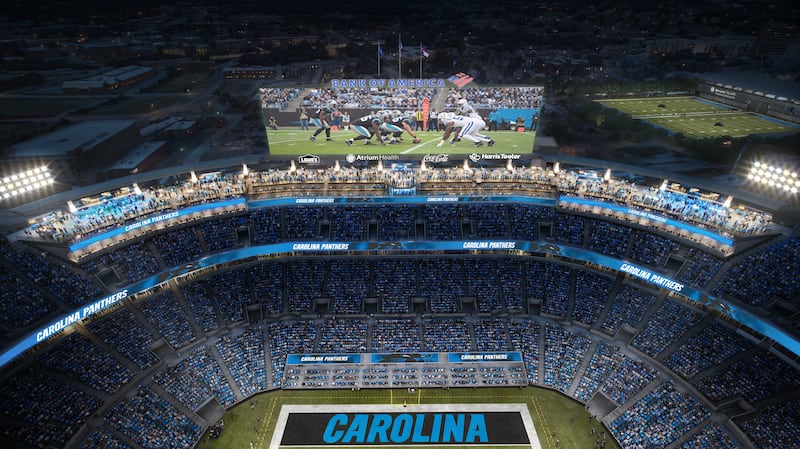

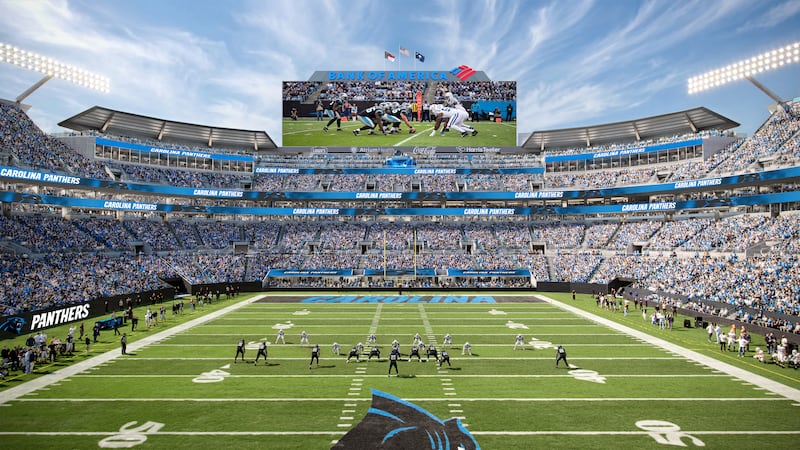


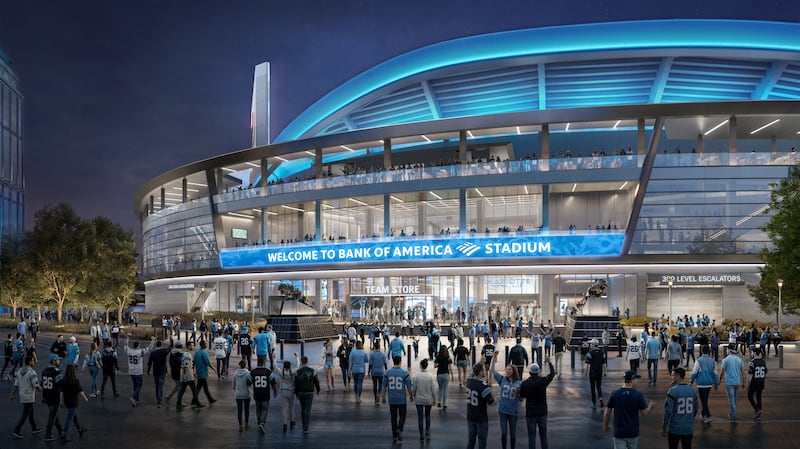


Also Thursday, Bank of America announced a long-term renewal to its naming rights on the facility, ensuring the Charlotte-based megabank will have its name on the structure far into the future. BofA had struck a short-term deal in 2023 as the organization and city developed the renovation plans, but was prepared to go long once the plan was in place.
“The stadium has in many ways become synonymous with the Bank of America brand,” said BofA Global Sports Partnerships Executive Elliott Cox. “Over 20-plus years, we’ve built a tremendous amount of brand equity with the Panthers. We’re excited to step into the next chapter with Tepper Sport and obviously the exciting projects that are getting ready to kick off across the street.”
Other major changes depicted in the renderings include: a large social patio area on the upper deck’s northwestern side, which will include a DJ/game-day experience stage; covered bars and standing-room-only space; an expanded team store; comprehensive upgrades to premium club space; and a new club space overlooking the east gate with views of Uptown. In general, a major goal of the renovations is make better use of the eastern sides of the stadium, which face the bulk of the center business district, in terms of fan activity, ingress and egress and revenue generation.
The top of the stadium will have new lighting at night, meant to evoke a “crown” in a nod to the city’s “Queen City” nickname.
Every seat will be replaced, and the entire audio-visual system will be replaced. The behind-the-scenes upgrades are already underway, with fan-facing renovations starting in 2027.
Overall, the renovated stadium will include much more diversified options for seats, in both price point and experience, officials said. The new seating manifest is not final yet.
“We did previously have one of the largest upper decks in the NFL, and we’ll continue to have that,” Coleman said. “But what we’re most excited about is the diversity in offerings, so people can enjoy the game a little bit differently.”
Neither financial terms nor time duration of Bank of America’s renewal were disclosed. The initial 20-year deal starting in 2004 was worth $7M annually. This is Bank of America’s only naming-rights deal, but it also sponsors five NFL teams -- the Cowboys, Commanders, Patriots, Rams and Panthers -- and has deals with The Masters and the just-completed FIFA World Cup. The renewal comes as U.S. Bank starts its term as the NFL’s official bank at the league level. Octagon, Bank of America’s agency of record, advised on some elements of the deal.
Earthquakes add sales software Apollo as sleeve sponsor

The Earthquakes have signed AI sales software firm Apollo to a multiyear jersey sleeve sponsorship agreement that designates it as the club’s official go-to-market partner. The MLS franchise will also begin utilizing Apollo software for key revenue-generating functions, including group ticket sales, sponsorship pipeline management, inbound lead routing and season-ticket renewals.
Financial terms of the agreement were not disclosed, but most MLS jersey sleeve deals are valued in the $1M-$2M range per year, excluding high-profile outliers. The Earthquakes deal is Apollo’s first with a professional sports organization and is intended to serve as a blueprint for working with many others. The company negotiated the deal directly with the Earthquakes.
In addition to the jersey sleeve placement, Apollo will have marquee signage in the stadium and a presence on Apple TV broadcasts.
The Earthquakes’ jersey sleeve position had been vacant for the first half of the 2026 season. The club signed a short-term agreement last May making Habbas Law its first-ever sleeve partner for the latter portion of the 2025 season. The local law firm remains a sponsor of the club with entitlement rights to the Epicenter matchday entertainment area at PayPal Park.
Queues sees high traffic (and short lines) at MLB All-Star Week

Congrats to Queues for becoming a back-to-back MLB All-Star. OK, maybe I’m taking some liberties here.
But as both the Braves and Phillies are clients of the occupancy-tracking startup, Queues has supported the last two All-Star weeks with its sensors, which have broken into sports as a useful back-of-house tool to manage lines and divert traffic around shopping spaces in stadiums.
The work around Citizen Bank Park with MLB and its marquee event came with a significant milestone for Queues: its data stepped into the batter’s box in a fan-facing pilot with MLB, allowing attendees to go through the Ballpark app to see where the longest and shortest lines were at the New Era Phillies Team Store and its main concourse concessions area.
CEO Samuel Porta said the discoverability in the Ballpark app led to next-level engagement on the Queues platform, which isn’t surprising when you consider that more than 111,000 people passed through the multiday event.
“Whether it be end of this season or going to the next, we expect a good handful of teams will have this be something that fans can use,” Porta said.
Queues, which deploys sensors that only measure an area’s congestion (no identifying data is taken on fans), latched on with the Braves last year and started spreading through MLB with other relationships like the Royals, Phillies and Padres. The startup closed a $3 million Series A round earlier this year, led by Nashville Capital Networks.
The fan-facing component is the next wave of Queues, giving fans the clearest paths toward quicker transactions. Working with T-Mobile for the PGA Championship in May, Queues deployed similarly in the PGA app.
While the fan-facing nature means more user traffic, Queues CTO Caleb Lee noted that the company’s software handled it seamlessly, which he said is a benefit of both he and Porta being technical founders.
“We build all our systems to be super robust, and we always expect for the ‘worst case, but best case,’” Lee chuckled. Worst case here means a lot of traffic. But that also becomes the best case — more retail and concession items moved.
There’s an onboarding conversation that always comes from prospective Queues clients about going with fan-facing intel: the concern that a fan opens their app and sees red (meaning long lines everywhere). But at MLB All-Star Week, Porta said fans were met with steady views of green — like in the photo above. Porta and Lee are hopeful that the MLB All-Star and PGA Championship work sets up a growing ... queue *looks around sheepishly* ... of marquee events for the company to support in the future.
Tournament identities create moments, but organizational behaviors build brands
Watching this year’s FIFA World Cup unfold, I found myself paying as much attention to the identity system as I did to the football. It reinforced something we don’t talk about enough in sport branding: A tournament identity and an organizational identity are two different systems. A tournament identity is designed to define a moment. An organizational identity is designed to build equity over time.
The tournament’s “26” identity was designed as a flexible system, adapting across host cities, broadcasters and platforms while remaining recognizably part of the same event. It did exactly what a tournament identity should do. Brands aren’t experienced only through what they look like. They’re experienced through how they behave. That’s what I kept looking for: behaviors. A behavioral motion philosophy connecting those pieces together. The why. The movement principles that belonged to FIFA itself. Recognizable behaviors of a legacy brand that could remain consistent, regardless of which tournament, broadcaster, or moment you were experiencing.
How do you build one coherent brand when your defining moments happen years apart, unfold across continents and are interpreted by hundreds of teams? Motion is one of the mechanisms that can close that gap, but to do so, it must function as a brand behavior, not a visual layer draped over an event.
What worked — and where the opportunity lies
The World Cup’s adaptable “26” identity demonstrated how a visual system could flex across three host countries and sixteen host cities. It created room for different cultures, broadcasters and partners to interpret the identity while remaining recognizably part of the same tournament.
That flexibility extended into broadcast. Telemundo built its coverage around Multitudes, using repeated forms, crowd-inspired geometry, and environmental graphics. TSN in Canada centered its package around the football scarf, threading national colours and all 48 team crests through its graphics. Different creative approaches, but outcomes connected by the same underlying system.
The opportunity begins where the tournament ends.
Every competition should have its own identity. What shouldn’t reset every cycle is the organization’s recognizable behavior. That’s how recognition compounds instead of starting over every four years.
The Men’s World Cup, Women’s World Cup, club competitions, qualifiers, digital products, social content, broadcast packages and sponsor activations don’t need to look the same. They should all contribute to building recognition for the same institution.
For rights holders and tournament organizers, this is more than a creative question. Without a shared motion language, creative teams naturally default to familiar category conventions: speed, impact, dramatic reveals, and broadcast mechanics. Over time, those conventions build recognition for the category, but not necessarily lasting equity for the organization behind it.
Tournament-scale motion has to do more than animate assets. It has to create recognizable organizational behavior, so that every tournament, regardless of how different it looks, strengthens the brand.
Build behaviors, not just assets
Some organizations define motion alongside a new identity. Others recognize the need once the identity is already in market and teams begin applying it across campaigns, products, broadcasts, and events. Both are valid starting points.
The greater opportunity is using motion to define organizational behavior rather than simply animate tournament assets. Think of motion behavior as a brand’s body language. It’s not a single animation or transition, but a repeatable way a brand moves. How it builds anticipation. How it celebrates. How it reveals information. Those behaviors become recognizable over time, allowing audiences to recognize the organization even as campaigns, tournaments, and visual identities evolve.
Visual identities establish what a brand looks like. Motion behaviors establish how it acts. That distinction matters because identities evolve. Campaigns change. New tournaments come and go. Motion behaviors create continuity through that change, giving audiences something recognizable beyond a logo or graphic system.
Instead of prescribing every animation, those behaviors give creative teams a shared language that allows different executions to reinforce the same organization.
Governance through movement
The challenge isn’t creating one memorable tournament. It’s creating consistency across the hundreds of teams, partners, broadcasters, agencies and host cities responsible for bringing FIFA to life.
No central brand team can direct every creative decision, nor should it.
That’s where motion behaviors become valuable. They don’t dictate how every animation should look. They establish how the organization behaves, giving different teams the confidence to interpret the brand while reinforcing the same underlying identity.
In that sense, motion becomes a form of governance. Not through rigid rules, but through shared understanding. The more contributors involved, the more valuable that shared understanding becomes, allowing the brand to evolve without losing recognition along the way.
We’ve seen this principle firsthand through our work on Spotify Wrapped. Every year, the visual expression changes by design, yet audiences recognize it instantly because it’s powered by the same underlying motion behaviors. Brands like Coca-Cola and IBM work the same way. The surface evolves. The behavior doesn’t.
Global tournaments need the same capability. Not a single visual identity that spans every competition, but a recognizable behavioral layer that allows each tournament to express itself while continuing to strengthen the organization behind it.
Building toward the next cycle
The next World Cup won’t make this challenge any simpler. More host countries, more partners, more platforms and more contributors will only increase the number of interpretations a brand needs to support.
Tournament identities should continue to evolve. That’s what keeps each competition culturally relevant and memorable.
The larger opportunity is ensuring every new expression contributes to something more enduring. A recognizable set of motion behaviors allows each tournament to feel distinct while continuing to strengthen the organization behind it.
That’s the difference between designing for a moment and designing for a legacy. Tournament identities are built to capture attention. Organizational behaviors are built to accumulate recognition. For institutions like FIFA, that’s where motion has the greatest opportunity to create long-term brand equity.
Andrew Vucko is a body language expert and founder and executive creative director at Toronto-based motion agency Vucko.
Speed reads

- The latest SBJ Sports Media Podcast features host Austin Karp enlisting SBJ’s Alex Silverman, Bret McCormick and Richard Deitsch for a deep dive on the 2026 FIFA World Cup. Deitsch and Karp look back on the media milestones, and Silverman and McCormick share insights from the host cities and venues they visited during the tournament.
- Hendrick Motorsports driver Alex Bowman signed a one-year extension with the team through 2027 and plans to retire from full-time competition after that, opening a position at one of NASCAR’s premier teams starting in 2028, reports SBJ’s Adam Stern.
- The Premier League is launching an experiential event dubbed “Coast to Coast” in the U.S. to help launch the 2026-27 season with all 20 clubs hosting free watch parties and activation areas, writes Karp.
- Noah Lyles is working with Onyx Authenticated to create a 2026 track and field trading card set as well as autographs and race-worn memorabilia, reports SBJ’s Joe Lemire.
- Upshot League, the professional women’s basketball league co-founded by former WNBA President Donna Orender that launched earlier this year, signed AI startup AirPLAi Sports to power several of its workflows, notes SBJ’s Rob Schaefer.