

Tonight in Unpacks: A larger field and NFL-capacity stadiums helped the FIFA Men’s World Cup hit the 5-million attendance mark after a sellout for Tuesday’s France-Sweden match, reports SBJ’s Joe Lemire.
Also tonight:
- Understanding how the prediction game plays out
- NBA Europe closes bids as EuroLeague teams want in
- Mariners, Sodexo Live ink 25-year renewal
- Op-ed: Teams face a generational media opportunity
Listen to SBJ’s most popular podcast, Morning Buzzcast, where Abe Madkour discusses how the Premier Lacrosse League’s $100 million funding round shows that investors remain believers in sports, Bob Iger’s move that could signal an upcoming bid for an NBA expansion team, the Chicago Fire’s signing of a marquee star in Robert Lewandowski and more.
World Cup attendance reaches 5 million for the first time

EAST RUTHERFORD, N.J. -- Attendance at the FIFA men’s World Cup has eclipsed 5 million for the first time after France-Sweden drew a sellout 80,663 crowd for Tuesday’s round of 32 knockout match at New York New Jersey Stadium.
The tri-country tournament has averaged 64,511 fans across its 78 matches played to date with an occupancy rate of 99.7%. All nine matches in Mexico City and New Jersey have exceeded 80,000.
The World Cup has drawn record turnouts despite the high ticket prices and, at times, soaring temperatures. France and Sweden started their contest in 90-degree heat, with humidity making it feel a few degrees warmer.
Understanding how the prediction game plays out

The lines separating traditional state-licensed sportsbooks from federally regulated prediction markets have blurred to the point that they’re indistinguishable.
We had questions. We bet you do, too.
What are these things?
The now-common sports betting workaround first popularized last year by Kalshi and online broker Robinhood is based on event contracts — financial derivatives that allow commodities investors to hedge against risks such as a drought that wipes out crops, or an OPEC decision that affects global oil prices. Regulated by the Commodity Futures Trading Commission, they allow investors to take a yes-or-no position on whether something will occur. If it does, those who chose “yes” collect, while those who took “no” lose their investment. Prices fluctuate based on the perceived likelihood of something occurring.
Though allowed since 2004, the contracts didn’t crack the retail investor zeitgeist until 2020, when Polymarket began offering unregistered markets on the Centers for Disease Control and Prevention’s count of COVID-19 cases. Kalshi secured a CFTC license in 2021, initially offering markets on politics, economics and entertainment before stumbling into a tsunami of sports betting ahead of the Super Bowl in 2025. That led to point spreads, which led to props, which led to parlays — and the frenzied entry of a host of online sportsbooks and pick-’em apps now vying for a crack at the 40% of U.S. adults who reside in states that haven’t legalized sports betting.
Though there’s debate around the mechanics behind them and laws around them, prediction markets look identical to a sportsbook to most consumers.
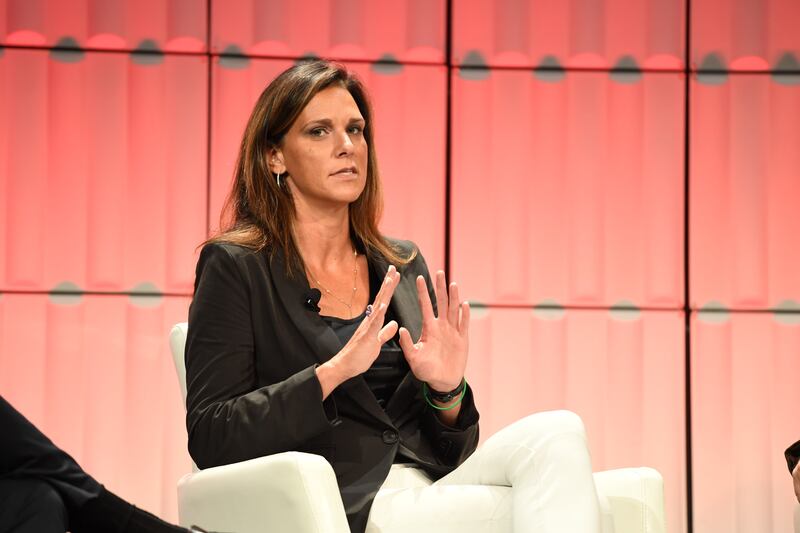
“There’s so much that is so far off base; that this is just the wild, wild west and we have no oversight, no regulation and it’s a free-for-all. It’s just not that way at all.”
— Sara Slane, Kalshi head of corporate development
How do they work?
On the screen of a mobile device? Pretty much the same as DraftKings and FanDuel. But the back of the house differs dramatically.
A sports prediction market is created when an exchange such as Kalshi’s notifies the CFTC that it intends to list an event contract on the outcome of a game or occurrence within a game — for example, whether the Knicks will win or Jalen Brunson will score more than 26 points. Unlike state-regulated sportsbooks, which must get new bet types approved before offering them, exchanges “self-certify” that the contracts meet CFTC guidelines.
There has not been a reported instance of the CFTC blocking or pulling a sports-related contract. But CFTC Chairman Michael Selig has conceded that today’s event contracts likely require more nuanced regulation than their predecessors. He set expectations for what that might look like in March, when the CFTC advised exchanges to confer with the leagues when determining whether a market was “readily susceptible to manipulation.” Earlier this month, the CFTC issued a rules proposal that set up a “public interest” review process that could place restrictions around contracts resolved on “gaming” — aka sports betting — banning bets on officiating and injuries, for example. But it also made it clear that it favored broad acceptance of common point spread, over-under and player prop wagers.
Once an exchange lists a contract, it opens it to market makers; trading firms, such as Susquehanna International Group, which agree to supply the underlying liquidity that allows brokers to fill orders on both sides. Prices rise and fall based on market sentiment. Each contract resolves at $1, meaning those who buy 100 contracts on the correct side are paid $100 if they hold it until the end, while those on the wrong side who hold until the end lose their entire stake. Buyers can attempt to exit at any point to lock in profits or stem losses, paying fees on each trade. The difference between a buy and sell price, or “spread,” is kept by the market maker, which sometimes assumes risk by taking its own position. Those who blanch at Kalshi and Polymarket’s claims that there is no “house” point to sophisticated market makers such as Susquehanna and the many sportsbooks likely to act as market makers as evidence to the contrary.
The manner in which most predictions operators list prices further blurs the line between a contract and a bet. Rather than picking a side based on a 56-cent or 44-cent price commonly listed on exchanges, bettors can set their Kalshi, Polymarket or DraftKings apps to convert those to sportsbook style odds of -127 or +127. That pricing almost always aligns with the prevailing odds at sportsbooks.

“We were given specific authority to review these products and discretion to reject them in certain cases and we’re going to use that authority. And we’re going to put out really clear standards for how we’re going to evaluate the products going forward. We believe that’s how those markets should be regulated and we’ll do so as soon as these rules get finalized.”
— Michael Selig, CFTC chairman
Who’s in?
Who isn’t? Kalshi dominates with an estimated 90% share of U.S. sports prediction market volume. About 20% of that comes through Robinhood, the everyman online retail broker, which launched its own Rothera exchange this month in partnership with Susquehanna. Already popular globally, Polymarket is in the early stages of rolling out its sports offering to U.S. consumers. Crypto.com offers sports contracts directly and as the primary sports predictions exchange used by sportsbooks FanDuel and Fanatics.
Among the traditional online sportsbooks, DraftKings has been the most aggressive early mover, hiring former fintech executive Jeanine Hightower-Sellitto ahead of the March rollout of a rebuilt “super” app that offers users either sportsbooks or predictions, depending on where they are when they log in. It reported about $250 million in predictions volume in May. DraftKings and FanDuel plan to spend more than $200 million pushing their new prediction offerings in the fall. None of the sportsbooks offers predictions in legalized states other than Florida, where many now will compete with Hard Rock, the only state-licensed sportsbook.
Notably absent from the sportsbook rush are BetMGM and Caesars, which thus far have opted to sit out predictions in deference to the many state gambling regulators fighting Kalshi and the CFTC in court.
The player pick-‘em contest operators — Underdog, PrizePicks and Sleeper — are all in. Like Kalshi, those apps have been especially popular in states that haven’t legalized sports betting, and with 18- to 20-year-olds in the many states that set the legal betting age at 21.
The list continues to grow, in large part because the barrier to entry is far lower than for state-regulated sportsbooks, which often pay seven-figure licensing fees and are taxed at upward of 20%.
Some say they plan to graduate to operate their own exchanges, as Kalshi and Polymarket do. DraftKings has begun integrating Railbird, a CFTC-regulated exchange it acquired in October. Underdog purchased the Aristotle Exchange in March.

“Similar to sportsbooks, we have a right to win in this space. We have a right to win because we know the sports audience and have the sports audience. We understand the sports product better than anyone.”
— Paul Liberman, DraftKings co-founder and president of operations
How much money are we talking about?
Before we get there, it’s important to understand the difference between sportsbook handle and prediction market volume. Prediction volume counts both the buy and sell sides of a trade, so what looks like a $100 bet is at least $200 in volume. Because traders — aka bettors — frequently move in and out of positions, that volume on a single market can multiply over the course of an event. In the case of a four-day golf tournament, the monthlong NCAA basketball tournament and the World Cup, the inflation can be significant.
That said, Kalshi is doing whopping business, especially around big events — about $1.8 billion on March Madness, more than $600 million on the Super Bowl and more than $500 million on the Masters. Through May, its sports volume for the year eclipsed $40 billion.
Kalshi would have been the No. 4 sportsbook in the U.S. in March, according to gambling research firm Eilers & Krejcik, which developed a model to convert volume to estimated handle. That would have put it on par with BetMGM for the month, behind DraftKings, FanDuel and Fanatics.
Bank of America analysts estimated that sports-related volume could exceed $1 trillion annually, throwing off about $10 billion a year for operators. They projected $100 billion in volume from sports this year.
“We can argue about how big it is. We can argue about how big it’s going to get. I don’t think we’re really having an argument anymore about whether it has crossed that threshold of big. And that’s important.”
— Chris Grove, partner at gambling research and consulting firm Eilers & Krejcik
How do others in sports make money from this?
As with legalized sports betting, the leagues get a chance to open a new sponsorship category. The NHL signed deals naming Kalshi and Polymarket as its official prediction markets in October. MLB struck an exclusive deal with Polymarket in March. MLS and the UFC also have Polymarket deals.
As part of its MLB deal, Polymarket agreed to buy official league data from Sportradar, a boilerplate item in the authorized operator agreements that most of the leagues created around sports betting. Sportradar recently announced a deal to provide official data feeds from MLB, the NHL, MLS and UFC to Kalshi. An authorized operator designation for predictions operators could be another incremental revenue source for MLB, the NBA and NFL, which require sportsbooks to hold — and pay for — that designation to advertise during game broadcasts and sponsor teams.
A cluster of teams that were left out of the sports betting sponsorship windfall also could see substantial paydays if the leagues allow them to sell the predictions category. Thirty-one teams in the NFL, NBA and MLB play in states that haven’t legalized sports betting, precluding them from making deals that often sold for seven figures annually when states opened. The marquee Dallas Cowboys, Los Angeles Lakers and Dodgers could be among the teams with spots up for bid if the category were to open in the NFL, MLB and NBA.
While making more money from more betting and a resulting bump in viewership is one goal, the leagues also hope to have a say in what sort of contracts can be offered. MLB and the NHL have signed agreements to work with the CFTC on regulation of sports-related predictions. The CFTC has said it hopes to strike similar agreements with more leagues and governing bodies.

“Partnering with professional sports leagues is really important to lend legitimacy to the category.”
— Ari Borod, president of sports business development, Polymarket
What’s the outlook for these remaining legal?
Nobody knows. Worse yet, there’s not even a prevailing theory. More than 20 states have argued in lawsuits and cease-and-desist orders that prediction markets constitute gambling and, like other forms of gambling, should be subject to state regulation where permitted and banned where not. That stance has been supported in court filings by attorneys general in at least 38 states.
Kalshi and the CFTC argue that the contracts are a commodities derivative, falling under the federal agency’s exclusive jurisdiction, which “pre-empts” state regulation. Each side has notched conflicting wins in federal and state courts, making the dispute a likely candidate for eventual Supreme Court consideration. That could be derailed if Congress were to act, as suggested by recent hearings and proposed legislation. But even a bipartisan bill isn’t likely to get past the president, who has supported CFTC lawsuits against seven of the states that have tried to block or regulate prediction platforms.
Among the cases to watch are a 3rd U.S. Circuit Court of Appeals opinion that went Kalshi’s way on the matter of pre-emption in New Jersey, denying the state’s attempt at an injunction, and a soon-to-come 9th Circuit ruling on similar grounds in Nevada. That split alone could be enough for the Supreme Court. But there also are interesting cases that criminalized Kalshi’s business in Arizona and Minnesota, making it a felony in the latter.
Analysts say the matter could make its way to the Supreme Court next year, or even late this year if the lower court judgments accelerate and appellate rulings are divided.
If the court decides narrowly around the pre-emption question of whether the CFTC has the authority to define the markets it regulates, Kalshi likely will prevail. If it looks more broadly at whether this is gambling, it almost certainly will lose.

“In the period of time that it takes those legal issues to get resolved in a definitive way, it’s incumbent on us to do everything we can to protect the integrity of the sport. It’s not going to stop immediately even if the states win in all the litigation.”
— Rob Manfred, commissioner of Major League Baseball
NBA Europe closes bids, undisclosed EuroLeague teams want in

The bidding for NBA Europe franchises ended on Tuesday, with sources saying a few of the various offers are from current EuroLeague teams, former Bucks owner Marc Lasry and existing soccer clubs hoping to launch first-time basketball franchises.
Those sources indicated many of the undisclosed bids exceeded the NBA’s preferred range of $500M to $1B and that ownership groups from Athens, Barcelona, Berlin, Istanbul, London, Lyon, Madrid, Manchester, Milan, Munich, Paris and Rome all are in the running.
It is unknown which of those markets Lasry -- who sold the Bucks in 2023 -- is pursuing. But he was born in Marrakesh, Morocco, moved to the U.S. at the age of 7 and, according to sources, is likely not the only former NBA owner to bid for a franchise. Lasry was unavailable for comment.
“We’re extremely encouraged by the final bids we received for permanent franchises in a new NBA and FIBA-backed league in Europe, which reflect the tremendous interest and momentum around this project,” NBA Deputy Commissioner and Chief Operating Officer Mark Tatum said in a statement Tuesday. “This will be the biggest influx of capital European basketball has ever seen, and we have clear front-runners in each of our 12 target cities including many existing basketball and football clubs. We will now work with the NBA and FIBA Boards to finalize the long-form agreements.”
The NBA’s BOG is scheduled to meet in mid-July, although it is unclear whether the governors will greenlight the franchises in just a matter of two weeks. The sense, according to sources, is that the winning bids will be announced on a rolling basis -- not all at once -- and that the NBA is still trying to sort out a potential EuroLeage partnership.
Indications are that Real Madrid, Asvel and Fenerbahçe all aspire to join NBA Europe, which is targeting an October 2027 launch. For now, those three franchises -- plus Barça, Baskonia, Efes, Olympiacos, Panathinaikos, Maccabi, Milan, Zalgiris, Bayern, Villeurbanne -- have signed 10-year EuroLeague renewals. But sources said there are exit clauses (buyouts of €10M) that would allow them to opt out for NBA Europe.
Executives from the NBA, FIBA and EuroLeague are expected to meet in the coming week, with each side saying they are willing to move on without the other. EuroLeague CEO Chus Bueno has said he does not believe EuroLeague teams should pay the $500M to $1B price to join the league and that the NBA should actually pay for a brand like Real Madrid to join.
“A team like Real Madrid, Barcelona, Bayern, or Olympiacos is bringing the IP, the fan base, the 100 years of history, the tradition and the city,” Bueno told Eurohoops roughly three weeks ago. “They already ‘own’ their cities, and that needs to be taken into account.”
Sources said that since the NBA tweaked the league’s financial model in late April, the initial bids (due in late March) have grown by more than 100%. For instance, in the first decade of NBA Europe, the NBA expects to make over $10B in distributions, will invest over $3B right away to offset potential early-stage losses and that the 12 permanent franchises will earn money by Year 3.
Tatum has also said the NBA Europe roll-out will be “one of the largest marketing campaigns ... not just in sports but of any consumer brand period.” All of this carried weight among bidders considering EuroLeague teams who have, as a whole, reportedly lost more than $5B over the past 10 years.
In other developments, the NBA and FIBA have drawn up the skeleton of a competition schedule that will have the 16 teams (12 permanent and four arriving annually on merit-based entry) engaging in a round robin, followed by playoff series and an NBA Europe Finals series.
For those four merit-based teams, they will earn their spots through the upcoming 2026-27 BCL and domestic league seasons.
Mariners, Sodexo Live buck sports concessions industry trends with 25-year renewal

After decades of three- and six-year contract renewals, the Seattle Mariners and Sodexo Live have finally committed to each other long-term. They’ve struck a 25-year renewal of a food and beverage relationship that began in 1997 at the Kingdome and will continue until 2051 at T-Mobile Park.
The 25-year extension defies an industry trend in which food and beverage providers were working with shorter and shorter contracts, often with mid-term opt-outs increasingly being activated.
“It’s the best proof point, that you can actually maintain long-term partnerships and be given the chance to do it again,” said Sodexo Live CEO Belinda Oakley, who said the deal shows that the sports F&B business is “not as fickle as people might think. That’s a good impact for our whole business.”
Sodexo Live and the Mariners maintained their business relationship through a litany of three-year extensions of the original agreement (struck with Sodexo Live predecessor Centerplate), until finally, the six-year extension in 2020. The Mariners, according to Malcolm Rogel, the team’s VP/Fan Experience, believed the short terms would hold Sodexo Live accountable.
“But it seemed like neither of us could commit to each other because at some point, very soon, we may not be partners. That was difficult,” said Rogel, who has been with the Mariners for 28 years, overseeing F&B for the last 11.
Given six years for the first time, the T-Mobile Park F&B management team flourished, taking more risks as the companies’ relationship deepened.
It was an eye-opener for the Mariners, and they decided that for their next concessions contract, “who” would be less important than “how.” The team would seek a long-term deal, whether with Sodexo Live or one of its half-dozen sports food and beverage industry competitors.
Before taking their business to the F&B marketplace, the Mariners gave Sodexo Live an exclusive window to pitch itself for a long-term collaboration. The concessionaire took advantage. It tricked out T-Mobile Park’s Diamond Club, deploying different themes throughout the club’s various sections and utilizing technology to impress Rogel and company.
“We’ve never had a presentation like that inside our venue go so flawlessly and go so well,” said Rogel. “I’d call it a 10-course meal. They did a tour of different ideas and experiences they could deliver with this long-term deal, throughout the Diamond Club.”
Sodexo Live’s deep experience with the stadium enabled them to present new club and food neighborhood concepts they would create in underutilized portions of the venue.
“Had we gone to RFP and changed vendors, that would have taken years,” Rogel said. “We would have tripped over ourselves for a couple of years.”
The Mariners ultimately didn’t issue an RFP, committing instead to Sodexo Live.
“That’s what’s so crazy about taking that shared partnership investment,” for a quarter-century, said Oakley. “You know it’s not going to be the same generation of people sitting across the table from each other. You have to have real belief that you’re a partner. For both, it was really important that we’re partnered with the right franchise, the right culture, the right adaptability.”
Enhancing premium spaces and service and better data management and utilization of T-Mobile Park’s tighter concourses will be focuses over the next 25 years. And the renewal will also see Sodexo Live create a hospitality training academy within T-Mobile Park, for its and the team’s service-focused employees. It’ll open in the summer of 2027, Oakley expects, and will mirror a similar training academy Sodexo Live has in Atlanta for its Delta airport lounges, but focus on the live sports setting.
NBCU’s media future a key question in wake of Comcast plan for company split

When the idea of a marriage of Comcast and NBCUniversal started percolating in 2009, the creation of a strong competitor to ESPN was seen as a potential benefit of the deal — perhaps even allowing Versus to go head-to-head with Bristol’s flagship cable network. While Versus and then NBC Sports Network never quite got to that level, Comcast and NBCU became inextricably linked within many areas of sports since GE’s sale of the majority stake was approved in early 2011.
Since that time, Comcast/Xfinity has been present all across NBC Sports’ portfolio. That could be seen around sponsorships for programming like the Olympics, NBA or NASCAR, or bringing Notre Dame football games over to cable TV and then streaming.
Fast forward to Monday, and the relationship — already changed by the sell-off of Versant — looks to be in for another major change, as a split is planned between the telecommunications assets (Comcast/Xfinity) and entertainment side, which will house NBC, Peacock, Telemundo, Sky in the U.K., the theme parks business, film studio, Bravo and TV studios.
While any split is still around a year off (and then some time after that when thinking about IRS tax-free rules on spinoffs), I talked to some analysts on Wall Street and within sports media rights about how they view the future for NBC Sports.
“They’ll need to invest in sports even more than before,” one analyst said of the new entertainment spinoff. “They’ll have incentive to do so. There won’t be any influence — or less influence — from the broadband business. They had a Chinese wall, so in theory, they were operating pretty independently already. But it’s probably good for NBC Sports and sports media world in general.”
What’s the appetite for an NBCU acquisition?
While a move to pick up NBCU media assets would be years off, speculation has already started as to who might be interested in those. MoffettNathanson analyst Craig Moffett poured some cold water on that Monday in a note to investors, but this hasn’t stalled the rumor mill.
“The one person that will decide this is Brian Roberts,” another analyst told SBJ. “That’s really what the call is here — whether or not he wants to let go of the media business. ... That’s where investment bankers and anyone else that you talk to on the deal side loves to start to think about it.”
Some speculation quickly turned to Netflix, which made a strong play for Warner Bros. Discovery before David Ellison and Paramount Skydance came over the top. But buying a broadcast TV network like NBC (with its FCC license) comes with a higher level of scrutiny.
As one analyst told SBJ: “Is Netflix really willing to take all of this on and deal with all of the extra headaches that come with this NBCUniversal portfolio instead of just looking for going down their own path or looking for their own IP in other places?”
All of those questions are just on the linear side and before one gets to the question of streaming. “Peacock is really just a sports streaming platform,” one analyst said. “So the future of Peacock is tied to those sports rights.”
Pay attention to local
The RSN space has long been in flux, and less attention has been paid to NBC’s portfolio than was given to the old Main Street Sports RSNs. That makes sense. Main Street went into bankruptcy, whereas the NBC RSNs — Philadelphia, Bay Area, California and Boston — operate with little to no debt.
But sources have told me even before Monday’s news that those RSNs were ripe for a sale. One complicating factor was team ownership, as teams like the S.F. Giants and Boston Celtics have stakes in those RSNs. There is a similar situation in Philadelphia (via the Flyers), plus the added complication of Comcast being based in Philly.
“Without the MVPD, they’re even less of a company priority,” one analyst said of removing Comcast from the RSN equation. “Maybe they get folded into Peacock somehow more quickly. ... Comcast is tough. They were always a beast [in carriage talks,] even with under the same roof.”
===
SBJ’s America 250 series
- Yankees claim ‘America’s Team’ crown
- Football is America’s sport, but baseball may still own the pastime
- Pittsburgh punches above its weight in ranking of America’s best sports cities
- Brands are all in on America 250; fans may not be
- Where patriotism still works: MLB leans into its roots
- For America 250, the merchandise opportunity may belong to younger fans
===
Start your day with SBJ Morning Buzzcast, bringing you the hottest stories in sports business every morning in under 15 minutes. Sign up for SBJ’s free newsletters, and dive deeper inside the industry with all the latest sports business news here.
Professional teams have a generational opportunity to claim the media value chain
The disruption of the regional sports network model is not a distraction from the core business of fielding a winning team — it is the next chapter of building a durable, appreciating franchise asset, and the defining ownership opportunity of this generation. The instincts that made these owners successful as entrepreneurs are precisely the instincts they should be trusting right now. Reclaiming control of the local sports media value chain and cementing direct engagement with fans is not just smart, it is essential.
For three decades, RSNs served as an efficient — if ultimately fragile — proxy for local sports media. That ecosystem has now reached a point of logical transition. As teams consider this new environment, they face what can appear to be a binary choice: maximize reach through over-the-air broadcast (OTA) or maximize control through a direct-to-consumer (DTC) model. Broadcast offers the massive, undifferentiated scale of the 1970s, while DTC promises the high-ARPU future of the 2030s.
For premium sports properties, either choice alone — or in combination — is a strategic trap. The math on linear packaged distribution is unambiguous. Per-subscriber license fees collected across millions of pay-TV homes represent a recurring, contractually predictable revenue stream that no DTC platform has replicated overnight. The local advertising inventory embedded in linear carriage commands premium CPMs precisely because of the live, appointment-viewing nature of sports — and the team that walks away from a well-structured multichannel distributor deal is not being bold, it is leaving tens of millions of dollars on the table each season.
Despite headlines declaring its demise, the bundle remains the most efficient mechanism for capturing subscription revenue from the passive fan — the viewer who may never seek out a standalone app, but will leave a game on in the background. The goal is not to flee linear distribution entirely, but to re-price and repackage it on the team’s own terms within a broader, integrated strategy.
Any arrangement that hands rights wholesale to a third party — whether an over-the-air broadcaster, a national streaming service, or a league-controlled platform — fundamentally severs the connective tissue of a modern sports franchise’s commercial model, and in today’s regulatory climate, the risks are compounding. Exclusive streaming arrangements are precisely what Congress, the FCC and the DOJ are scrutinizing. Policymakers are asking whether the Sports Broadcasting Act, written for a 1961 broadcast world, is fit for purpose in an era when, according to the FCC’s own findings, watching all NFL games in 2025 could cost a consumer over $1,500 across 10 different services. The National Association of Broadcasters has formally urged Congress to reexamine whether exclusive streaming arrangements align with the Sports Broadcasting Act’s original public interest rationale.
Teams that have ceded their rights to these platforms are not just accepting commercial dependence — they are tethering themselves to arrangements that may face forced restructuring. The moment you outsource your media rights, you outsource the fan relationship that sits at the center of every other revenue line. Ticket sales, merchandise, in-venue sponsorships, and local media advertising packages are not independent silos. They are a 360-degree commercial ecosystem that generates maximum value only when the media platform is owned and operated by the team itself, allowing for coordinated activation, unified fan data, and seamless cross-channel sponsorship integration. A broadcaster or streaming partner has no structural incentive to drive a fan through arena gates or co-sell an integrated sponsorship spanning the Jumbotron, broadcast, and digital overlay. That synergy belongs exclusively to the team — but only if the team retains control of the rights.
The launches of Altitude+ in 2024; the Rangers Sports Network in 2025; and BravesVision and Angels Broadcast Television in 2026 demonstrate the success of a hybrid framework that maintains presence across three distribution layers: traditional multichannel video distributors, over-the-air broadcast for mass accessibility, and a direct-to-consumer streaming for fans who require a super-served experience.
This tri-cast approach acknowledges the reality that sports consumption is fragmenting across platforms while preserving the economic strengths of each distribution channel. Linear carriage continues to capture subscription revenue from passive viewers. Broadcast expands reach and community visibility. DTC platforms create new opportunities for fan data, targeted marketing, and flexible pricing. By controlling production, distribution, and advertising inventory, teams can build unified commercial ecosystems around their media assets.
Research from BIA Advisory Services indicates that local advertising in high-intent environments like live sports generates conversion rates roughly 35% higher for sectors such as retail and automotive compared with national-to-local ad buys. Additional research from Magna Global suggests that contextually relevant local advertising, particularly talent-integrated or live-read formats, can produce a 20% increase in brand recall.
When teams control their own media ecosystem, they capture the full value of that attention rather than surrendering it to intermediary networks.
The demise of the last conglomerate RSN is therefore more than a crisis for local sports media. It is an ownership moment — and team owners should recognize it as exactly that. These are, as a class, some of the most entrepreneurially driven, independently minded investors in American business. They did not acquire franchises worth hundreds of millions or billions of dollars by deferring to consensus or outsourcing their most critical strategic decisions to intermediaries. They built companies, took calculated risks, and bet on their own ability to execute. So why, at perhaps the single most pivotal inflection point in the history of sports media, would those same owners hand their most valuable asset — local media rights — to a broadcaster, a streaming platform, or a centralized league structure and simply hope for the best?
For decades, RSNs acted as the intermediary layer between teams and their audiences. That proxy model is fading. The organizations that succeed in the next era will be those that reclaim control of their media platforms — and, in doing so, finally own the most valuable asset in sports: their direct relationship with the fan.
Ken Tolle is president and senior advisor of Launch Pad Media Advisors, PC. He is a legal professional and strategic advisor specializing in sports media and independent media.
Speed reads
- The Premier Lacrosse League raised a $100 million Series E funding round led by Nets and Liberty owner Joe Tsai and funds of Ares Management, reports SBJ’s Chris Smith. Tsai first backed the PLL in 2019.
- France remained the No. 1 digital brand among World Cup teams, while the USMNT cracked the top 10 for the first time during the tournament in the latest Sports Social Pulse rankings, writes SBJ’s Jesse Gordon. The rankings are a partnership between SBJ and South Carolina’s Social Media Insights Lab.
- Fans of women’s sports are more global and more willing to spend, notes SBJ’s Rachel Axon from Genius Sports’ “Turning Culture Into Commerce” report.
- A tumultuous year for the Professional Tennis Players Association continued late last week, when players connected to the group sued another set of affiliated players and executives in the Superior Court of the District of Columbia, reports SBJ’s Rob Schaefer.
- Houston-based consultancy Deutser formalized its growing work in the industry with Deutser Sports, a dedicated division that goes inside franchises and athletic departments to rebuild culture, leadership systems and physical spaces, often in tandem with Excel Search and Advisory group, writes SBJ’s Irving Mejia-Hilario.
- Mejia-Hilario also notes that Choice Sports Group formed a partnership with attorney-agent Orlando Castaño Jr. and his 4Front Sports operation, giving the Boston-based agency access to a deeper women’s basketball talent pipeline while allowing Castaño’s players to tap Choice’s NIL, marketing and athlete development resources.
- Golf tech company Full Swing signed a multiyear extension of its agreement with PGA Tour player Jordan Spieth, who’s been repping the brand since 2015, writes SBJ’s Josh Carpenter.